The National Bank of Ukraine (NBU) kept its key policy rate unchanged at 15%, while warning it stands ready to raise rates if inflationary pressures intensify.
The decision came against the backdrop of slowing headline inflation – which eased to 8.2% year-on-year (yoy) in May – partly driven by seasonal factors and increased raw food supply. Core inflation, however, ticked up slightly to 7.9% yoy, and both indicators came in above the NBU’s April forecast, largely due to second-round effects from rapid energy price growth in earlier months.
JOIN US ON TELEGRAM
Follow our coverage of the war on the @Kyivpost_official.
“Given signs of increasing underlying price pressures, the NBU is ready to raise its key policy rate if necessary to keep inflation expectations in check,” NBU governor Andriy Pyshny said at the briefing on Thursday.
The NBU expects inflation to remain near current levels in the coming months, then accelerate toward year-end before returning to a declining trajectory in 2027. Sustained pressure is expected from higher business costs, a weaker hryvnia, and wage growth driven by ongoing labor shortages, the NBU wrote in its press release.
The Hryvnia weakening question
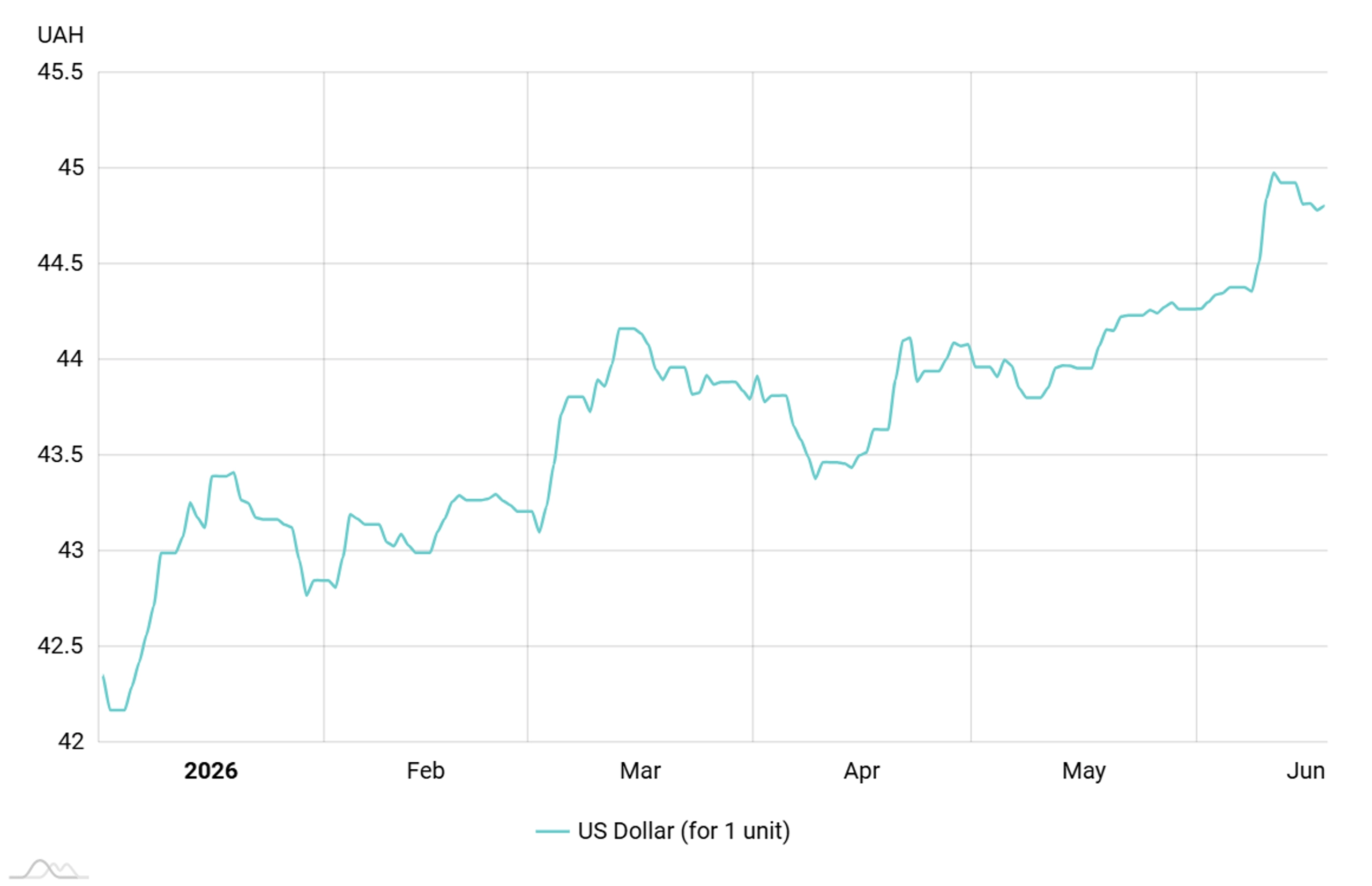
The hryvnia weakened from 44.2 to 44.8 per dollar between June 1 and June 18, according to NBU data, with the sharpest slide – from 44.3 to 44.8 – occurring over the final ten days. ICU analysts described the moves as “unexpected” in their latest newsletter. Two other market analysts, who asked Kyiv Post to remain unnamed, also said they did not expect the same degree of weakening.
More Than 60% of Russians Want War to End, Zelensky Says
NBU Deputy Governor Yuriy Heletiy said, in response to Kyiv Post’s question, that such hryvnia dynamics have occurred because net aggregate demand is growing faster than aggregate supply.
“The main contributor to the growth in demand, first and foremost, the fiscal stimulus – defense sector in budget expenditures, if you say in detail. We’re also seeing growth in demand in the fuel and energy sector, as well as in consumer goods,” Heletiy said.
“In the cash segment, the situation is under control; we’re seeing exchange rate expectations stabilize, and there’s no sign of any nervous reaction,” he added. “There was a certain reaction from the public when the devaluation occurred – they slightly increased their currency purchases.”
The NBU allows the exchange rate to fluctuate in both directions, both Heletiy and Pyshny emphasized. The official hryvnia rate has trended upward since January 2026, climbing from around 42.2 to a June peak of nearly 45 for 1 dollar. But the trajectory has not been linear: the NBU data show repeated pullbacks, including a dip from 43.1 to 42.8 in late January, a retreat from the March high of almost 44.2, and a correction from the current June peak back toward 44.8.
War remains dominant risk
Russian attacks on production facilities, logistics hubs, and energy infrastructure in Ukraine’s industrial regions have intensified in recent months, posing continued risk to economic activity and cost pressures.
The NBU also flagged additional budgetary pressures tied to defense needs, as well as elevated wage pressure from deepening labor shortages and negative migration trends.
Deputy NBU Governor Volodymyr Lepushynsky said during the briefing:
“The assumption [on negative migration trends] influences other assumptions and other indicators… Ukrainian economy’s growth potential is significantly limited by the fact that such a large portion of the population has left the country. …We estimate that 300,000 people left last year. This year, the estimate is 200,000, and we consider it accurate.”
The wind of optimism began to blow over a potential resolution to the Middle East conflict. Falling oil prices are seen as a factor that could reduce Ukraine’s energy import costs and curb inflation. However, the bank cautioned that risks of a prolonged conflict, which would boost Russian revenues and push energy prices higher, have not disappeared.
External financing on track
International assistance inflows in January-May fell short of expectations, but the NBU anticipates a significant catch-up. Ukraine may receive approximately $13 billion in June alone – through bilateral aid and programs including the Extraordinary Revenue Acceleration (ERA) and Ukraine Support Loan (USL). The Staff Level Agreement after the first review of the program with the International Monetary Fund (IMF), was cited as an “important step toward securing continued financing” under the four-year Extended Fund Facility (EFF).
The NBU will maintain the key rate but has signaled its readiness to hike it if necessary.
You can also highlight the text and press Ctrl + Enter

Ukraine Unveils New Underwater Drone, the Sea Trident
Fuel Rationing Spreads to Moscow and St. Petersburg
Germany Warns of Russian Orbital Nuclear Threat