What began in mid-2023 as a small volunteer circle of drone enthusiasts has quickly turned into one of Ukraine’s fastest-growing defense tech companies – building fiber-optic strike drones, battlefield sensors, and now preparing for entry into missile and air-defense systems.
BlueBird Tech co-founder Valerii Zarubin says the early days had nothing to do with business plans or funding rounds. It started with curiosity and necessity.
JOIN US ON TELEGRAM
Follow our coverage of the war on the @Kyivpost_official.

“There was no brand at all,” he recalls. “We just studied FPV [first-person view] drones from scratch – what they are made of, how they fly, how the systems actually work.”
By January 2024, that informal group had become a registered company.
From hobby parts to industrial scale
At first, the work looked almost improvised – assembling drones from components ordered online and testing them in the field. But very quickly, the scale changed.
“The real challenge was not building one drone,” Zarubin says. “It was understanding how to build thousands.”
By late 2023, the team had stabilized a working design and began preparing for serial production. That shift forced a new reality: funding, procurement chains, suppliers, logistics, and long waiting lists for components – especially from China, where global demand for drone parts was already overheating.

Zelensky Confirms Strikes on Russian Oil Refineries in Krasnodar and Yaroslavl Regions
“We had to solve financing and supply at the same time,” he says. “It was not just engineering anymore. It was global procurement.”
BlueBird Tech was formally registered only when the prototype stage ended and scaling became unavoidable.
“In 2023, there was no real company – just people working without salaries,” Zarubin explains. “We were testing, breaking things, improving them, and trying again.”
The turning point came when the first production batch was completed and the team began hiring its first employees.
“At that moment it became clear – this is not a temporary project. This is a long-term company.”
The decision to formalize also aligned with future military requirements, including codification, structured cooperation with the armed forces, and compliance with strict legal frameworks.
Fiber-optic drones: built for electronic warfare
One of BlueBird Tech’s most defining products is its “Zhakh” (Horror) FPV drone line, which uses fiber-optic control instead of radio signals.
The advantage, Zarubin says, is absolute immunity to electronic warfare.
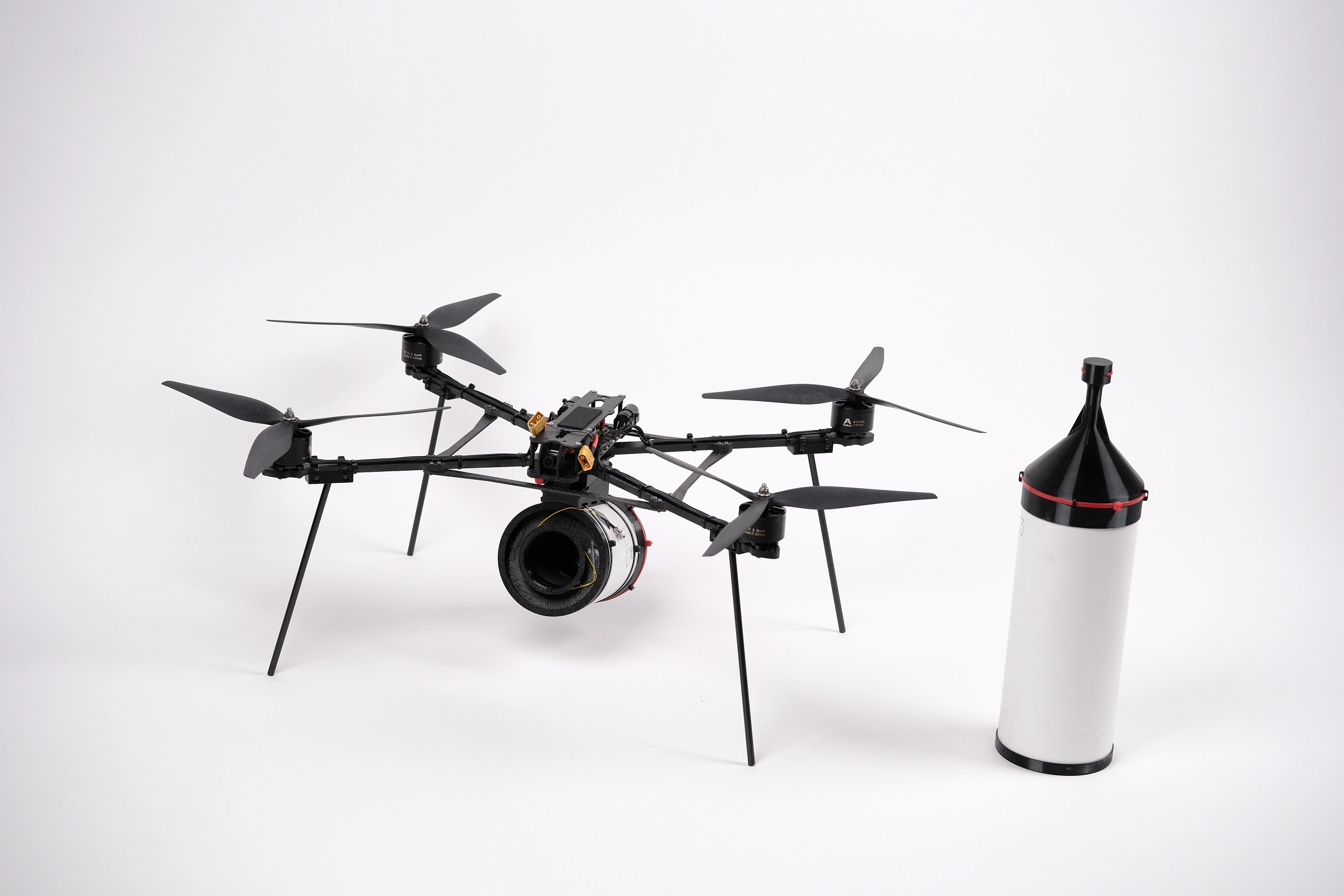
“You cannot jam it. You cannot intercept it. There is a physical cable between the operator and the drone,” he says. “It gives a stable video feed until the last second.”
That physical link, however, creates a different set of challenges. The thin fiber cable can break easily if it gets caught in trees, buildings, or sharp turns.
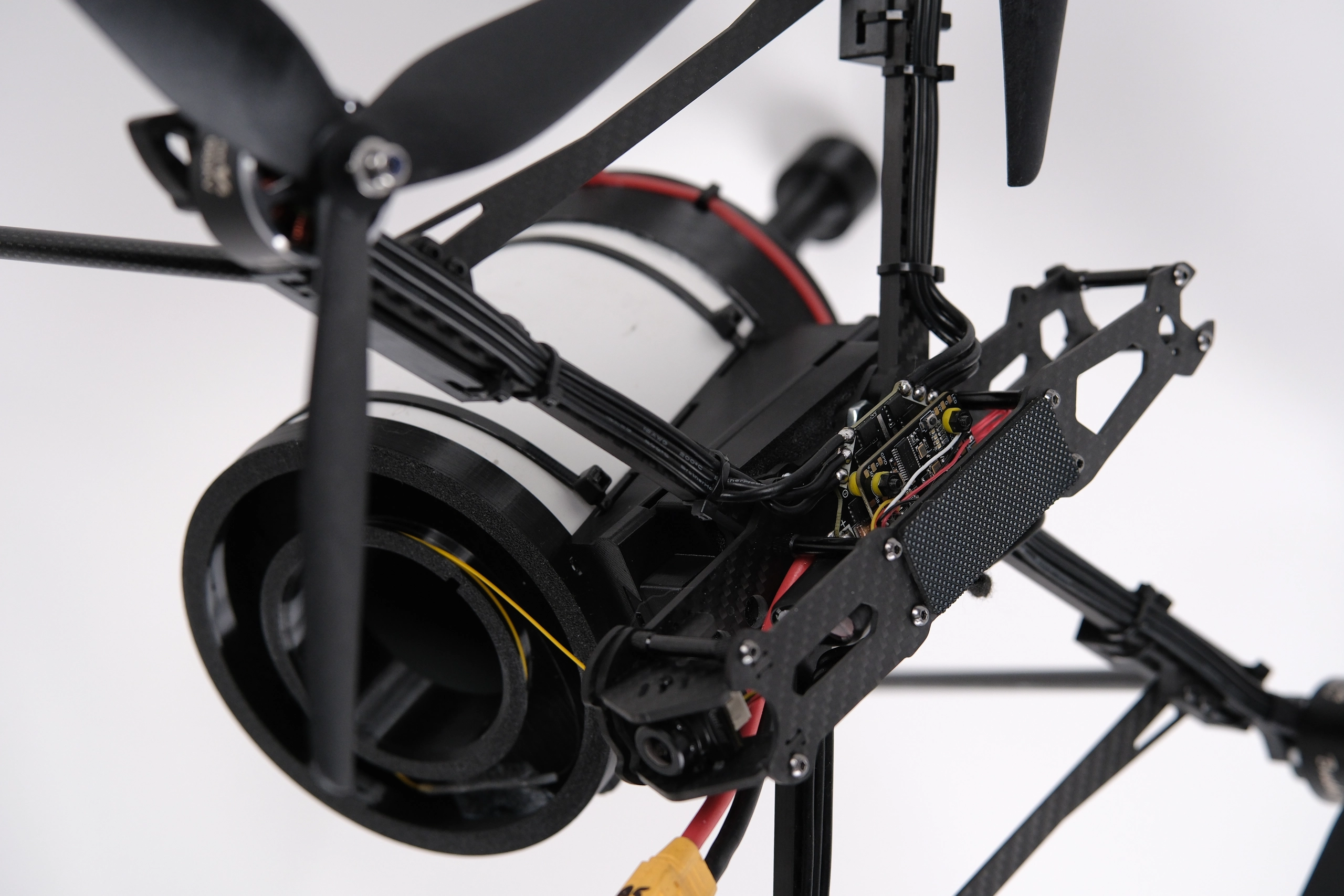
“It demands a completely different level of piloting,” he explains. “This is not just technology – it is skill-intensive warfare.”
In practice, fiber-optic drones reduce one of the biggest advantages of modern battlefields – electronic jamming – but shift pressure onto operator training and precision control.
“Chuyka” system
Among BlueBird Tech’s most unusual products is “Chuyka” (Intuition), a portable drone detector designed to help troops spot enemy unmanned aerial vehicles (UAVs) before they strike.
Unlike traditional systems that simply warn soldiers that a drone is nearby, Chuyka does something more useful. It captures the drone’s analog video signal and shows operators exactly what the drone itself is seeing.
“It’s like looking through the enemy drone’s eyes,” Zarubin says.
The system scans key frequencies in just a few seconds and can detect drones at distances of up to 4 kilometers (2.5 miles). But the real challenge was not finding the signal – it was separating it from the chaos of the modern battlefield.
On the front lines, countless radios, jammers, and electronic warfare systems are competing for space in the airwaves. BlueBird Tech engineers spent months developing algorithms that filter out interference and false signals, allowing soldiers to focus only on drone video feeds.
“The battlefield is extremely noisy electronically,” Zarubin says. “Our task was to eliminate everything unnecessary and quickly show operators what matters.”
Chuyka does not automatically identify whether a drone is friendly or hostile. Instead, soldiers determine that themselves by looking at telemetry, labels on the video feed, the drone’s flight direction, and the surrounding landscape.
The result, Zarubin says, is more than just an early-warning device.
“It’s one thing to know a drone is nearby,” he says. “It’s another to actually see where it is looking and understand what the enemy is trying to do.”
From FPV drones to deep-strike systems
Beyond FPVs, the company has expanded into larger platforms, including the “Bebradron” – a fixed-wing tactical UAV.
Unlike smaller quadcopters, it can carry up to 9 kilograms (20 pounds) of payload over distances of up to 45 kilometers (28 miles).
“This is a different category,” Zarubin says. “It is designed for deeper targets – command posts, logistics hubs, and fortified positions.”
The trade-off is reduced maneuverability, but the gain is range and payload capacity.
“You cannot replace it with a small FPV drone. It fills a different role entirely.”
The slow exit from Chinese components
Like much of Ukraine’s defense industry, BlueBird Tech is actively trying to reduce reliance on Chinese electronics.
But full independence is not close.
“This is not just Ukraine’s problem – it is global,” Zarubin says. “Even the United States and Europe are trying to localize production.”
He estimates that noticeable progress will take 3–5 years, while full independence could take far longer.
“China has built decades of dominance in electronics. That cannot be replaced quickly.”
Still, the company is gradually increasing the share of Ukrainian-made components in its systems, calling it a step toward long-term resilience.
Entering the missile era
Perhaps the most ambitious development is BlueBird Tech’s entry into missile-related work.
In April, the company announced the creation of a dedicated missile division focused on air-defense systems capable of intercepting Russian drones, cruise missiles, and ballistic threats.
It is a major leap for a company that only three years ago was a volunteer group experimenting with FPV drones.
For Zarubin, however, the move is less a gamble than an inevitable next step.
“Nothing can stop an idea whose time has come,” he says. “Ukraine has reached the point where developing and mass-producing its own missile weapons is no longer optional – it is a necessity.”
The company is also launching a design bureau dedicated to guided aerial bombs, another field that until recently was dominated by major state manufacturers.
Zarubin believes Ukraine is approaching a new phase in military technology, where missiles – not tanks or artillery – will increasingly determine battlefield dominance.
“The next revolution will belong to precision weapons,” he says. “The countries that master missiles and air defense will shape the future battlefield.”
BlueBird Tech hopes to unveil its first tangible results by the end of this year or early next year.
“Ukraine has already changed the world of drones,” he says. “Now we have to secure that success in missile technology.”
Close ties with the state
Despite rapid growth, Zarubin says that defense technology cannot function outside government coordination.
“We work with state structures daily,” he says. “This is a partnership, not a separate process.”
Zarubin says support from government agencies and defense institutions has been direct and continuous.
“The state is interested in seeing modern weapons developed and produced in Ukraine,” he says. “We are in contact with the state structures every day. This is a close partnership.”
BlueBird Tech’s products must also undergo codification and certification before entering service.
“Without quality control, chaos would follow,” he says. “You could end up with ineffective systems reaching soldiers. Codification is a filter that guarantees reliability.”
Strict export controls also play a major role, ensuring that sensitive technologies do not reach unauthorized users or hostile actors.
Every potential deal is reviewed by multiple state agencies before approval.
“The system is built so that even if someone makes a mistake, the state won’t allow sensitive technologies to fall into the wrong hands,” Zarubin says.
Bureaucratic procedures that once took much longer have been streamlined, allowing new technologies to move from prototype to the battlefield at unprecedented speed.
“We are all working toward the same goal,” Zarubin says. “The faster Ukraine can create and field its own weapons, the stronger and more secure the country will be.”
The Drone Dominance program
BlueBird Tech is already involved in international cooperation programs, including the Drone Dominance Program with US partner Zaruba Tech.
“We combine Ukrainian battlefield experience with global defense systems,” Zarubin says. “This is about shaping future standards.”
The partnership spans joint production, technology transfers, engineering cooperation, and the integration of Ukrainian software and hardware into Western defense systems.
BlueBird Tech is also eyeing joint ventures in Europe and the United States and plans to expand training programs for foreign specialists.
“Ukraine is no longer just buying technologies. We are helping shape them,” Zarubin says.
He argues that the battlefield has turned Ukraine into a testing ground whose lessons are now attracting global interest.
“The whole world is asking for Ukrainian experience,” he says.
BlueBird Tech already shares office space in the United States with Zaruba Tech, which Zarubin says provides a bridge into tightly regulated Western defense markets.
Beyond the battlefield
Looking ahead, the company expects to remain active long after the war ends – and expand beyond defense.
Many of today’s innovations, Zarubin notes, have historical parallels in aviation and industrial tech, where military programs later evolved into civilian industries.
“We plan to turn our engineering experience into civilian technologies as well,” he says.
For BlueBird Tech, the war compressed what would normally be decades of development into just a few years. What comes next, the company believes, could redefine Ukraine’s place in global defense – and technology more broadly.
You can also highlight the text and press Ctrl + Enter