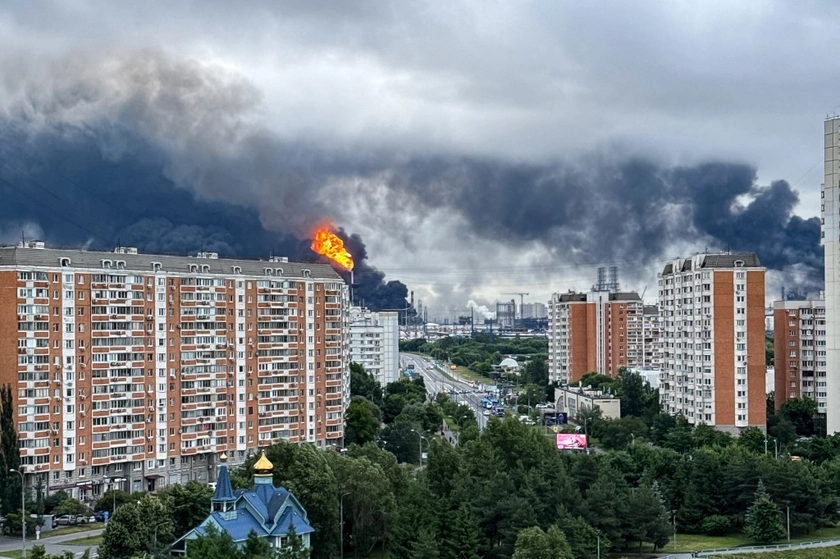
Early Saturday morning, June 27, a series of explosions occurred in the Russian city of Volgograd following a Ukrainian long-range strike targeting local defense infrastructure.
Volgograd Region Governor Andrey Bocharov stated that the area was attacked by “high-speed aerial targets.” He confirmed that an industrial enterprise was damaged and reported that 10 people sustained injuries, though he did not identify the specific facility.
JOIN US ON TELEGRAM
Follow our coverage of the war on the @Kyivpost_official.
The approach of the projectiles prompted air raid warnings across several Russian regions, including Penza, Samara, Orenburg, and Tatarstan.
Following the strike, Denys Shtilerman, co-founder of the Ukrainian defense tech initiative Fire Point, confirmed the use of FP-5 “Flamingo” cruise missiles. Publishing a video of a missile launch on social media, Shtilerman wrote: “Volgograd is welcoming the seasonal migration of flamingos from Ukraine. To be continued.”
Волгоград зустрічає сезонну міграцію фламінго з України. Далі буде... pic.twitter.com/yChQJobawp
— Denys Shtilierman (@DenShtilierman) June 27, 2026



Open-source intelligence (OSINT) Telegram channles, including the ASTRA monitoring group, analyzed footage of the missile flights and the resulting smoke plumes, geolocating the impact site to the territory of the “Titan-Barrikady” Federal Research and Production Center.
Titan-Barrikady, a subsidiary of the Russian state corporation Roscosmos, is a highly classified and critical component of Russia’s defense industrial base. The enterprise designs and manufactures mobile launchers for strategic missile systems, including the Yars and Topol-M, as well as launchers for the Iskander-M operational-tactical missile system and various large-caliber artillery systems.

Former Russian Defense Minister Sergei Ivanov Dies at 73
The facility has been under international sanctions from the EU, the US, and other allied nations since the onset of the full-scale invasion in 2022.
40-day strike operation
The strike on Volgograd aligns with a newly intensified Ukrainian campaign against Russian military and logistical infrastructure. On Thursday, President Volodymyr Zelensky announced the approval of a 40-day Security Service of Ukraine (SBU) operation designed to pressure Moscow through medium- and long-range strikes.
As part of this operation, the SBU reported striking Russian military support vessels and an S-400 air defense system in occupied Kerch on Friday. The agency stated that drones struck the Project 15310 cable-laying ships Volga and Vyatka, which are utilized for deploying underwater acoustic surveillance systems, as well as the passenger and cargo ferry Petropavlovsk at the Zaliv shipyard.
This sustained pressure also includes a massive drone wave launched overnight into Friday. The Russian Defense Ministry and local authorities reported intercepting approximately 660 Ukrainian drones across more than a dozen regions.
The Friday drone barrage targeted the Russian capital, forcing temporary flight restrictions at Moscow’s major airports, and struck the Azot chemical plant in Novomoskovsk, Tula region. The Azot facility, one of Russia’s largest chemical enterprises, produces ammonia, nitric acid, and other materials that open-source analysts note are supplied to the Russian defense sector for the manufacture of explosives and ammunition.
You can also highlight the text and press Ctrl + Enter

Attack on Moscow Oil Refinery: Putin Under Pressure?