Ukraine’s punishing drone bombardment of Russia has expanded from oil and gas infrastructure and the Kremlin’s shadow tanker fleet to systematic targeting of the power grid in the Russia-occupied Crimea peninsula.
Tens of thousands of residents of the Black Sea territory invaded and annexed by the Kremlin in 2014 and called by President Vladimir Putin “an inescapable part of Russian territory” have been without power for a week or more, with homes and businesses in Crimea’s poorer northern steppe districts the worst-hit.
JOIN US ON TELEGRAM
Follow our coverage of the war on the @Kyivpost_official.
Crimea’s 2.3 million residents, along with visitors to the territory’s resort-dense southern coast, had already been grappling with near-catastrophic automobile fuel shortages following weeks of Ukrainian drone raids against Crimea’s fuel storage sites and the arrival of incoming ship and truck tanker fuel shipments from the Russian mainland.
The widened Ukrainian campaign taking on Crimea’s power grid kicked off in earnest in early July. Repeated follow-up strikes have focused on transmission nodes, with strike packages of five to 20 drones hitting a Kyiv-claimed number of five to 20 targets a night.
The Simferopol Combined Cycle Thermal Power Plant, a major natural-gas-fired facility, known locally as the Tavriyska TPP (or Tavria TPP), was an early priority target in that campaign – with Ukrainian kamikaze aircraft scoring confirmed hits in three air raids from June 20 to 25.
Ex-155th Brigade Commander Jailed Without Bail, Prosecutors Detail Alleged Double Murder Plot
The modern station near the regional capital Simferopol provides almost all power to northern Crimea and generates about 40-45% of Crimea’s entire electricity needs. Its construction, requiring sanctions-evading import of Germany-manufactured Siemens turbines, was a flagship Kremlin infrastructure project.
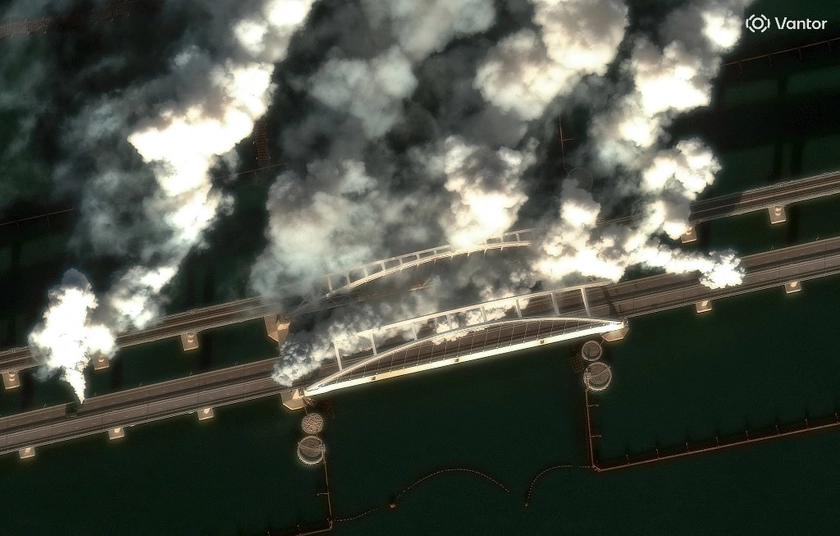
Overnight Monday to Tuesday, the Ukrainian drone swarms did not let up with a major strike attacking transmission nodes linking Crimea’s second main electricity generation facility, the Balaklava Thermal Power Plant, to the power grid. The facility itself had last been hit by drones on June 24, but damage from that attack had been limited, with subsequent strikes reportedly targeting adjacent power transmission stations.
Like the Tavria TPP, the Balaklava TPP at full capacity produces around 470 MW of power from two Siemens SGT5-4000F gas turbines. Together the two stations produce about 90% of Crimea’s power.
During the early hours of Tuesday, the first Ukrainian drone waves appeared to seek out Russian anti-drone air defense systems positioned around the Balaklava plant. At about 4 a.m., explosions were reported in the vicinity of anti-aircraft sites overlooking Balaklava Bay.
According to imagery and reports published by the Ukrainian partisan group Atesh, between five and 10 Russian Pantsir air defense systems designed to intercept low-flying aircraft and drones are usually positioned on the heights overlooking Balaklava, a Black Sea resort village near the major Crimean city of Sevastopol. Russian social media reported at least seven explosions in the vicinity. Strikes against Russian anti-drone air defense systems prior to making an actual attack is a common Ukrainian drone operator tactic.
Multiple hits and at least one heavy explosion were reported in the vicinity of the Balaklava TPP on Tuesday morning by local social media, with kamikaze aircraft reportedly making individual attack approaches between 5 a.m. and 6 a.m. Some purported eyewitness accounts mentioned a “bright flash” followed by an audible blast and thick white smoke rising from the plant.
Some reports suggested it was steam, possibly a sign of a breach in one or both of the German turbines. Photographs of the power station published by the pro-Ukraine information platform Krymsky Veter showed windows blown out and a possible puncture hole in an upper level of the building from a reported recent penetrating drone strike, but it was not possible to confirm the date of the image independently.
Other reports said the power plant escaped hits but power transmission lines and a key transformer station connecting the facility to the grid had been badly damaged. Ukrainian milbloggers reported some of the attacking aircraft had been jet-powered, a rarity for Ukraine’s drone forces using primarily propeller-driven kamikaze drones.
Power surges and failures were reported across Sevastopol, a city of 550,000 and former home base for Russia’s Black Sea Fleet. Most consumers were without electricity, but for a minority of residents, military, and government facilities – the lights stayed on.
Mikail Razvozhaev, the Russia-appointed head of the greater Sevastopol occupation authority, in the morning confirmed “technical failure” in regional energy generation had taken place without offering details or stating that Ukrainian drones were responsible. He said consumers would “for now” receive two hours of electricity followed by six hours of mandatory blackout. Authorities have the situation in hand and local residents and visitors to southern Crimea should remain calm and only trust official announcements, Razvozhaev said.
“Our goal is to fill the power gap and make the blackouts less frequent,” Razhvozhaev said in part.
In a possible move to reduce social media images of plant damage reaching the public, a parallel Razvozhaev order shifted public transport bus routes away from the Balaclava TPP. The city’s oldest public transportation, trams, were shut down completely.
Russia’s most extensive military base in Crimea, and thanks to the warm climate, a popular retirement home for Russian soldiers and their families. The Russian navy abandoned that port in October 2023 following Ukrainian missile strikes; most Russian ground and air forces evacuated facilities there in 2024-2025 following increasingly effective Ukrainian drone strikes.
Ukraine’s Tuesday Sevastopol-centered attack came on the heels of weeks of Ukrainian strikes in Crimea’s central and northern regions targeting the power grid and power generation capacity. Some northern districts, particularly the logistics and transportation hub Dzhankoi, have faced severe power outages, with blackouts lasting a week or more there and in the nearby cities of Armyansk and Krasonperekopsk.
Home and business owners in those cities complained of frozen and refrigerated food spoiling during the power outages, and fans and air conditioners that couldn’t be turned on, in temperatures above 30 degrees Celsius. An Armyansk city announcement published on Monday said that residents would have water in their taps only every other day, because power was insufficient to run water main pumps at full capacity.
Along Crimea’s heavily touristed south shore, power outages were reported along with electricity rationing at some locations. The mid-range summer holiday village of Alushta and nearby villages were completely cut off from the power supply, with the exception of the hospital, and because of low capacity local residents and tourists were being supplied electricity two hours out of every twelve on a rolling blackout schedule, Russia-appointed Alushta mayor Galina Ogneva said on Monday in a statement.
According to announcements by Ukraine’s drone forces, the USF (Unmanned Systems Forces), dozens of electrical substations or other power infrastructure have been hit by Ukrainian robot aircraft across Crimea in recent weeks, with 38+ strikes claimed in the first week of July and 45+ in the second week of July. Besides power transmission and generation infrastructure, attacks have hit gas distribution stations and compressor stations.
Most of the strikes have been carried out by Ukraine’s workhorse FP-2 push propeller drone, a slow-flying plane roughly the size of a large sofa. USF commanders have said attacks against the Russia-run power grid in Crimea are succeeding because of months of preliminary attacks that hit and destroyed Russian air defenses. The top Ukrainian target in those preparatory drone attacks has been Russia’s Pantsir gun/missile system, an air defense weapon designed to shoot down drones.
You can also highlight the text and press Ctrl + Enter

OPINION: The Bill for Crimea Comes Due for Putin
‘Shadow Fleet Is Leaving the Chat’: Ukraine Hits 10 Russian Fuel Tankers in One Day