The EU has imposed sanctions on nine Russian nationals and four entities accused of carrying out cyberattacks against the EU, its member states, Ukraine, and other international partners, according to the Council of the EU.
On Monday, the EU and the UK imposed coordinated sanctions targeting Russia‘s cyber operations, accusing Moscow’s FSB intelligence service of orchestrating a campaign of cyberattacks against European governments, critical infrastructure, and businesses.
JOIN US ON TELEGRAM
Follow our coverage of the war on the @Kyivpost_official.
The sanctions target individuals and companies that Brussels says form part of Russia’s “cyber ecosystem” responsible for ransomware, phishing campaigns, and attacks on critical infrastructure.
The measures were adopted in coordination with the UK, marking the first time the EU and UK have simultaneously imposed sanctions under their respective cyber sanctions regimes.
Among those sanctioned are Media Land LLC and its owner Alexander Volosovik, as well as affiliated company ML.Cloud, which the EU says was involved in ransomware and phishing attacks causing significant financial losses across Europe.
The pro-Russian hacker group Z-Pentest was also designated over cyberattacks targeting critical infrastructure, including energy and water facilities. The group was blamed for an attack on a Danish water utility in December 2024.
Sanctions were also imposed on the group’s leader, Yuliya Pankratova, and chief hacker, Denis Degtyarenko, who are also linked to the hacker collective Cyber Army of Russia Reborn (CARR).
Can Europe Build Its Own Air Shield? | Bohdan Nahaylo
According to the EU, the group has carried out coordinated distributed denial-of-service (DDoS) attacks against countries supporting Ukraine since 2022.
The sanctions list also includes Impuls LLC, its owner Evgeniy Bashev, and Russian nationals Maksim Voronin, Maksim Gordienko, and Vitaly Kovalov, who are accused of developing or distributing malware, including LummaC2, Trickbot, and Conti.
Separately, the EU imposed sanctions on Ivan Kasyanenko, deputy commander of the Russian military intelligence’s Department 29155, accusing him of overseeing covert operations in Europe and Afghanistan.
The bloc said he coordinated activities linked to the 2018 poisoning of Sergei and Yulia Skripal in the UK, the deployment of Wagner mercenaries in Africa, and cyber operations targeting EU member states and Ukraine.
The latest measures come as EU ambassadors race to finalize the bloc’s 21st sanctions package against Russia before a Wednesday deadline that could force the EU to raise its oil price cap from $44 per barrel, potentially boosting Moscow’s oil revenues.
The package has been delayed by objections from several member states, including Bulgaria over sanctions on Patriarch Kirill, and Germany over a proposed ban on Russian Alaskan pollock imports.
Diplomats also remain divided over broader visa restrictions for Russians involved in the war against Ukraine.
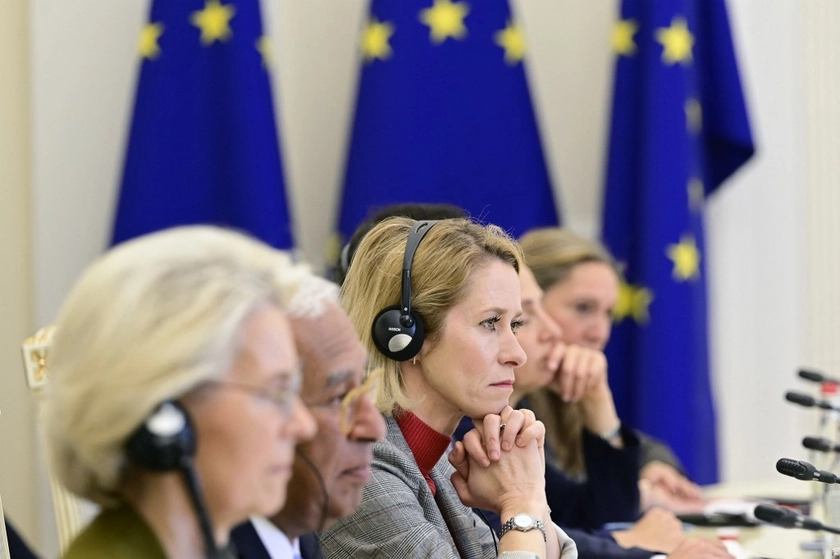
EU foreign policy chief Kaja Kallas said member states were “quite close” to an agreement, adding: “Our aim is to have an agreement. If we don’t have an agreement, then we start to work on Plan B.”
You can also highlight the text and press Ctrl + Enter

OPINION: The Bill for Crimea Comes Due for Putin
‘Shadow Fleet Is Leaving the Chat’: Ukraine Hits 10 Russian Fuel Tankers in One Day