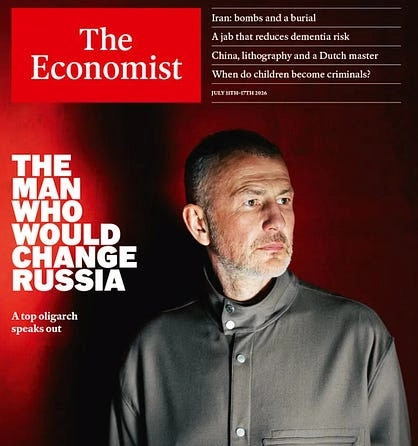
The Economist put a Russian oligarch on its cover with the strange headline “The Man Who Would Change Russia: A Top Oligarch Speaks Out.”
The article, based on interviews with oligarch Andrey Melnichenko, claimed that it was dangerous for him to speak out. But in fact, its publication was a “dezinformatsiya,” or “disinformation,” coup for Putin.
JOIN US ON TELEGRAM
Follow our coverage of the war on the @Kyivpost_official.
The story’s headline read “Why a Broken Russia is Bad for the World,” and contained only Kremlin talking points that were designed to stoke fear among Western allies about a possible Russian defeat.
Moreover, Melnichenko is hardly credible. He’s a war profiteer and did not refer to the fact that Russia’s invasion – which began in 2014 – was unprovoked, illegal, and laden with war crimes.
Instead, he argued that Moscow, the chief perpetrator for decades of wars and strife globally, be allowed to retain its global status. “It will need to be part of the new security architecture,” he said. Frankly, as a journalist, it is questionable whether to publish advice from a man who has made a fortune off the dictatorship and its wars, owns the world’s most valuable yacht, and has homes and wealth socked away in offshore havens. But as Aeschylus wrote: “In war, truth is the first casualty.”
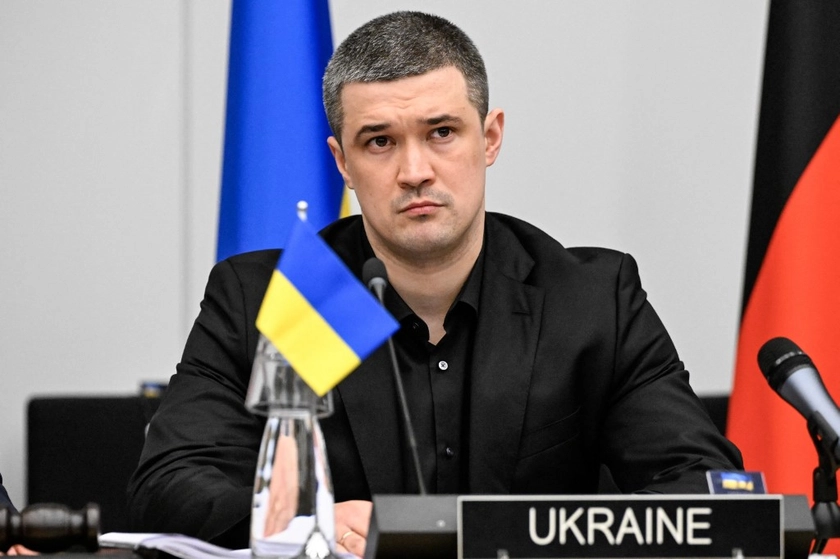
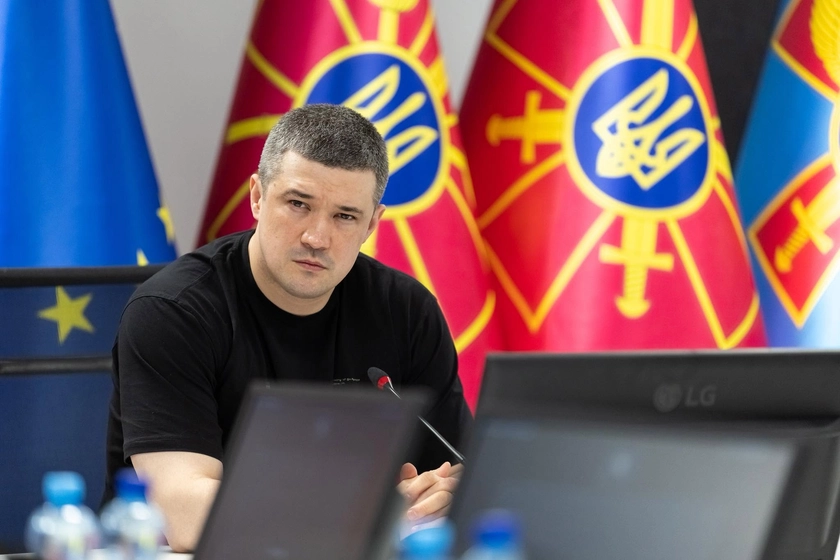
Fedorov: Open Tenders Saved Ukraine $100M, Threatened Powerful Interests
The technocrats and tycoons who run Russia have known for some time that the war is going badly for Putin. But lately the Kremlin has begun to trot out prominent Russians to frighten its foes into believing that Russia’s defeat will be bad for everyone. This is rubbish, but, ironically, the interview is also a positive sign.
Oligarchs and other Russians cannot publicly come forward without the approval of its secret service. This means that the real significance is, as an intelligence source noted to me, “it’s a good sign that things are not going smoothly if they are trying to scare people. It’s a well-thought-out agenda.”
The reality is that Russia’s collapse would be the best thing to happen for the West, geopolitically and globally. It may be messy for Russian oligarchs and the people for a while, but their government is the perpetrator in a war in Ukraine as well as in other conflicts such as in Sudan. The last time Moscow lost a war was in 1991 in Afghanistan; the Soviet Union dissolved into pieces. It divided into smaller nation-states such as Ukraine, the Baltics, and Central Asian nations. Unfortunately, the Russian Federation morphed into another odious Soviet imperialist state backed by a mafia of oligarchs.
Now it wants Ukraine back, which will also be its undoing and hopefully once more dissolve Russia into even smaller nation-states. Contrary to this oligarch’s propaganda in The Economist, the defeat of Russia is desirable and is the best possible outcome for the West and the rest of the world.
Strangely, The Economist promoted this Russian fear peddling. There is no way an oligarch would speak publicly without the approval and a script provided by Putin’s propagandists. This wasn’t mentioned; instead, he was praised for his courage in coming forward.
Melnichenko also failed to mention that Putin’s invasion broke international law, involved war crimes, was unprovoked, or was based on his loopy revanchist notions about restoring the Soviet Union and beyond into Europe.
Noted a Ukrainian official to me about this interview: “Western elites think all the other countries, Russia or China, are like them, just a little bit different. But the problem is completely different – the majority of Western journalists think that sources in the White House or America are the same as sources in Moscow. But in Moscow they are sitting in the same room with the FSB [Russia’s CIA], which is telling them what to say.”
It’s also naïve to believe that Putin or others in charge will turn Russia peacefully into a decent country or democracy. Russia has never been a democracy in its history, not even for a day or two. Even so, Melnichenko describes scenarios for Russia – if it loses its assault on Ukraine – which he alleges must be avoided because they would be dangerous for the West. He lists anarchy; a civil war among oligarchs; a takeover by foreigners dominated by China; or bankruptcy.
Hopefully, the most likely scenario is that the Russian Federation will dissolve into smaller nation-states, as did the Soviet Union in 1991. That would also be disruptive, but the Russian people have only themselves to blame. The same fears and issues accompanied that meltdown – namely access to nuclear arsenals – but these were immediately addressed, commandeered, and guarded by the West. Russia became isolated politically and economically and was a mess for years under Gorbachev, Yeltsin, and then Putin, who gained popularity by simply making the trains run on time. Now it’s become a kleptocratic mafia scourge, and when it loses this time, Russia will hopefully go bust and divide.
Ironically, hand-wringing about Russia’s future in the Western media and halls of power is a tribute to Moscow’s incredible propaganda machinery. Despite a brutal war and atrocities for years in Ukraine, the West is hostage to this Kremlin fiction that somehow victory should be undesirable. Of course, this is hardly surprising. Europe has been badly compromised and indoctrinated for years. Some of Germany’s leaders were actually on Putin’s payroll. The Kremlin instructed Hungary’s Viktor Orban to sabotage the continent’s alliances. Russia helped bring about the ruinous Brexit vote with social media manipulation. Worst of all, the Western media failed to report that the Oct. 7 massacre by Hamas on Israel was perpetrated by terrorists who were trained by Russian mercenaries in a Russian-controlled portion of Syria and executed on Putin’s birthday.
Now, after years of war crimes and genocide in Ukraine, Europeans remain oblivious to the peril posed by Putin. Many balk at remilitarization or upping their contribution to NATO, notably those farthest from the eastern border. Just last week, Europeans bought a record amount of Russian liquefied natural gas to prepare for higher prices due to the closure of the Hormuz Strait. Their purchases were 18% higher in the first half of this year and added $6 billion to Putin’s war chest. Who were the buyers? Mostly France, Belgium and Spain.
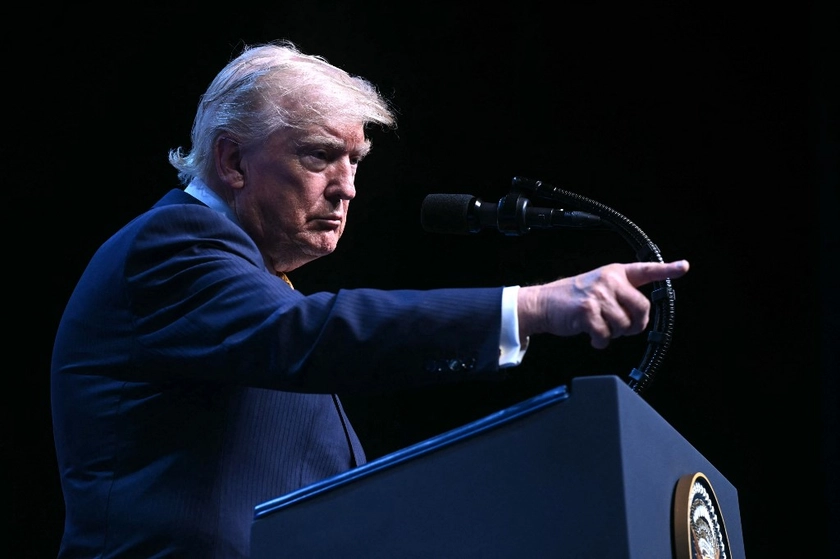
How can they justify this when Ukrainian babies and mothers die daily from Russian ballistic missiles, thousands of Ukrainian children remain kidnapped, Ukraine’s energy infrastructure is being destroyed, and tens of thousands of soldiers die or are wounded monthly on the battlefield? (Fortunately, US President Donald Trump said on June 14 he would back a revised version of Senator Lindsey Graham’s Russia Sanctions Bill. This will impose 100% tariffs on the world’s top five buyers of Russian crude oil and natural gas, notably China and India. Allies will be somewhat exempted, but only if they are taking drastic steps to reduce dependence on Russia. Europe isn’t as yet.)
Clearly, energy purchases from Russia must be banned, and attitudes in Europe must change. France’s President Emmanuel Macron is a staunch ally of President Volodymyr Zelensky, but he stated recently that Europe will defend its freedom and rule of law “at the cost of blood, if necessary,” then said that Russia should “not be humiliated” to get peace.
Not humiliated? Given the Holocausts that Putin has caused in Ukraine, Georgia, Afghanistan, Sudan, and Israel, plus the bloodshed it’s spawned around the world, the West should destroy the Russian army and overthrow, punish, and humiliate its regime and leaders. That would clean up the planet. And that would be justice.
Reprinted from [email protected] – Diane Francis on America and the World.
The views expressed in this opinion article are the author’s and not necessarily those of Kyiv Post.
The views expressed in this opinion article are the author’s and not necessarily those of Kyiv Post.
You can also highlight the text and press Ctrl + Enter
OPINION: The Bill for Crimea Comes Due for Putin