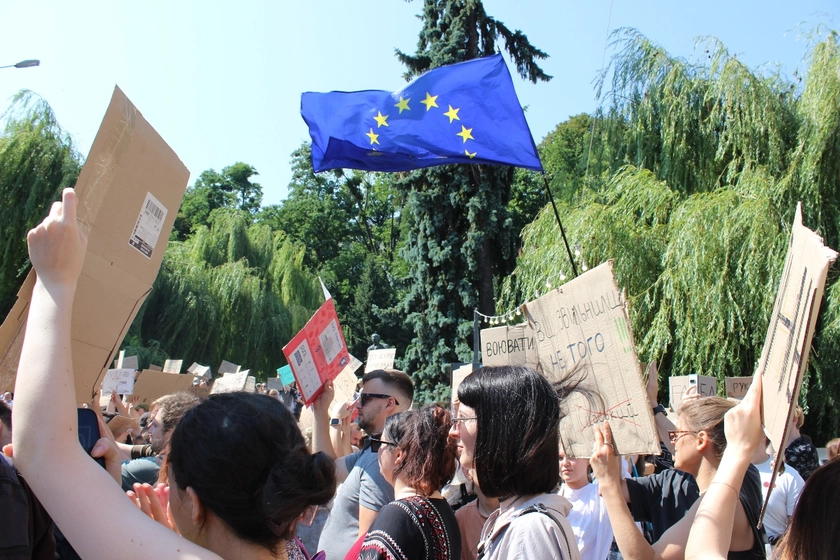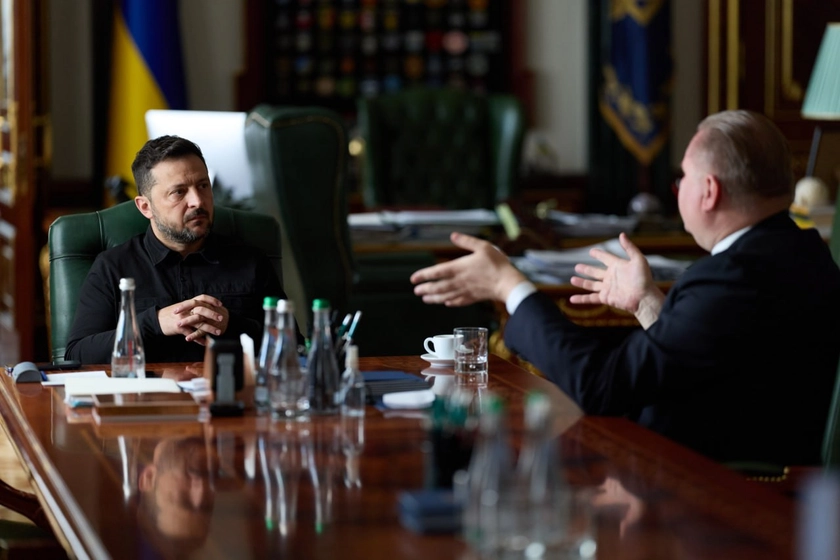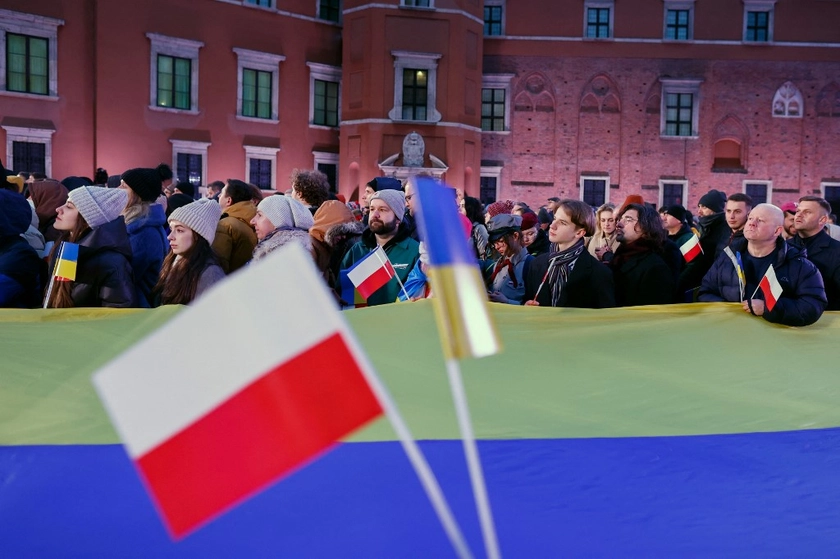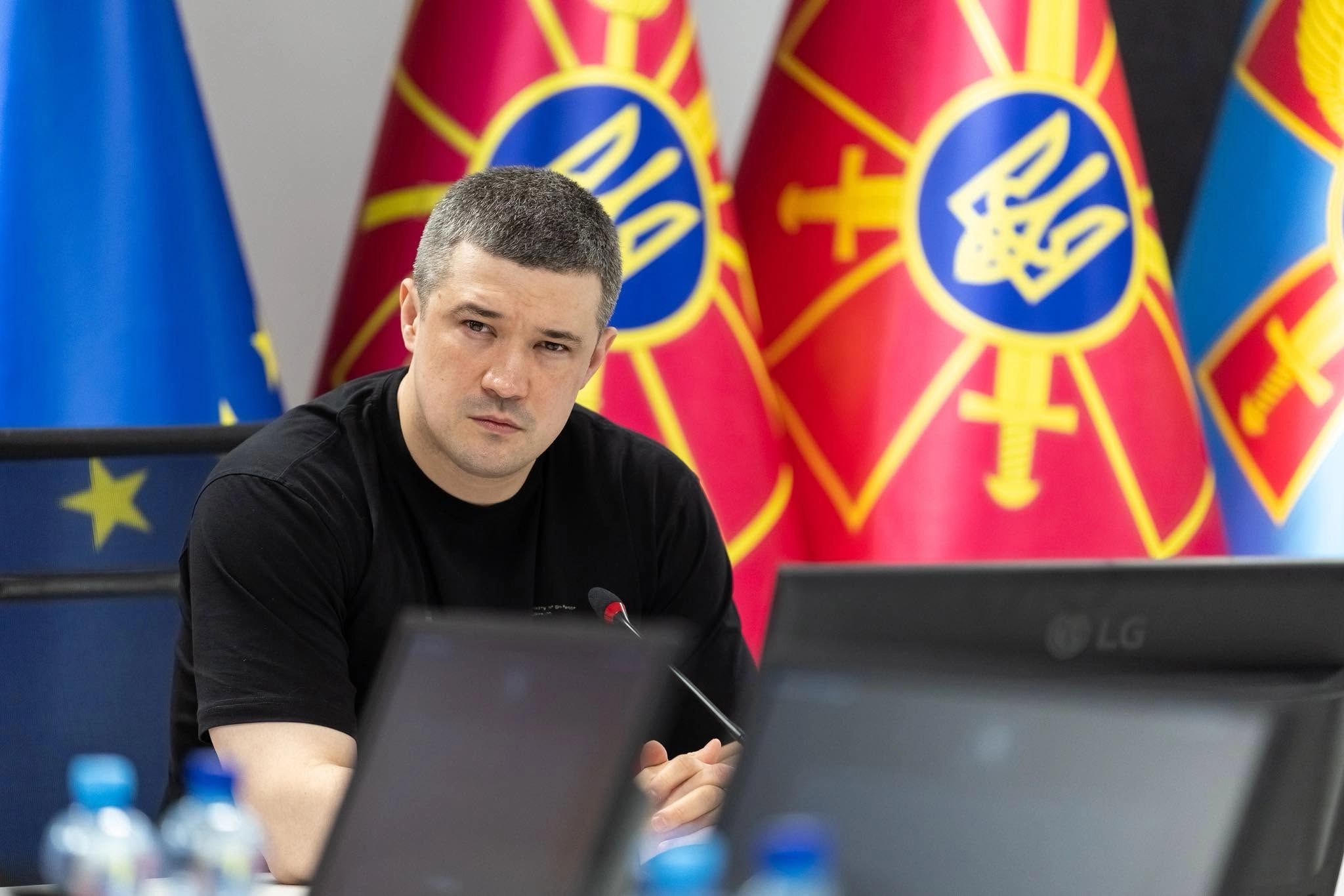
The dismissal of Ukraine’s defense minister, Mykhailo Fedorov, following a governmental reshuffle caused an outcry in Ukraine as the country continues to fight off Russia’s full-scale aggression.
In Russia, the news didn’t go unnoticed. The Kremlin, collaborators, lawmakers, and war bloggers reacted extensively to wartime protests across Ukraine and to the acting head of the Security Service of Ukraine (SBU), Yevhen Khmara, taking over Fedorov’s seat.
JOIN US ON TELEGRAM
Follow our coverage of the war on the @Kyivpost_official.
Kremlin says it does not matter
Kremlin spokesman Dmitry Peskov tried to downplay the significance of the shake-up.
“Broadly speaking, it makes no difference who the defense minister is,” he told journalists, according to Interfax.
Peskov said Moscow’s priority was for someone in Kyiv to take what he called a “responsible decision” that would lead to a negotiated settlement or allow Russia to conclude its so-called “special military operation” – the Kremlin’s official term for the invasion of its neighbor.
But the assessment from other Kremlin-related figures differs.
In a Telegram post, former Ukrainian lawmaker and pro-Kremlin collaborator Oleg Tsaryov credited Fedorov with introducing competitive procurement and a marketplace through which military units could select drones, robotic systems and electronic-warfare equipment.
Tsaryov said the number of Ukrainian drone manufacturers had grown from 7 to more than 500, while the number of electronic-warfare producers had risen from 2 to 200.
Anti-Ukrainian Hate Incidents Surge in Poland Amid Online Hostility
He also pointed to the creation of the Unmanned Systems Forces (USF), the expansion of long-range strikes inside Russia, weapons exports, the blocking of Starlink for Russian drone operators and a new center analyzing brigade performance in real time. These figures and claims require independent verification.
“Fedorov proved to be a strong and effective enemy,” Tsaryov concluded. “But it makes sense to adopt the best practices he introduced.”
Meanwhile, Andrei Medvedev, a Moscow City Duma lawmaker and deputy head of the state broadcaster VGTRK, noted that the Ukrainian public has reacted negatively to his dismissal.
“That makes it a positive development for us. After all, some of the arguments – Starlink, Crimea and so on – are difficult to dispute,” he said.
The war blogger exhilaration
Yet, the reaction from Russian pro-war commentators undermined that message almost immediately.
Within hours of Fedorov’s removal, pro-war Telegram channels described the decision as “excellent news” and “a favorable factor for Russia.” Some called him an unusually intelligent and effective enemy. Others celebrated the prospect that Russia could regain access to Starlink terminals for its attack drones.
The pro-war channel Voevoda Veshchaet turned to SpaceX owner Elon Musk after the news broke, demanding – partly in jest and with profanity – that he restore unverified Starlink access for Russian forces now that Fedorov had gone.
The post said Russian Geran and BM-35 attack drones should be allowed to use Starlink until Russia’s planned Rassvet satellite system is ready. The original used an anti-Ukrainian slur.
The reaction was revealing. Fedorov had worked with SpaceX to block unauthorized Russian access to Starlink, which Russian forces had used to improve the range and resilience of some long-range drones. The channel was not merely mocking a dismissed Ukrainian official. It was identifying a concrete Russian capability that Fedorov had helped restrict.
Another pro-war channel by Alexei Zhivov welcomed Zelensky’s decision after listing what it presented as Fedorov’s achievements.
It claimed Fedorov had introduced monthly pay equivalent to 500,000-700,000 rubles ($6,379-8,930) for Ukrainian assault troops, compared with 150,000-200,000 rubles for drone operators ($1,913-2,552). Kyiv Post has not independently verified those figures.
“It is very good that Zelensky removed him from managing the army,” Zhivov wrote. “He was simply too intelligent and effective an enemy. Things should become easier now.”
The channel mocked reports that Fedorov was removed over a failed reform of Ukraine’s Territorial Recruitment Centers (TRCs), but its conclusion was not ambiguous: His removal served Russian interests.
Russian military blogger Yuri Kotenok reached a similar conclusion through more abusive language. He called Fedorov the leader of a group of “techno-fascists” focused on remote warfare and what he described as “unlimited aerial terror.”
Yet Kotenok rejected the official explanation that Fedorov had failed to reform recruitment. He said reports of a conflict between the former minister and Ukraine’s military leadership appeared closer to the truth.
Kotenok credited Fedorov with introducing military supply systems borrowed from commercial management and directing major resources toward unmanned systems, digitalization and artificial intelligence (AI) – reportedly against the preferences of generals who believed the war would be decided through conventional combined-arms operations. His claims about financial flows and procurement were unsupported.
Stripped of its slurs and propaganda framing, the post described the same divide now being debated in Ukraine: a struggle between a technology-driven model of warfare and a more traditional military command culture.
From celebration to conspiracy
Not all Russian reactions focused on Fedorov’s record. Some tried to deny that the protests had any authentic Ukrainian basis at all.
The Bloknot Propagandista channel, reposted by Dva Mayora, called the demonstrations a second “cardboard Maidan” and claimed they were staged by “old elites” in the United States and the European Union to discipline Zelensky after his contacts with US President Donald Trump.
It further claimed, without evidence, that Washington had tied Patriot missile supplies to demands for a change of government in Kyiv and that rival Western factions had activated a manual “Maidan mechanism” to retain control of the war.
The channel declared that every Ukrainian protest was staged for the benefit of Western capitalists and that freedom of assembly had never existed in Ukraine.
What the Russian reaction reveals
Even Komsomolskaya Pravda highlighted how unusual the reaction was.
It recalled the corruption scandals that had destroyed the reputations of previous Ukrainian defense ministers – from overpriced food to jackets bought at several times their market value – and noted that Ukrainians had never previously rallied to demand a defense minister’s return.
One channel also called early reports that Interior Minister Ihor Klymenko could replace Fedorov “excellent news for us,” using an anti-Ukrainian slur to argue that a Klymenko-Oleksandr Syrsky pairing would produce more Ukrainian casualties. Klymenko was not ultimately named to the post; Zelensky selected Khmara on an interim basis.
Zelensky eventually offered Klymenko the role of secretary of the National Security and Defense Council (RNBO), a post currently held by Rustem Umerov, who assumed the role almost exactly one year ago following another government shakeup.
Although the reaction was not uniform, a consistent judgment ran through much of the commentary: Fedorov had made Ukraine more difficult to fight. His departure is a gift to Russia.
You can also highlight the text and press Ctrl + Enter

OPINION: The Bill for Crimea Comes Due for Putin