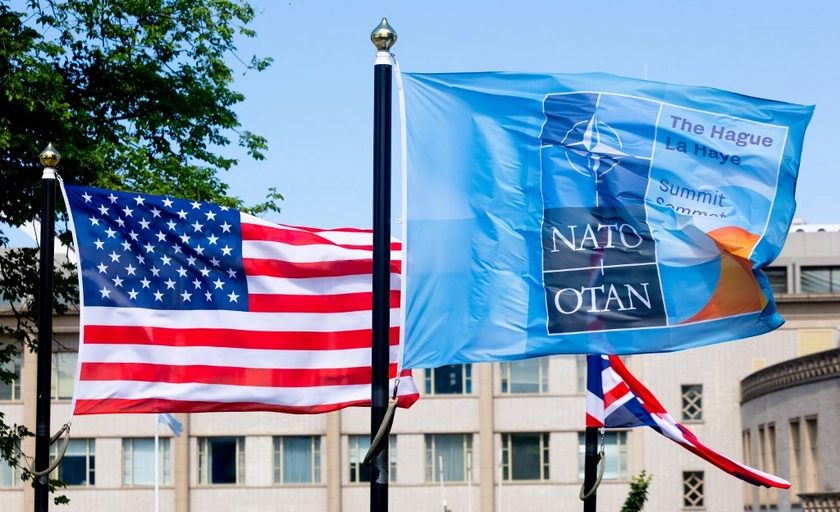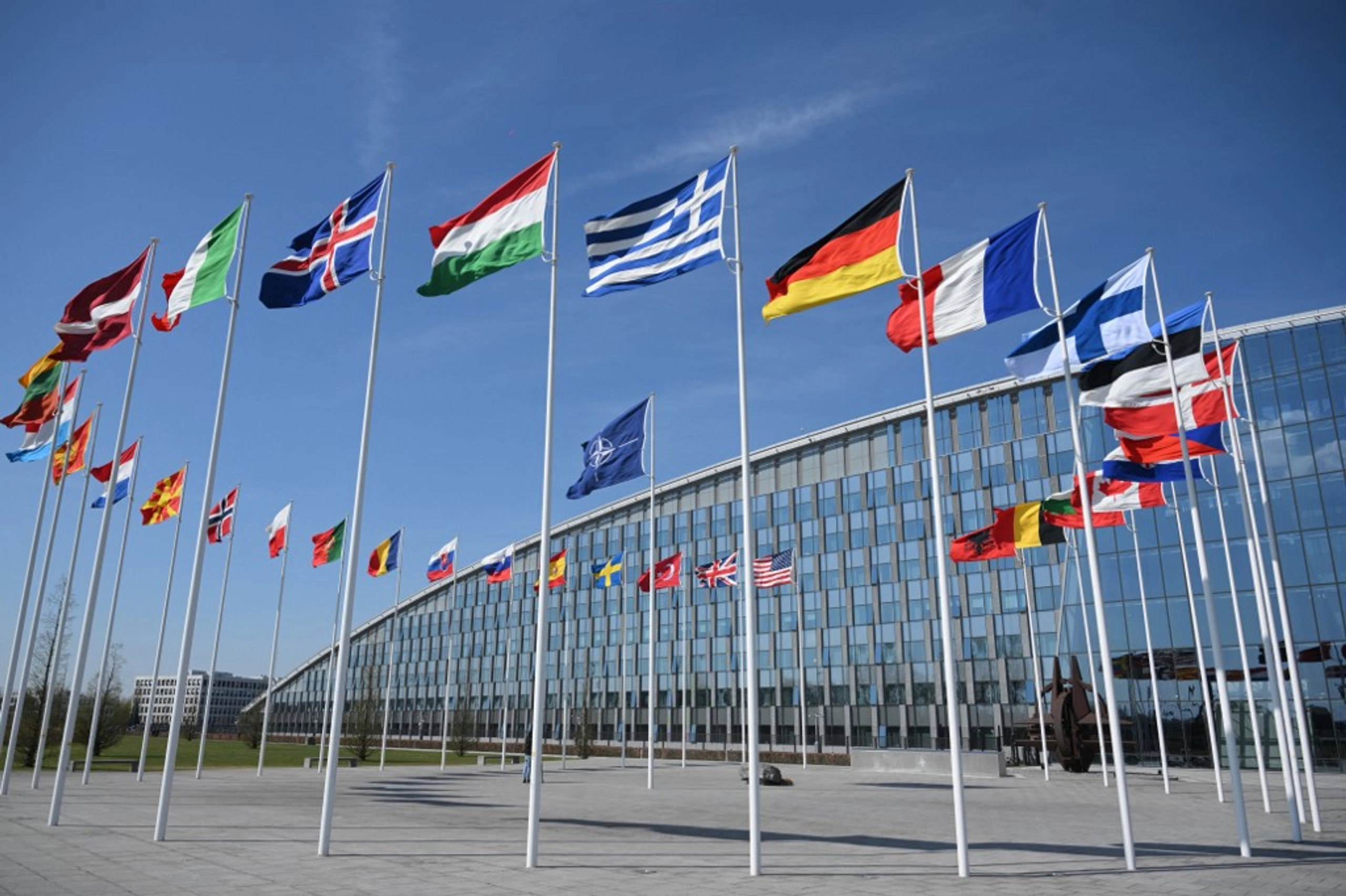
More than three years into the full-scale invasion of Ukraine, there has been a growing frustration at the Western world’s lack of robustness in pursuing a clear-headed strategy of defense. All that changed this week with the announcement of a new NATO defense doctrine which should provide much needed clarity.
General Deepa Sleep, Commander of Allied Expeditionary Forces East explained: “Over the last months we have assembled our coalition of the willing to consider what linguistic weapons we are going to deploy to help stop this war and achieve a coordinated defense of existing NATO members.”
JOIN US ON TELEGRAM
Follow our coverage of the war on the @Kyivpost_official.
The new defense posture has now been formally adopted by the EU and the US.
The new doctrine calls for four levels of defense. The first level, Defcon 1, would be NATO’s response to a single attack, such as a cruise missile slamming into an apartment complex and killing innocent civilians.
“It took us a long time and many hours of looking through the dictionary to develop the appropriate defense capability for this scenario,” explained General Sleep. “We thought about using the word “worried,” but that’s the expression a squirrel has when you take away its nuts, so we settled on the much stronger term “troubled.” “We are troubled by the recent attack” is forcefully worded and should act as an effective deterrent to any future attacks.”
US Plans to Slash Fighter Jets, Warships to NATO in Europe: Report
In the case of the bombing of a whole settlement or a rain of drone and ballistic missile terror launched against a city, Defcon 2 would be the next level of defense.
“It’s important to provide a proportionate response,” said General Sleep. “Obviously, if a city is being attacked, we need more forthright language. We decided that “concerned” was the appropriate word, but there was much debate about whether we were to be “deeply” concerned or “very” concerned. We settled on “deeply concerned” to deliver the required message and to emphasize to the aggressor that we feel more emphatic about this than merely being troubled.”
Sleep went on: “In the case of Ukraine, we felt that if the West was ‘very’ concerned, Russian bomber pilots might not get the message, but if we expressed ‘deep’ concern, this is a powerful demonstration of our resolve. We expect that it will cause the bomber crews to abandon their missions and head home.”
Over the last three years, even more serious attacks have led to cities being reduced to rubble, with hellish conditions for those remaining and terrible loss of life.
“We need to be absolutely clear about our stand on this,” General Sleep went on to explain. “It’s not good enough to express deep concern for the destruction of an entire city and the erasure of a population. For that reason, we have defined a new level of response, called Defcon 3, at which we will deploy new semantic weapons. After four round table meetings and examining the contents of several dictionaries, it was decided that this level of attack must be met with ‘strong condemnation.’”
Strong condemnation is only to be applied sparingly so as not to weaken its deterrence. “If you say ‘condemnation’ enough,” explained General Sleep, “people start to ignore it. Where would we be if we lived in a world where invading armies felt no compulsion to go home when their actions were strongly condemned? We must maintain our deterrence posture, and one way to ensure this is to restrict the use of condemnation to once a month.”
Condemnation could become a more powerful weapon when combined with other words in the dictionary. “It’s essential to emphasize the force that NATO can apply when it needs to,” General Sleep insisted. “If, for example, a missile was fired into a children’s cancer hospital, we’d be able to ‘very strongly condemn’ or ‘express our complete condemnation,’ thus deploying the full panoply of NATO capabilities.”
Defcon 4, the final level of NATO’s defense posture, is reserved for the invasion of Western Europe and the subjugation of the Baltic States. In that moment of calamity, NATO will deploy its most powerful phrase – ‘utterly unacceptable.’” This will not merely be announced in public, but “we will also deploy it in a number of strongly worded written letters,” explained General Sleep. It may even be written on placards and held up in front of advancing tanks to arrest the invasion in its tracks.
NATO is developing plans to maintain secret files containing words that would send devastating shock waves across the advancing battlefield should Europe be invaded. “I can’t divulge what those capabilities are,” said General Sleep, “but I am at liberty to say that words like ‘outraged’ and phrases such as ‘completely reprehensible’ may be launched from NATO territory towards the invading forces. Even stronger words, which you wouldn’t say in front of your grandmother, will allow us to defend European territory. Those words are protected by the highest levels of secrecy, and they are not even in online dictionaries of urban slang.”
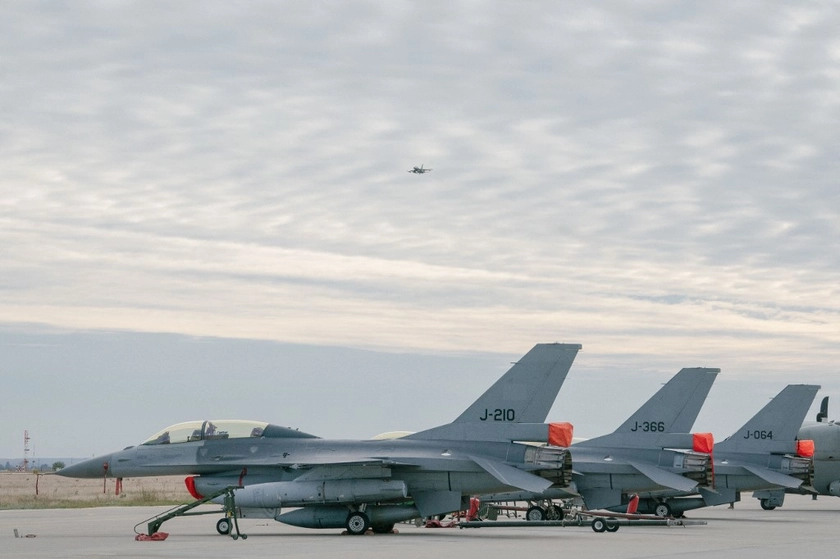
When asked what wording should be used when airborne NATO fighter pilots spot cruise missiles and drones flying through NATO airspace, intended to attack people in other countries, General Sleep was unambiguous.
“Clearly, that is both troubling and concerning. We have three working groups examining the dictionary, but we are a little lost for words. We’ve considered ‘dismaying’ or ;shocking’ as possibilities. ‘Disturbing’ is also a favorite, but we’ve already used that to describe Chinese soldiers fighting on European soil and North Korean nuclear capable ballistic missiles destroying European cities, so we’ll need to come up with something different. We are currently convening a working party with a thesaurus to consider what language to use in these cases and we expect to have a decision by early 2037.”
Asked how the Defcon levels will allow the West to respond to the forthcoming invasion of Taiwan (should that be encouraged by any ineffectiveness in NATO’s word deterrence in Ukraine), General Sleep was clear, “Things are always lost in translation, but we have numerous high ranking linguistics experts working to ensure that ‘strongly condemn’ will be very clear in Chinese. We are ready for everything.”
The views expressed in this opinion article are the author’s and not necessarily those of Kyiv Post.
You can also highlight the text and press Ctrl + Enter