For a short period following the 1991 dissolution of the Soviet Union, it appeared that Russia’s ruling elites and its population had accepted the loss of their empire. It was an empire that had been held together through the dictatorship of the Communist Party, which, at times, in order to consolidate and hold on to power, had regularly used repressive means and on occasions even mass terror against its own citizens.
It seemed that Russians had finally decided to establish a democratic nation-state in the Russian Federation – an agglomeration of regions and peoples – which had been by far the largest and most populous republic of the Soviet Union. This new post-Soviet Russian state also recognized the other republics of the USSR as independent states.
Almost 34 years later, it is clear that a sharp U-turn has been made. In place of a nascent democracy, a dictatorship has been re-established, and through its war of aggression against Ukraine, Russia is attempting to reconstitute itself as an empire.
Some Russian history
This is not the first time that Russians have failed or even turned away from the chance to build a democratic nation-state following the collapse of their empire. The first opportunity occurred in the wake of the March 1917 Russian Revolution. The overthrow of the Russian Empire’s monarchical government and the establishment of a Provisional Government in Russia inaugurated a democratic spring, which also allowed the non-Russian nations of the empire to exercise their right to self-determination. Ukrainians, for instance, established a national legislature and autonomous government by summer 1917. The Bolshevik party, however, ended democratic freedoms and established a dictatorship after overthrowing Russia’s Provisional Government in November 1917.
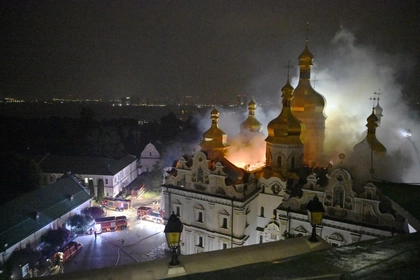
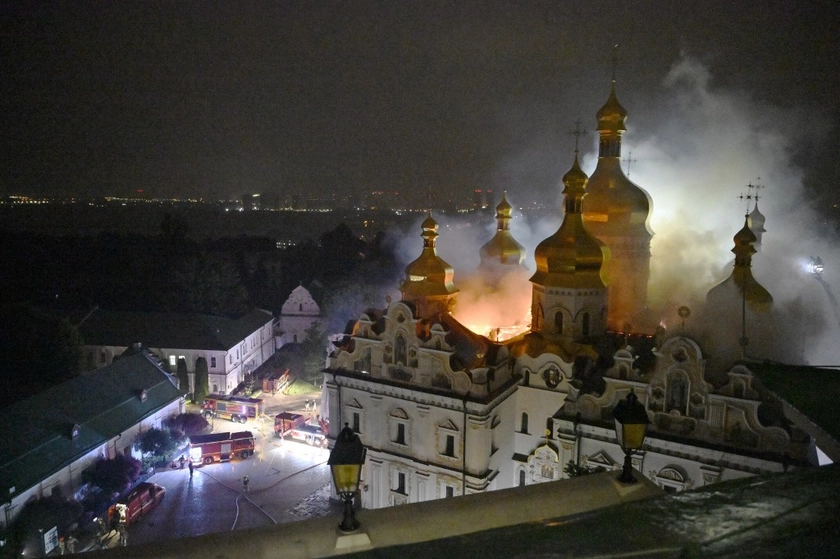
UN Security Council to Convene on Kyiv-Pechersk Lavra Strike
In its relations with the external world, the new Bolshevik-led Russian state, still in its infancy as a dictatorship, chose the path of re-imperialization by invading Ukraine and Georgia, suppressing their independence. Following the reassembly, mainly by force, of most of the territories of the former Russian Empire, a new empire was formally reconstituted in 1922, this time in the form of a federation, the Soviet Union.
In September 1939, the still youthful Soviet empire, in partnership with the re-imperializing Nazi Third Reich, precipitated World War II by invading and dismembering Poland, following which it attacked Finland. In 1940, the Soviet Union swallowed up the three Baltic republics, annexed new territories following World War II victories over Japan and Germany, and established indirect control over several central European states. To keep its imperial system from breaking apart, the USSR used military force – in Hungary in 1956 and Czechoslovakia in 1968.
The key features following Russia’s re-imperialization as the Soviet Union were thus, externally, a belligerent foreign policy (characterized by wars of aggression, military interventions, and the decades-long Cold War confrontation with the West) and, internally, the existence of a harsh dictatorship.
Under Joseph Stalin’s rule, almost complete control or totalitarian rule was established over society. In short, the Communist Party’s ruling elites created and led an expansionist imperialist state that created tensions and instability abroad. Internally, this imperialist state was itself unstable, as dictatorial rule – supported by the constant threat and use of repressions as well as strict control over information – was required to maintain the Communist Party in power and force society to do their bidding. The repressions aimed at suppressing both those advocating for democratization as well as those defending the rights of the subjugated nations within the empire.
The first collapse of the Russian Empire, its reconstitution as the USSR, and the accelerated re-imperialization and territorial expansion that took place under Stalin, should be compared with the fate of other European empires following the two world wars of the 20th century. A distinguishing feature of this period was the disintegration of empires and the emergence of nation-states in their place. The great land-based Austro-Hungarian and Ottoman empires ceased to exist after World War I. Imperial Japan and Hitler’s Third Reich were defeated in World War II, while the overseas empires of several European powers in Africa and Asia began to disintegrate soon afterward.
The post-Soviet world
When the central European countries broke free of the Soviet empire’s control in the late 1980s and the Soviet Union itself collapsed in 1991, allowing the non-Russian republics to gain or regain their independence, it appeared that the planet’s last great land-based empire and imperial system had ceased to exist. This also freed Russians from the burden of having to pay the price in treasure, blood, and their personal liberties and freedoms to serve and maintain this empire and system. It also presented a second opportunity for establishing a functioning democracy and build a nation-state.
Russia’s post-Soviet leadership, headed by Boris Yeltsin, did discard communism, which had served as an ideological justification for dictatorship, as well as motivation and a cover for the USSR’s imperialist expansionism and animosity toward the world’s so-called bourgeois democracies. Internally, however, the Yeltsin government, despite its democratic credentials, soon used military force to solve a constitutional crisis with Russia’s legislature in fall 1993, which resulted in gaining greater powers for the presidency. In 1994, Yeltsin’s Russia launched an all-out war against Chechnya, an autonomous republic within the Russian Federation that had declared independence, again, resorting to the use of brute force, this time to try to crush a nation and its political leadership that was exercising its right to self-determination.
In foreign relations, Yeltsin’s government, soon after the breakup of the Soviet Union, engaged in confrontations with and undertook belligerent actions against other post-Soviet republics. Examples include military interventions in Moldova and Georgia in 1992. Relations with Ukraine were strained by Russia’s refusal to hand over control of the Black Sea fleet based in Crimea, and territorial claims against Ukraine made by notable Russian politicians. The extremist nationalist idea that the Russian state should intervene to “protect” Russians and Russian speakers living in other post-Soviet states was already raised in Russian diplomatic circles in1992, and subsequently became a guiding principle of Russia’s foreign policy.
In short, Russia’s political elites, already in the early Yeltsin years, were failing and even turning away from addressing the challenges of transforming Russia into a federation that could have become democratic nation-state. They also never jettisoned completely imperial-type thinking and imperialist policies in their relations with the other post-Soviet states, or internally within their own federation with non-Russian peoples, as shown by their brutal treatment of Chechnya.
This unwillingness to reject the idea of rebuilding an empire went hand in hand with the erosion of Russian democracy, still in its infancy, and which accelerated after Putin was handed the keys to power by a tottering Yeltsin regime in 1999. Following his election in 200, many opposition political leaders and other figures, including journalists who challenged Putin’s subsequent establishment and consolidation of a dictatorship, have been imprisoned, killed, or forced to emigrate.
In its relations with the other post-Soviet states as well as the broader international community, Putin’s Russia has increasingly used military means to achieve foreign policy goals as well as to maintain the unity of the Russian Federation. Upon becoming prime minister in 1999, he launched Russia’s second, much more brutal, war against the Chechen republic. In 2008, Georgia was invaded. Following the Arab Spring, Putin’s military joined Bashar Assad’s forces in committing atrocities and war crimes against Syrians who had risen up against their dictator.
Russia today
Since 2014, after intervening militarily in Crimea and eastern Ukraine, the Russian leader’s rhetoric has become increasingly belligerent, at times justifying his often exaggerated and sometimes preposterous assertions and accusations by making reference to or even incorporating historical myths as well as extremist Russian nationalist ideas. In his rhetoric regarding Ukrainians, Putin does not recognize that a Ukrainian nation apart from the Russian even exists, a view that even the founder of the Bolshevik state, Vladimir Lenin, would have resolutely condemned as an example of Russian chauvinism.
In today’s Russia, however, such chauvinist rhetoric has been normalized as has the extreme nationalist and exceptionalist idea of Russia as a civilization-state.
Today, not communism, but Russian extremist nationalist and chauvinist ideas provide justification and ideological fuel for its aggressive imperialism. In its relations with the outside world, and first of all with the former Soviet republics, this re-imperializing state, although itself unstable – as a dictatorship is needed to keep the regime confident in its ability to retain power – has taken actions to destabilize and also has invaded its post-Soviet neighbors. Its leader’s attempt to mask Russia’s imperialist aggression against Ukraine as a defensive measure, claiming that it had no choice but to use military force to protect Russians and Russian speakers who were being persecuted and even subjected to genocide by Ukraine’s authorities.
This return to re-imperialization, drawing on the wellspring of extreme Russian nationalism and chauvinism for its inspiration, may still present an attractive image to those who approve of great-power nationalism and pine after imperial greatness. However, such reactionary and nostalgic views clash with the reality of historical developments that have taken place over more than a century, which indicate that that the world has been moving in the direction of a more geopolitically pluralistic community of nation-states – one less dominated by the great powers, in which middle-level and even lesser powers could play a greater role in global affairs. In this context, Russia’s attempt at imperial restoration is out of step with historical trends and the period we currently find ourselves in – an age in which empires are relics of the past. There were 51 founding states of the United Nations in 1945; today’s UN membership is193. Most of the new states were once colonies or parts of empires.
Thus, the outcome of Russia’s imperialist war against Ukraine will probably provide an answer to the question: Quo Vadis, Russia? If history is to serve as a guide, Russia’s inability to decisively defeat Ukraine after almost four years of war, and achieve its goal of total domination over the country, is confirmation that the global trend of the breakup of empires is still ongoing, and that even much weaker and smaller nations that are determined to free themselves of imperial domination and establish their own nation-state on democratic foundations can succeed, if they are supported in their efforts. However, Russia can still achieve victory if support for Ukraine by its European partners and other democratic states falls short or fails, or if the Trump administration succeeds in forcing Ukraine to accept peace terms that would merely serve as a prelude to its eventual absorption by Russia.
If this were to occur, Russia’s re-imperialization efforts would continue, and the global community can look forward to more destabilizing actions and wars on its part to achieve Russia’s expansionist goals against other neighboring post-Soviet and EU countries.
A Ukrainian victory, on the other hand, which would more than likely occur if EU support and that of other democratic states remain steadfast and increase, would shatter re-imperialization efforts – they have already been slowed and weakened by Ukraine’s strong resistance.
In that case, Russian citizens would be presented with a repeat opportunity to finally rid themselves of the bloody chains of empire and return to the path that leads to building a nation-state and a functioning democracy.
Such a possible and desirable outcome would also reinforce the global majority of middle- and lesser-power nation-states – representing a significant geopolitical shift toward a truly more multi-polar world and an opportunity to return to building an international order based on respect for human rights, limits to the use of military power to solve disputes among nations, and adherence to a system of norms and laws.
The views expressed in this opinion article are the author’s and not necessarily those of Kyiv Post.
You can also highlight the text and press Ctrl + Enter

Zelensky Reveals Intercepted Intel From Putin’s Desk