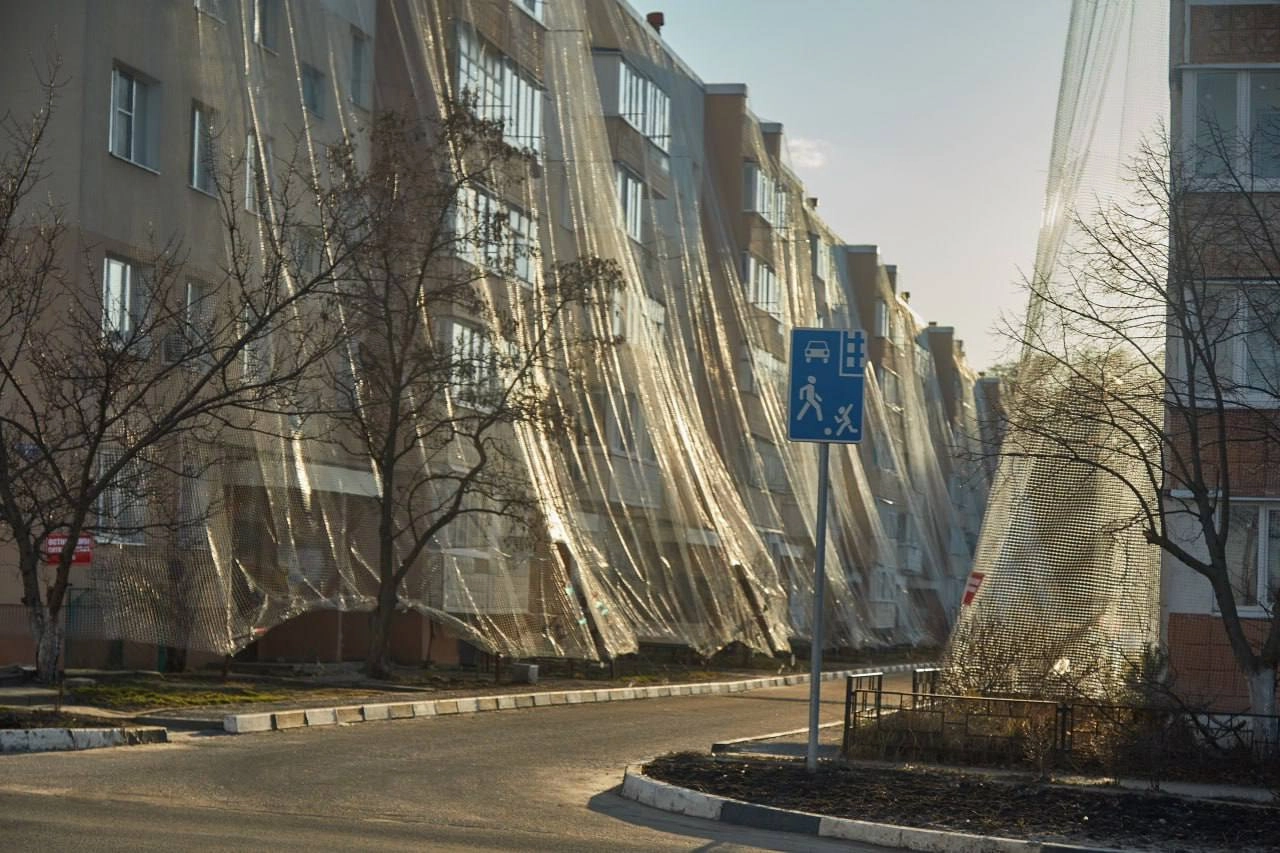
Entire apartment blocks are disappearing behind anti-drone nets in Belgorod Oblast, Russia. Officials claim they shield civilians from Ukrainian strikes – but is this a real defense or just a costly illusion?
More than 40 apartment buildings have already been equipped with all-metal material protective nets against drones in the town of Shebekino.
JOIN US ON TELEGRAM
Follow our coverage of the war on the @Kyivpost_official.
At the end of 2024, Belgorod governor, Vyacheslav Gladkov, announced on his Telegram channel that the installation of the nets in Shebekino would begin in the second half of January.
Russia’s newest defense
Initially, Gladkov announced that materials for this purpose had already been purchased for 50 buildings, and installation would begin after delivery in mid-January.
However, on Jan. 17, he reported that about 60 houses in Shebekino were planned to be protected with the special netting. The first 640 rolls of material had already been received.
“This is a large-scale project, but I can say that it’s an ‘experiment’—after all, we have never done this before. We see that the situation is tense, so we are trying to find new solutions to protect people and their property,” Gladkov added.
The facilities to be protected with the nets were selected following an analysis jointly conducted by regional and municipal authorities, with the participation of law enforcement agencies and the Russian Ministry of Defense, the governor said.
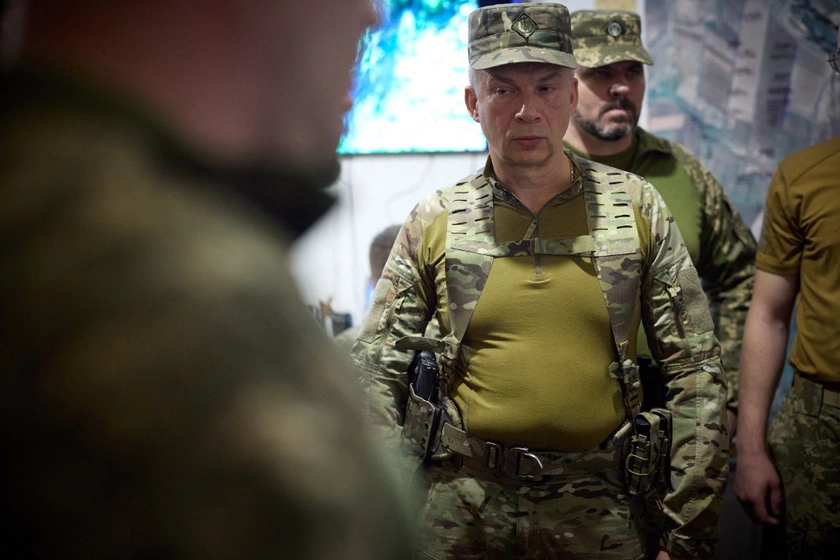
Ukraine’s General Syrsky: AFU Is Making Fair Progress vs Russia But No Victory Soon
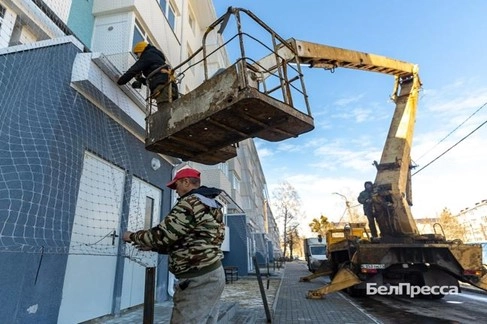
By the end of January, it was reported that 16 multi-story buildings and two social facilities had already been covered with anti-drone nets. Denis Kokol, the general director of the contracting organization, revealed that the goal was to completely cover the perimeter of 60 houses with nets by March 1.
“It takes about a week to cover one house under good operational conditions,” Kokol said.
However, as of early April, this task has not yet been completed.
Russian media reported that the nets had been tested at a testing ground and were capable of entangling drones, preventing them from colliding with buildings. However, in real conditions, the nets have yet to prove their effectiveness, as there have been no recorded drone strikes on protected buildings.
At the same time, Russian media claims that even if drones become entangled in the nets and explode, they do not cause significant damage to the buildings.
Reports also suggest that anti-drone nets have been successfully used on agricultural machinery. By order of Governor Gladkov, the nets began to be installed on tractors and combines in the border area in the spring of 2024.
On March 21, 2025, Russian outlet BelPressa reported that 41 buildings in Shebekino had been covered with anti-drone nets.
“It takes us five to six days per house. It depends on the length of the building, the number of floors, and the number of entrances,” said one of the workers, Andrey, as quoted by BelPressa.

Another worker, Alexander, added that residents were grateful for the nets. “A drone can fly in at any moment. There are no sirens, no missile threat warnings. But with the net, it gets tangled and won’t reach the apartment,” he said.
Local Tatyana, whose building has already been covered with a net, told BelPressa:
“We feel safer with this net. These buzzing copters even fly into the windows – it’s scary, of course. But with the net, we feel calmer. We don’t have to constantly look out the window!”
Ukrainian Telegram channels began reporting on the situation on Wednesday, April 3, posting photos of net-covered buildings in Shebekino. Reactions among Ukrainian users were mixed, with many mocking the decision:
- “That’s to protect from infected mosquitoes.”
- “Well, that will only protect them from pigeon s*it on the windows.”
- “Let them fill all their houses with concrete. Morons!”
- “F***ed up Russia and happy pigeons – no need to build a nest.”
Some commentators argue that the structures shown in the photos are unlikely to provide effective protection against drones. Additionally, some users suspect that Russian officials have devised this as a scheme to embezzle money.
- “The net is a last resort. It works in 2% of cases. And that’s if you install it properly – not like in the photos.”
- “Is this protection? This is just another way to steal money.”
- “It’s unclear whether these nets will work or if this is just another case of budget embezzlement.”
- “It’s a dead duck. But maybe it’ll help against our drones, which only shatter windows.”
- “How is this net supposed to protect anything? Even if the drone’s fragments fly off, it won’t do much. Not to mention if the drone flies straight into the building. Or is this net some kind of a magical barrier that stops everything?”
- “And how the f**k will nets protect anything?? They need to make at least several layers and fence the houses with structures.”
At the same time, many users believe that Ukraine will eventually adopt similar protective measures and question why Kyiv hasn’t implemented something similar already.
- “They’ll soon cover an entire town with a net while we’re still chewing our snot. We laughed at drones on a string (fiber-optic cables) too.”
- “We mocked the dragon’s teeth, then the ‘barbecue grilles’ on tanks, then the fiber-optic drones. Well, is it funny now? They evolve, and we are digging flower beds and changing traffic lights.”
Local authorities in Belgorod have repeatedly complained about first-person view (FPV) drone attacks, with these drones typically weighing around 3 kilograms (6.6 pounds).
However, Russian forces mainly target Ukrainian cities with far more powerful Shahed drones, which weigh 200 kilograms (441 pounds) and carry warheads of up to 50 kg (110 pounds).
Furthermore, the effectiveness of such nets is highly questionable when Ukrainian cities are regularly attacked by various types of missiles, including anti-ship missiles, while frontline settlements endure strikes from guided aerial bombs and artillery.
How Russia is experimenting with drone protection
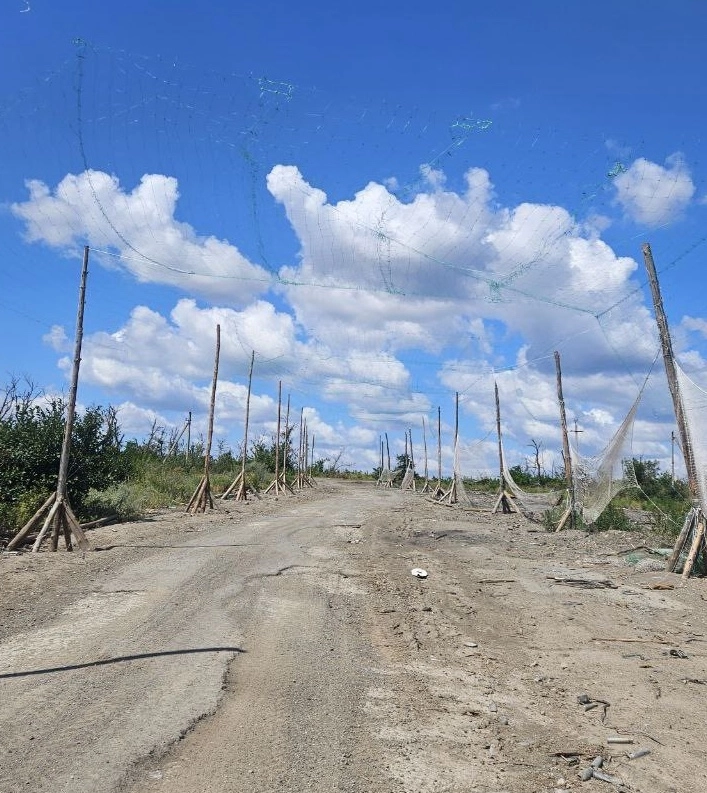
In early February, Ukrainian electronic technology specialist Serhii Beskrestnov, best known by his pseudonym “Flash,” released a video via Telegram showing how the Russian military had constructed a 2-kilometer-long (1.2-mile-long) “tunnel” of nets near Chasiv Yar in the Donetsk region to shield their equipment from drone attacks.
At the time, the commander of a separate engineering and sapper battalion from Russia’s 3rd Army Corps, part of the “South” military group, disclosed that the nets were installed along the most exposed sections of roads to protect the movement of Russian equipment.
“We are constantly working to expand the coverage area. We are also improving our installation techniques to set up the nets more quickly,” he said.
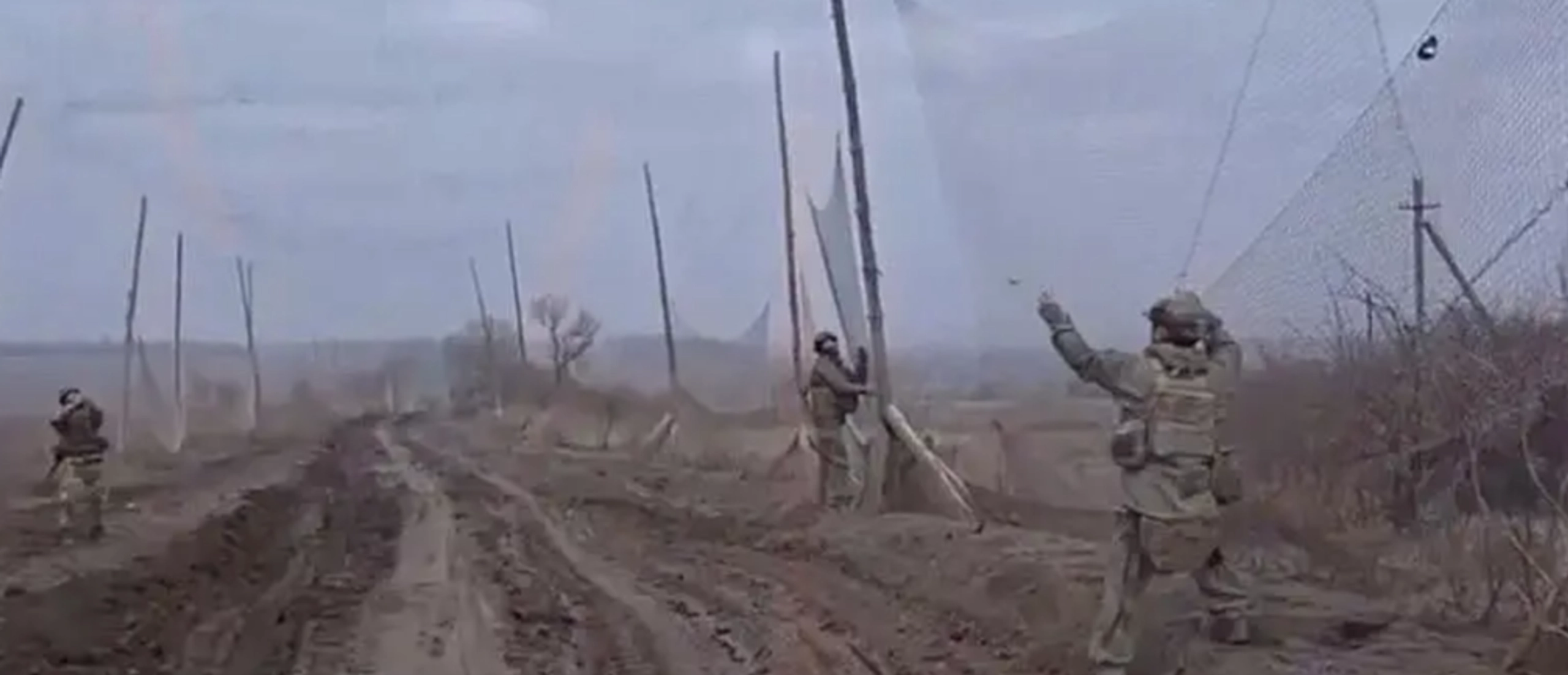
According to the plan, an attacking FPV drone – due to the low quality of its analog video feed – should fail to detect the net and become entangled in it. Even if the drone operator spots the net, they would still be unable to maneuver close enough to hit the target.
Additionally, the net is designed to counter all types of kamikaze drones, including those controlled via fiber optics.
At the same time, Ukrainian military experts said that while these structures are relatively inexpensive, their installation requires significant labor, including setting up poles and stretching the nets. Moreover, this process is carried out in areas vulnerable to drone attacks of the counterpart.
Such large-scale engineering structures also require ongoing maintenance and repairs.
Nevertheless, in relatively rear areas, these nets can significantly reduce the risk of equipment and supply routes being targeted by strike drones.
Russia’s experiments with net-based road protection began in 2023. The first publicly known structures of this type were observed in the summer of 2023 near Bakhmut in the Donetsk region.
Unlike the continuous tunnel seen near Chasiv Yar, these earlier versions consisted of separate nets stretched over the roads.
By the summer of 2024, Russian state media outlet TASS reported that Russian forces in the Kupiansk sector had started covering vehicle routes with fishing nets, setting them up along roads to create so-called “safe corridors.”
Ukraine’s military response: “We need more nets too”
In discussions with Kyiv Post, Ukrainian military personnel also highlighted the urgent need for fishing nets at the front to help protect both equipment and personnel from FPV and other types of drones.
A Ukrainian drone operator, speaking anonymously to Kyiv Post, confirmed that Ukrainian forces also are using nets along logistics routes and military sites.
He revealed that fabric nets stretched over trenches and dugout entrances slow the fall of explosive devices, sometimes preventing detonation. They can also entangle the propellers of FPV drones, stopping them mid-flight.
Mykhailo Ardashyn, a serviceman from Ukraine’s Separate Artillery Brigade of the National Guard, called industrial fishing nets a “salvation” for protecting both equipment and personnel.
He told Kyiv Post that Ukrainian artillery operates far from frontline positions, where the biggest threats are FPV drones with extended range and Russian Lancet drones, which are guided by Orlan or Zala UAVs.
“It’s quite difficult to intercept a Lancet,” Ardashyn said. “So you need some passive security measures.”
While electronic warfare can sometimes counter drones, it isn’t always reliable - especially against fiber-optic-controlled FPVs, which allow operators to maneuver drones indoors. Given these challenges, nets are now widely used to cover both permanent and temporary artillery positions.
“The entire dome of the net is made over the position, and a lot of nets are needed,” Ardashyn said.
He stressed that industrial fishing nets are ideal because they entangle drone propellers, preventing them from continuing their flight. Ordinary fishing line nets shine in the sunlight, making positions visible, while garden nets tear too easily.
Even if a Lancet detonates on a net, the blast is absorbed, reducing casualties and damage. Nets are also critical at “stopping and waiting places,” where crews rest while remaining within the combat zone.
“Their efficiency is high,” Ardashyn said. “That’s why these nets are needed now. There have been a lot of drones, and we are constantly looking for more nets.”
You can also highlight the text and press Ctrl + Enter