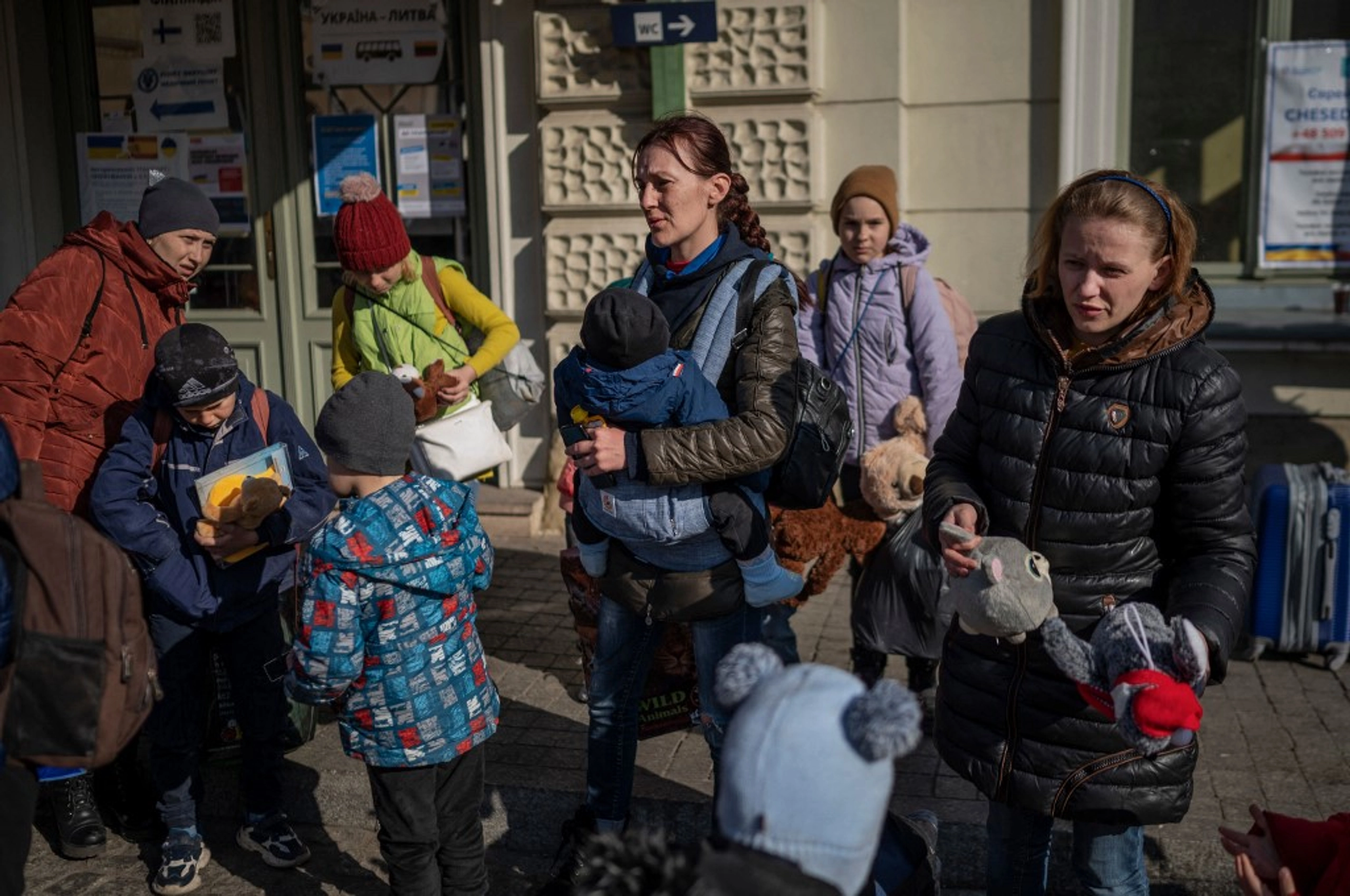
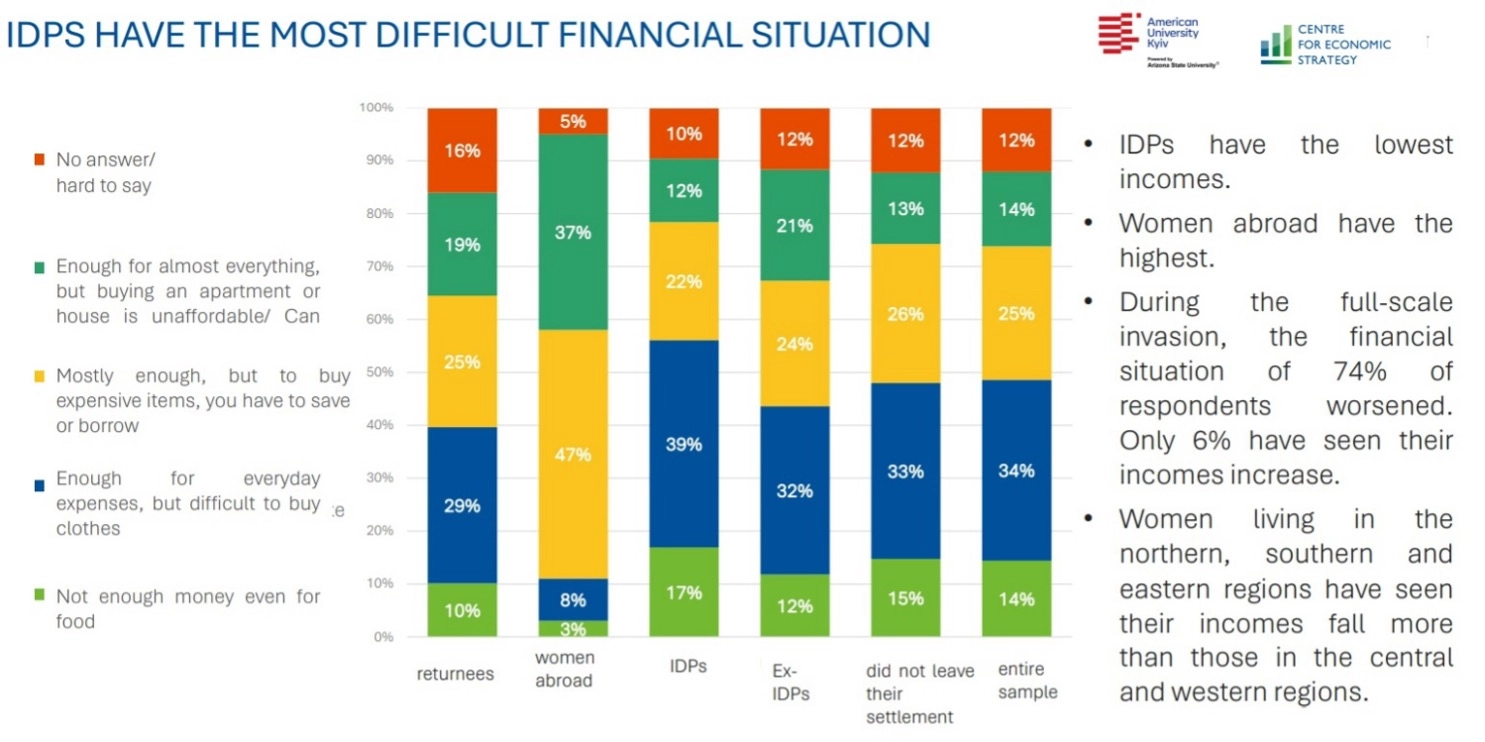
A total 39% of female Ukrainian refugees who relocated inside the country after Russia’s full-scale invasion of Ukraine only have finances sufficient to cover their needs for food and lack cash to purchase clothes, large purchases or luxury items.
Researchers from the Institute for Behavioral Studies at the American University of Kyiv (AUK) came to these conclusions in their report, “What motivates women to stay in Ukraine?,” after interviewing 2,018 females, aged 18-60.
JOIN US ON TELEGRAM
Follow our coverage of the war on the @Kyivpost_official.
The data was collected by Ukraine’s independent research organization – Sociological Group “Rating.”, while the report was co-organized by the Centre for Economic Strategy (CES).
The survey also asked the Ukrainian women why they refused to leave the country despite it being the third year of Russia’s large-scale invasion.
Researchers divided the respondents into categories represented by different social aspects:
- Those who remained in their home settlements during the invasion.
- Internally displaced persons (IDPs) – those women who relocated within Ukraine after Feb. 24, 2022, and have not returned.
- Returnees – Ukrainian women who left the country after Feb. 24, 2022, but returned, either home or to another settlement.
- Those women IDPs who left their home within Ukraine but have returned home.
- Ukrainian women refugees who fled abroad and are still there.
AUK researchers found that IDPs have the lowest incomes compared to other categories of respondents as many barely have money for clothes or major expenses for large purchases such as a new home.
“IDP’s is the most vulnerable group. 56% of people in this category cannot afford to buy clothes,” the AUK Institute for Behavioral Studies deputy director and researcher Natalka Zaika said while presenting the report in Kyiv.
Hungary Rejects EU Plan to Exclude Ukrainian Men of Military Age From Temporary Protection
The authors of the report also found that incomes of women in the northern, southern and eastern regions fell more than that of women living in the west or central part of the country.
Internally Displaced Persons in Ukraine Face Severe Poverty
Ukraine’s Ministry of Social Policy estimated there were 4.6 million internally displaced persons because of Russia’s war on Ukraine, as of January 2025. They had worked in devastated regions but could not find new jobs on territories where they evacuated. “There was a surplus of labor that could not find employment. Unemployment was estimated at around 20% in 2022,” National Bank of Ukraine Deputy Governor Sergiy Nikolaychuk told Kyiv Post in a previous interview.
Military requirements have fueled the need for funding industrial machinery manufacturing, drone production, textile industry, and food industry. “And it’s not always the case that you can refocus a metallurgist to a sewing machine,” Nikolaychuk added.
Poverty is a severe problem among internally displaced persons in Ukraine, especially from the eastern regions. The average salary of a Ukrainian worker who fled Donbas in 2022 does not meet the price of a monthly apartment rental in most of Ukraine, Petr Andrushchenko the advisor to Mariupol’s mayor previously told Kyiv Post.
Low incomes often force IDPs to return back to their homes in occupied areas. An estimated 130,000 Ukrainians have returned to their homes in the Russian-occupied Donbas territories in the last year due to the difficulties they faced living as internally displaced people since the full-scale invasion began in 2022, according to Andrushchenko.
He said he had obtained the data from Russian officials overseeing the Sheremetyevo checkpoint, showing that the root cause for their return was financial. A Sheremetyevo border control representative Oksana Myshchenko told Russian TV channels that a total of 107,000 Ukrainians have arrived at the airport since October 2023 of which only 83,000 were allowed to enter.
Lack of local infrastructure, accommodation, and jobs in host cities are also major problems for IDPs, Volodymyr Vakhitov, director of the Institute of Behavioral Studies at the American University in Kyiv, told Kyiv Post previously.
“The major issues they encounter include outdated residential norms, job market regulations and skills mismatch, and securing sufficient resources without additional assistance from the central government,” he said.
With the problem affecting millions, cities and regions need to be supported by national policies, created at the national level.
“When we’re talking about policies that motivate people to remain in Ukraine, policies aimed at economic growth and wage growth impacts everything: choosing to stay or leave Ukraine, the desire to have children,” Natalka Zaika said while presenting the AUK report.
Ukraine’s Ministry of Social Policy Addresses Poverty Among IDPs
Ukraine’s Ministry of Social Policy is aware of the problem and is working on several measures to tackle poverty among IDPs Daryna Marchak, Ukraine’s first deputy minister of social policy, said on a panel discussion at AUK’s report presentation.
First, a new housing policy to combat outdated norms, she said. “This process is led by Ukraine’s Ministry for Communities and Territorial Development, and I see they have a vision and also are doing something.”
Marchak sees the need to create social housing in Ukraine to help poorer IDPs rent accommodation for free or low price. The accommodation should be aimed at individuals but without granting the ownership.
Such a mechanism will be a change compared to soviet social policy where families could wait for decades to be granted a flat, but then being granted ownership.
Marchak says ministries developed an outline of the future policy where they also divided individuals into different societal groups, with the provision of specific instruments for different income levels.
IDPs with higher income can already seek a yeOselya mortgage, led by the Ukrainian Financial Housing Company “Ukrfinzhytlo”. Though the key rate in 2022 skyrocketed to 25% later decreasing to 13%, yeOselya mortgage loans are available with interest rates of between 3% and 7%.
IDPs who have very low earnings such as an elderly couple from Bakhmut, a city destroyed by Russian forces for example, could potentially qualify for social housing or rent subsidies, Marchak said.
“But there are people who will never afford to pay any rent, for example, individuals with severe disabilities who no longer have their carers close to them because their children went abroad,” she said.
For people with severe disabilities, Marchak proposed to create social housing supported by caring services.
For decades, Ukraine have not reformed social policies regarding IDPs and the most vulnerable. Marchak wants to fix it. “We are reconstructing policies that were unreformed for a long time. And our aim is to establish targeted social assistance, addressing the needs of every family to help them solve problems,” she said.
You can also highlight the text and press Ctrl + Enter