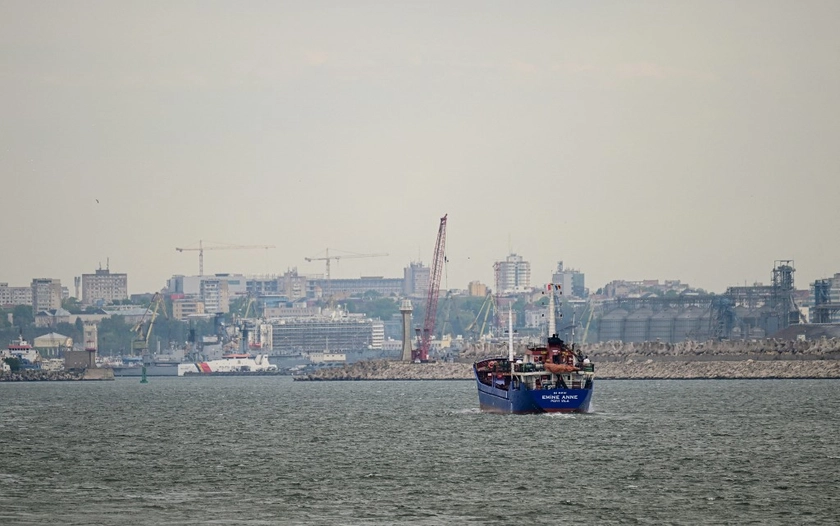
Authorities in Russia’s Black Sea region Novorossiysk on Tuesday said that a fierce fire and explosions at a seaside fuel storage site was caused by accident and not by Ukrainian long-range drones, official statements and news reports said.
A fire breaking out in a diesel fuel reservoir in an industrial region near the Novorossiysk suburb Kirillovka mid-evening on Monday engulfed a parking lot and set five automobiles ablaze, but no one was hurt, said Andrei Kravchenko, Novorossiysk mayor, in an early Tuesday morning statement to local media.
JOIN US ON TELEGRAM
Follow our coverage of the war on the @Kyivpost_official.
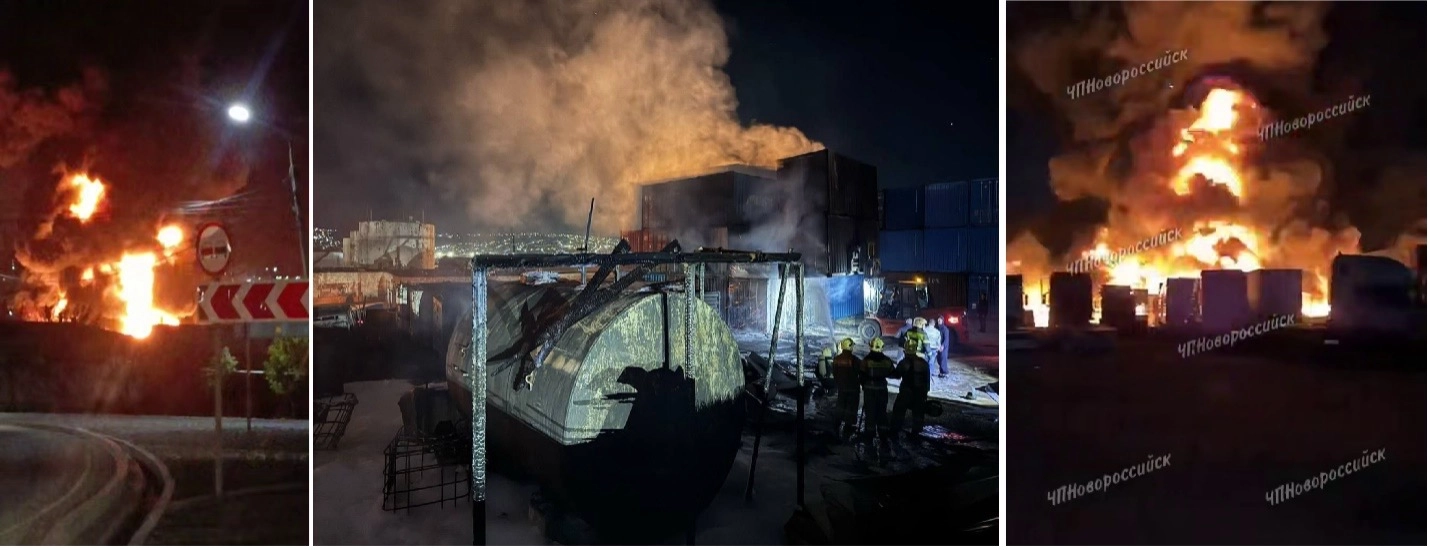
Novorossiysk social media showed images of flames billowing above the height of five-story buildings and some posters reported explosions.
Firefighters and emergency response crews from Russia’s Ministry of Emergency Situations (RMES) were on the scene within minutes of first reports of a fuel reservoir burning, and all fires were extinguished by midnight, an RMES statement said.
Local news agencies, citing eyewitnesses and images from the scene, reported that a diesel fuel storage facility operated by the Ufineft energy company had mostly been destroyed in the fire, and five automobiles on site were totaled. There were no reliable reports of Ukrainian drones.
Germany Warns of Russian Orbital Nuclear Threat
Ukraine’s national military intelligence directorate (HUR) is Kyiv’s main agency for long-range strikes inside Russia. Kyiv Post requested comment from HUR about the Kirillovka fire but had not received an immediate response by the time this article was published.
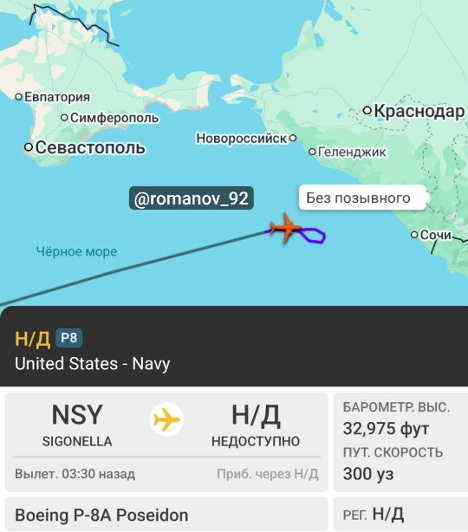
Some military information and air surveillance trackers had, since the weekend, been predicting a long-range Ukrainian strike operation against Russia’s Black Sea shore following a rare close reconnaissance patrol by a US Navy Poseidon maritime surveillance aircraft near Novorossiysk on April 25.
NATO air reconnaissance flights over the Black Sea take place daily, but patrols more than 50 kilometers (31 miles) east of Romanian or Bulgarian airspace are uncommon. That the US Navy Poseidon submarine and naval surface vessel surveillance platform flew the length of the Black Sea with radio transponders turned on was probably unprecedented for the Russo-Ukrainian War, Kyiv Post research of open-source flight data found.
According to data published on public flight tracking platforms, British and French military planes approached Ukraine’s Russian-occupied Crimea Peninsula periodically. On April 16, Atlantic Alliance aircraft flew a 13-aircraft observation operation with some intelligence, surveillance, and reconnaissance (ISR) platforms and fighter planes coming to within 130 kilometers (81 miles) of Russia-claimed airspace.
Ukrainian and Russian officials in mid-March told US interlocutors that they would respect a partial ceasefire and halt attacks against each other in the eastern half of the Black Sea, and against energy infrastructure everywhere. Ukraine’s President Volodymyr Zelensky on March 25 announced Kyiv’s promise to stop attacks against Russian energy infrastructure would stay in effect for 30 days.
Since then both sides have accused each other of violating the ceasefire on land and at sea, but, major raids taking place following the “ceasefire,” and visibly targeting only energy infrastructure, are not well-documented. The last confirmed heavy Ukrainian attack against Russian energy infrastructure, hitting an oil refinery producing about half of the retail fuel consumed in the Moscow region, and a key pumping station in the central Oryol region, took place on March 11.
The Russian milblogger Alekandr Zhivov, citing military sources, confirmed that Ukrainian drones were not responsible for the Kirillovka fuel storage site fire, but in the central region Ryzan locals reported five explosions near the city’s oil refinery early Tuesday morning.
Ukraine’s UNIAN news agency reported the blasts took place shortly after midnight, breaking windows and setting off automobile alarms, but did not confirm that drones attacked the refinery. A Tuesday mid-morning statement from the Ryazan regional administration said local air defense units had shot down 11 drones overnight. No ground damage was reported.
Ukraine’s long-range bombardment campaign against Russia’s oil and gas infrastructure, which kicked off in mid-2023, has seen dozens of massed drone strikes against refineries, fuel storage sites, and pumping stations across western and central Russia. Strikes intensified in mid-2024, and by early 2025, industry analysts were comparing shrinking Russian oil and gas production with intensified Ukrainian drone strikes.
According to a March 26 report by the independent Russia news group Meduza, from September 2024 to February 2025, Ukrainian long-range strikes had inflicted more than $700 million in damage to Russia’s oil and gas production capacity. A Reuters April 23 analysis predicted Russian oil and gas earnings would fall by 22% in April alone because of reduced capacity, weaker oil prices, and a stronger ruble. Between one-third to one-half of the Russian federal budget depends on energy export revenue, the report said.
You can also highlight the text and press Ctrl + Enter