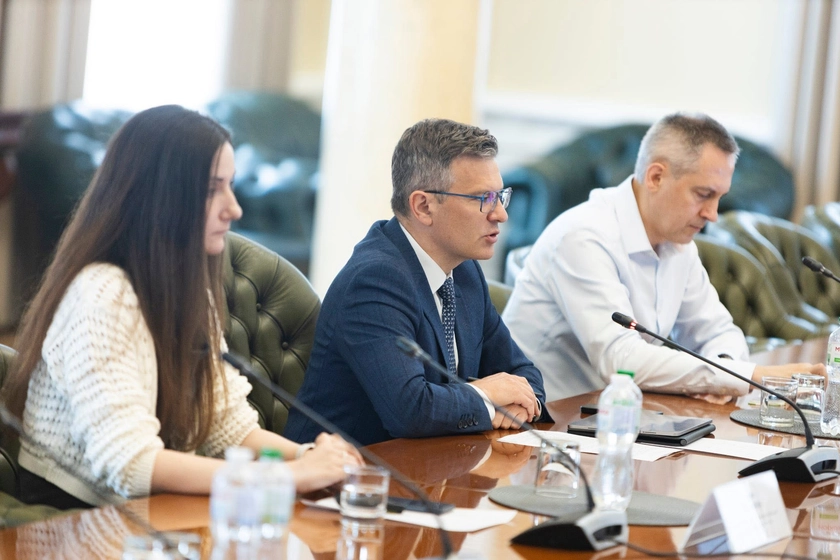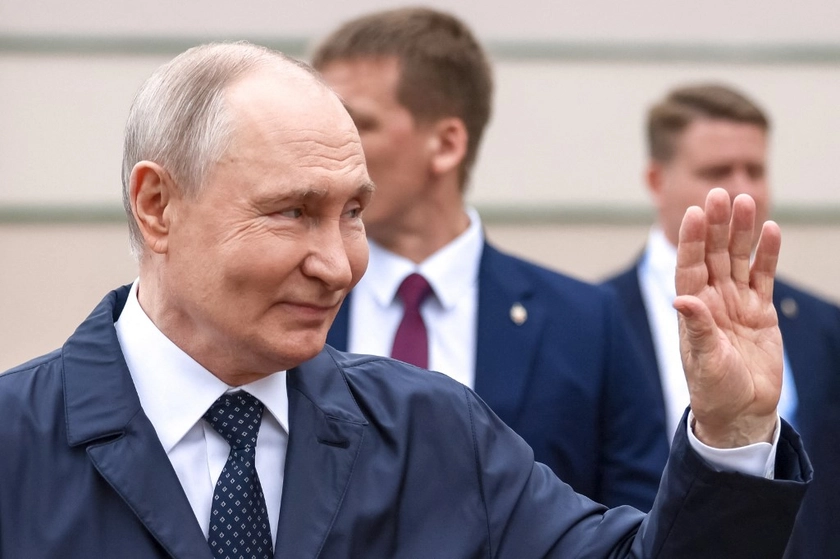
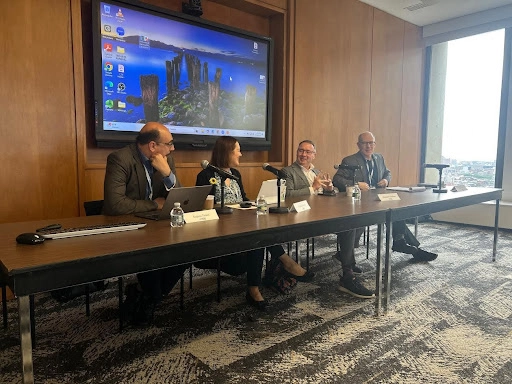
NEW YORK – Kyiv Post caught up with retired US Army Lt. Colonel Vindman and other Ukraine and Russia experts at the 25th annual Association for the Study of Nationalities Conference at Columbia University in New York City on May 22-23.
Below is a selection of their answers to timely questions about Ukraine’s position in dealing with the Trump Administration, Europe, and Russia.
JOIN US ON TELEGRAM
Follow our coverage of the war on the @Kyivpost_official.
The Trump Administration
Alexander Vindman is a retired United States Army lieutenant colonel and director of European Affairs for the US National Security Council. Vindman recently wrote his second book, “The Folly of Realism: How the West Deceives Itself about Russia and Betrays Ukraine.”
Vindman was born in Ukraine and served 21 years in the US military, receiving a Purple Heart medal for his service in the Iraq War. He came to national attention after testifying before Congress during Trump’s first impeachment trial about his “perfect call” with then recently elected Ukrainian President Volodymyr Zelensky.

KP: There is a lot of news coming out lately with the administration, and everybody’s trying to understand what the posture towards Ukraine will be. A lot of conflicting information. Do you have any ideas or thoughts about where things are going?
Ukraine's Banks Post Longest Credit Growth in 15 Years as Windfall Tax Threatens to Choke It Off
AV: So, I think fundamentally, we start with a premise where Trump is a partisan for Russia. He admires [Russian leader Vladimir] Putin and the kind of power that Putin wields. He wants to do business. He’s highly transactional, he thinks that there’s a deal to be had with Russia – not even the economic partnerships for the US specifically – that there’s, you know, a benefit to him personally, that is the nature of who you have in the Oval Office.
He also starts with a deep animus towards Ukraine, some scores to settle, vengeance over the first impeachment, and the fact that [this] created headaches for him. So, I think in general his line is pro-Russian, anti-Ukrainian.
But, he’s also fundamentally trying to serve his own personal instinct, or interest in getting PR wins.
So the longer that this dangle from the Russian side of the peace deal is put in front of him, the more it’s proven to him that it’s the Russians – Putin in particular – that’s the biggest impediment, the bigger chance that he rebalances because he doesn’t want to be embarrassed – he wants to be the winner, the bigger the chance that he might be able to change his mind.
I think the best case scenario was probably the status quo before the Trump administration – continued intelligence support, continued security assistance, what’s already been pledged in funds have been allocated, the Europeans spending resources on behalf of the Ukraine, the Ukrainians buying some resources, engaging in some sort of partnerships, [that] the Ukrainians are leading in this drone-warfare domain, and muddling through like the rest of the world.
And frankly, democracy has to muddle through with a hostile, illiberal Trump administration.
KP: Do you have any expectations on when Trump would reach this conclusion and lose patience with Russia?
AV: So I speculated that this is going to be a six-month process, and I wrote something in my Substack...So I think this is a long learning process, because Trump doesn’t really learn or learns the hard way.
Frankly, that’s the way he learns. And this is like a six-month arc to maybe get there, and we’re only four months in.
We’ve managed to avoid the worst-case scenario, which is a complete break. I thought that there was a risk that the Trump administration would completely cut off Ukraine.
We haven’t got there. I think it’s savvy diplomacy on behalf of the Ukrainian presidential administration, President Zelensky, and the Europeans. So maybe I think we avoid that worst-case scenario, and again, maybe the baseline case is muddling through a status quo type of thing.
KP: Outside of Trump, just in Washington, do you think that there are any other forces, maybe in the Senate or any intelligence community, that can maintain pressure on Trump, or is he going to be making decisions entirely on his own?
AV: So there was a much, much more balanced situation going against those same instincts in the first administration.
In that first administration, the national security folks looking to advance US National Security interests had the upper hand.
This is not that kind of administration in that there are more folks that are catering to [Trump’s] worst instincts, and in that regard, those same national security, kind of Reagan Republican folks, are still there, but they’re remaining silent. They’re operating behind the scenes. They’re trying to encourage a more balanced approach.
Maybe tempering, or even advocating for this outreach to Russia as a test on the proposition of a peace, and then ultimately doing what [Senator] Lindsay Graham is doing with Senator [Richard] Blumenthal – collecting and building their consensus for sanctions for this court.
So I think there are plenty of folks who understand the urgency of supporting Ukraine. Not for Ukraine’s sake, but for US national security’s sake, for your stability, the implications that it has for China, and its aggression towards Taiwan.
I think those things are there, but they’re suppressed and subdued with a reasonable chance of getting to a much healthier place, but everything is unpredictable.
On MAGA and US Public Opinion towards Ukraine
Serhiy Kudelia is an Associate Professor of Political Science at Baylor University and an expert on Ukrainian and Russian politics. He is the author of the recently released “Seize the City, Undo the State: The Inception of Russia’s War on Ukraine,” from Oxford University Press.
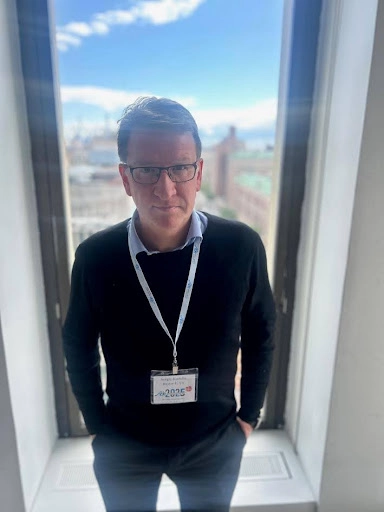
KP: From the American perspective, have you been at all surprised by the sudden drop in American public support for Ukraine from 2022 to 2024 when it became a campaign issue for Donald Trump?
SK: We knew from 2022 that there was a very vocal minority among members of Congress who opposed Ukraine assistance, right? And we remember, when Zelensky came to Washington, there were these people, like Marjorie Taylor Greene, Matt Gaetz, who were obstructing his speech.
I think the surprising part for me was the extent to which Trump managed to- and this MAGA minority in Congress ultimately managed to- subdue most of the reasonable Republicans who took more of a national-security-interest type of position – where they argued that Ukraine is in the national security interest of the United States and that the outcome of the war will very much influence America’s role, position, its commitment to Europe, all that is on the line in this war.
And their reversal – and Marco Rubio is one example, right – of a very conventional type of Republican who was very Hawkish in Russia, and who suddenly seems to be coming along with Trump’s position. That, I think, was the most surprising part to me.
I knew, because I followed MAGA a lot, and I have people around me living in Texas who have shared these views. I understand the logic of their approach, and I do believe, in many cases, that it’s not personally against Ukraine specifically. It’s about this idea that we are wasting too much time on these foreign countries.
So, it’s like a very narrow egoistic self-serving kind of position where we have to keep everything we have for ourselves, rather than give it away to some far, far-away countries that we don’t know what they are, what their purpose is, and how it’s spent, etc., etc.
And so the arguments about corruption in Ukraine, about autocracy, all of that serve to reinforce this view that this spending is absolutely unnecessary. And that also resonates with fiscal conservatives...so it sort of fits with a variety of different ideological paradigms.
I guess when JD Vance became the pick for vice president, that for me was a clear indicator of the direction that Trump wants to take on Ukraine.
So, JD Vance was probably the most outspoken senator who represented this MAGA line, which was very negative of Ukraine and Zelensky specifically. And from then onwards, I had little doubt that Ukraine would have great difficulty finding common understanding with the Trump administration.
But I still believe that there is- at least in the Senate, it seems like there is- a majority that wants to beat up on Russia. This is not a losing proposition, right?
So this is two separate issues. How much money and military assistance Ukraine gets, and whether or not the sanctions are applied [on Russia].
If sanctions do not require as much of a cost for the United States as, for example, sanctions for Europeans, right? Because the reason why sanctions have not been tough enough on Russia for Europeans was because of the internal cost for them, for their economists, etcetera.
America has no dependence on the economy of Russia, so imposing sanctions will be very easy [for them], and that’s where I think the real fight will be in the coming months.
It is not over the question of whether or not we will need to increase or maintain assistance to Ukraine – it seems to be much more difficult to get support on that issue – but on whether or not they want to agree with Trump’s position, that additional sanctions in Russia will be counterproductive to the negotiations.
That’s the position that the administration takes. Let’s not irritate the Russians. If we impose sanctions or criticize them, they will not talk to us. This is not an idea that is really embraced by the majority of members of Congress, from my understanding.
On Europe and Sanctions
KP: We are still talking about sanctions against Russia after three years of war. Why didn’t the Biden Administration and the Europeans impose greater sanctions on Russia in 2022
SK: I personally think that a lot of it had to do with the position of the Europeans. And it seemed like the Americans wanted to show solidarity, whether the West is unified and can walk at the same pace, right?
And so that’s why I think a lot of it had to do with the position of European countries that did not want to [break trade with Russia]. I saw the latest numbers were about $40 or $50 billion in funds that they paid Russia last year for energy. Some have calculated that this is more than they provided Ukraine in the amounts of assistance, right?
So that is where all the concerns are on the European side. So, I think that the American position was in some ways conditioned by the stance of the Europeans, rather than by their own calculations about the effects of sanctions.
KP: Do you think that you put any stock in the Europeans’ proposals to support Ukraine and arm Ukraine, or are they just posturing?
SK: Yeah, it’s a tough question. So, we’re dealing with the new government in Germany, [led by Chancellor Friedrich] Merz. And Merz has been very hawkish on Ukraine, in terms of his support. He was critical of his predecessor, Chancellor [Olaf] Scholz. And Zelensky was demanding the supply of Taurus, right, the missile. Now, it seems like he’s reconsidering now that he’s in power.
So it feels like a lot of what they’re doing is they’re trying to signal to the United States that they are not going to go along with this idea of ending any military assistance to [Ukraine.]
They’re also signaling to Ukrainians that they should not lose hope.
And so, I think a lot of it is about, right now, as you said, diplomatic posturing, trying to communicate to the Americans that Ukraine will remain in the fight, no matter whether America does, right? And so that means Trump may have weaker leverage than he thinks.
And trying to reassure the Ukrainians.
Whether or not they will ultimately be willing to step up in terms of military assistance and supplies, I think it’s 50/50 at this point.
And I think that, especially the Germans – I don’t know much about the French politics – but the debates that I’m following in Germany right now, demonstrate that public opinion is split and the rising support of AFD, right, the openly Russo-centric part that calls for ending assistance to Ukraine, is now is called on [at the] level of CDU or even higher demonstrates that society itself in Germany is split on this issue.
So that will make it more difficult for any new government to increase its military assistance.
So, I would say that I cannot have certainty in the ability of the Europeans to step up.
On Putin and Russia
Brian Taylor is a Professor of Political Science at Syracuse University and an expert in Russian politics. He is the author of “Russian Politics: A Very Short Introduction,” “The Code of Putinism,” and “State Building in Putin’s Russia.”
KP: As a Russia watcher, do you think that any of these moves from the Kremlin, like proposing on May 11 the Istanbul talks that he didn’t show up for, are significant? Do you think that Russia is actually at all concerned about any looming European - or less likely - American sanctions, or are they pretty well insulated from further sanctions?
BT: Well, I think Russia is concerned about it enough that Putin came out at 2 a.m. in the morning and made this proposal to – from the Russian point of view – “restart” the Istanbul negotiations. He wouldn’t have done that if he didn’t feel like the European initiative to say, “If they don’t agree to a ceasefire, we’re going to enact new, serious sanctions,” had something behind it.
Honestly, and you can quote me on this, it’s kind of ridiculous that the whole game has become, which leaders, and by which leaders, I mean, Putin, Zelensky, Starmer, Merz, Macron, whoever, can massage Trump’s ego in a way that will benefit their position. But that’s where we are.
And so, I think the fact that Putin is trying to make it look to Trump like he is interested in peace is definitely something he’s doing.
It’s definitely something he’s not genuinely interested in, but it is also something that I think he may persuade Trump of, because Trump is predisposed to think positively of Putin, for whatever reason.
KP: There’s been a lot of talk about looming structural problems for Russia, manpower, equipment, the economy, and oil prices. Do you have any reason to think that this year or next year, there are some flashing red warning signs for Russia?
BT: I don’t think Russia’s going to experience any kind of major structural problems in the next 12 to 18 months.
With respect to the three components of war – fighting men, materiel, and money – they seem to be able to replenish their losses in terms of manpower. They, obviously, have some materiel concerns, but nothing that’s going to kick in, I don’t think, from what I’ve seen, in the next year, and they don’t seem to have any major financial constraints that would force Putin to change course.
If he has to, he can always cut back on other parts of state spending, because the military is the priority, obviously. The only thing that I think might change that is if Donald Trump’s tariff policies drive the world into an economic recession, which drives down the world price of oil to a large extent, which obviously would have an impact on Russia’s ability to raise money and sustain its spending.
But I’m not convinced that any sanctions on shadow tankers, or the Russian oil market, or anything like that are going to bite enough to force Putin to change course.
I think he’s 100% committed to his vision of victory, and certainly nothing since January in the Trump administration’s coming to power has led him to think that he should change his objectives.
You can also highlight the text and press Ctrl + Enter