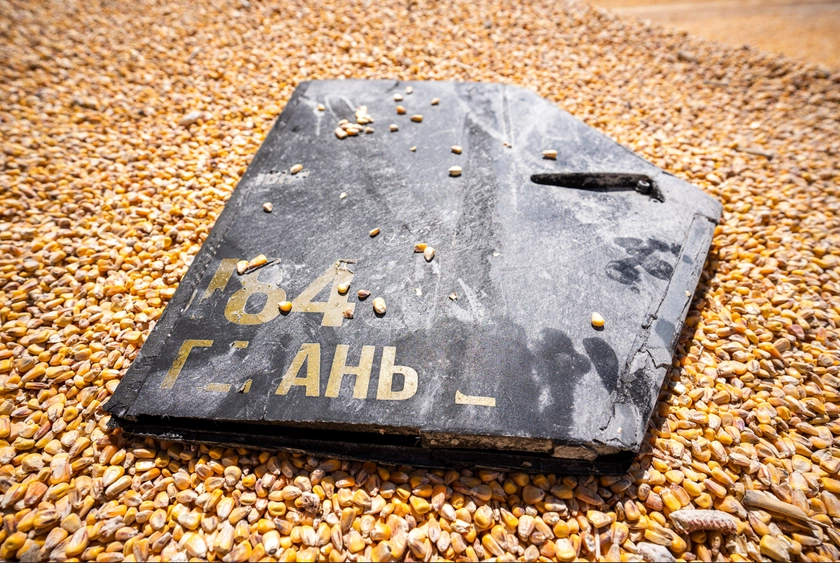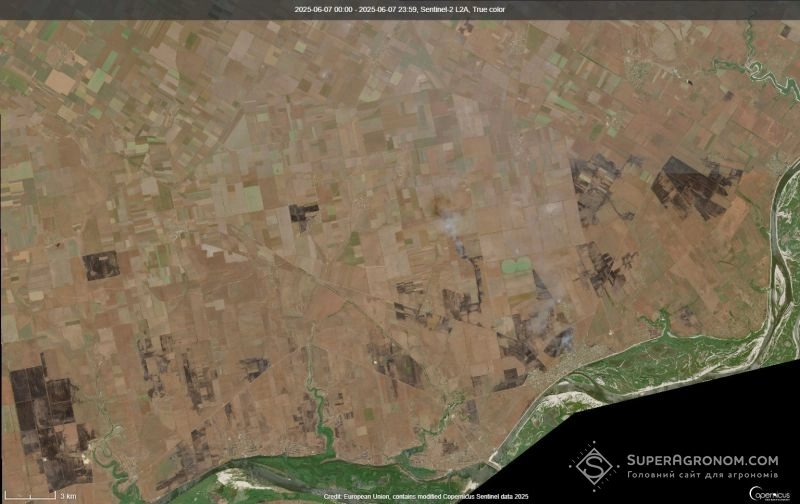
Around 5,000 hectares of fields in the Kherson Region were burned after Russiaʼs drone attacks for the three days in a row, Vitalii Pichura, head of the Department of Ecology and Sustainable Development at Kherson State Agrarian and Economic University, told SuperAgronom on June 9.
Along with frost, drought, the draining of the Kakhovka Reservoir after Russiaʼs attack on the dam in 2023, and the lack of irrigation, it further damages Ukrainian crops.
JOIN US ON TELEGRAM
Follow our coverage of the war on the @Kyivpost_official.
“To date, around 15,000 hectares of crops have burned. Damaged fields on the right bank [of Kherson region] are clearly visible on satellite images. I honestly don’t know how Kherson farmers will survive this season or the ones to come,” Pichura said.
For the past three days, Russia has been launching swarms of drones, torching crops – most severely impacting a 20-kilometer stretch of the right-bank area of the Kherson region. It was occupied by Russia from March to November 2022. The region is still suffering from missile attacks.
Russiaʼs attacks on Ukrainian fields are happening simultaneously with the 2025 frost, as well as drought, lack of irrigation and the draining of the Kakhovka Reservoir. The reservoir went dry after Russians blew up the hydroelectric power station, the Kakhovka Dam, on June 6, 2023. It was mined by them from the first day of the full-scale invasion of Ukraine.
It triggered one of the most severe environmental disasters in Ukraine’s history. The loss of the reservoir reshaped the region’s landscape, jeopardizing ecosystems, water supply, and the livelihoods of local communities, American centre EOS Data Analytics reported in November 2024.

Stalwart Denmark Announces 30th Military Aid Package for Ukraine
“Soil moisture is critically low, with cracks 3–5 cm deep visible across fields with leftover winter crops, which stalled the development of late spring crops,” Pichura said.
“During the entire May, only 20–25 mm of rainfall was recorded; in areas near the drained Kakhovka Reservoir, it was just 4–6 mm. [Ukraine’s agrofood business’] Yields will be minimal, and now the crops are being burned by drones – fires and smoke are widespread,” he said.
After frosts in late April and drought in Ukraine, winter wheat yield losses in some areas can reach 20-50%. In the south, especially in the Kherson region, satellite images and farmer feedback indicate significant stress or damage to crops, Latifundist reported.
According to Pichura, the situation is becoming more complicated: “Farmers are trying to save their fields from fire, isolating burning areas by disking the soil. But the heat, the vast dry areas, and continued drone attacks are making the task nearly impossible. Losses are growing.”
You can also highlight the text and press Ctrl + Enter