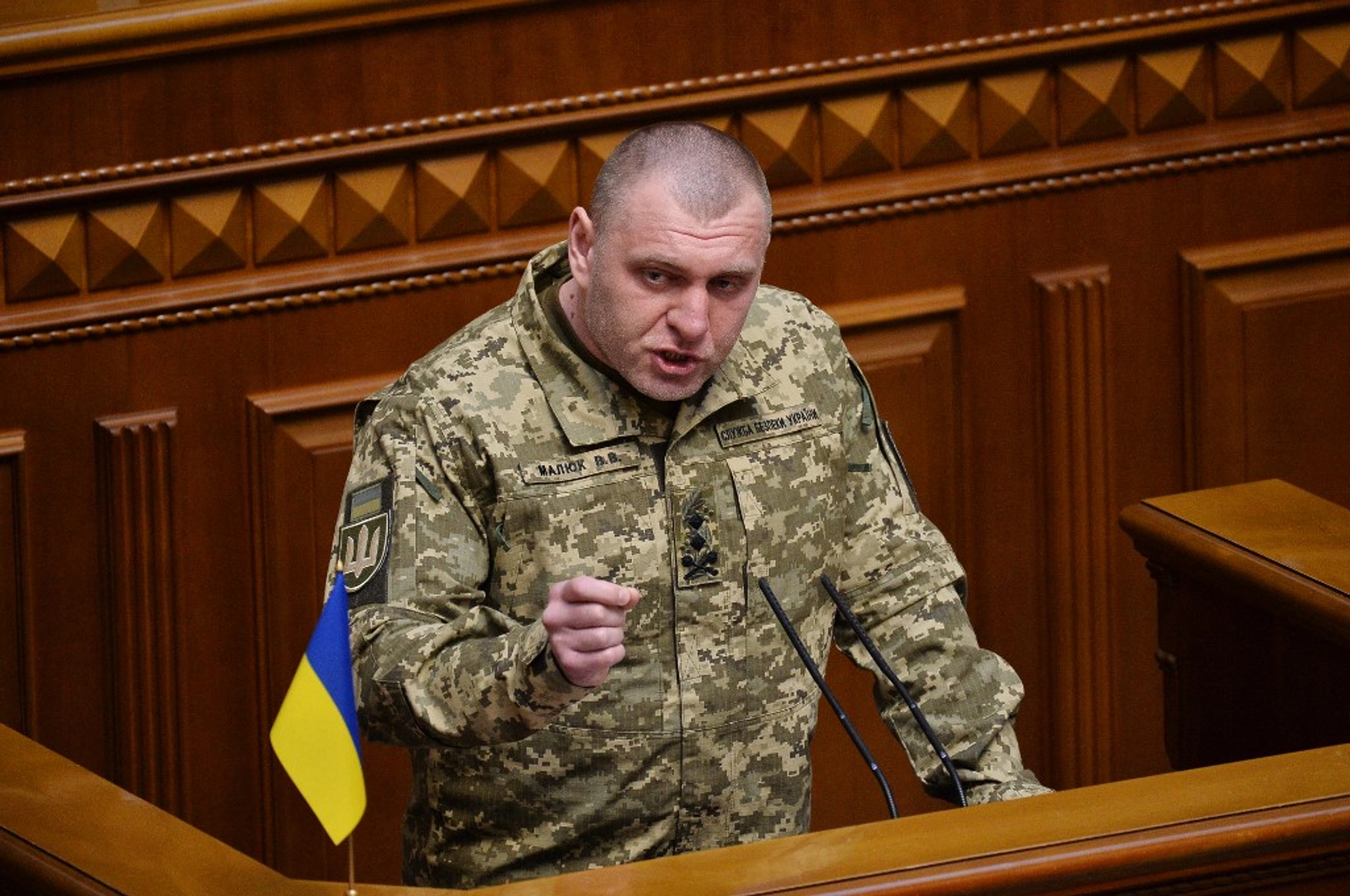
At a closed-door briefing with Kyiv Post and other journalists on Monday, the Head of Ukraine’s Security Service (SBU), Lt. Gen. Vasyl Malyuk, disclosed new details about two large-scale special operations: Spider Web and the third successful attack on the Crimean Bridge, which he called a major breakthrough.
Operation Spiderweb
Malyuk described the operation as a complex, multi-component project involving 117 combat drones equipped with unique warheads.
JOIN US ON TELEGRAM
Follow our coverage of the war on the @Kyivpost_official.
“We deployed 117 drones, and the results were seen by the entire world. The warhead inside each drone consisted of two components — 800 grams and 800 grams — making a total of 1.6 kilograms of a special shaped-charge high-explosive. We targeted fuel tanks, the side of the aircraft where the missile was located, and avionics — the kind of equipment the enemy has no replacement for,” Malyuk said.
The operation required meticulous logistics, including the covert delivery of autonomous launch “cabins” equipped with solar panels and EcoFlow batteries into enemy territory. This even involved corrupting Russian customs officials to move sanctioned equipment across the border. The entire operation took over a year and a half to prepare.
“The time we spent preparing ‘Spider Web’: one year, six months, and nine days. We began in November 2023,” he said.
Malyuk said that only a very limited number of individuals were aware of the true scope of the mission – among them, President Volodymyr Zelensky and one trusted SBU officer. Most participants were kept in the dark about the full plan:

Trump Downplays Russian Drone Incursion into Poland as ‘Mistake,’ Drawing Sharp Rebuke From Allies
“The people who built the drones didn’t know they were for ‘Spider Web.’ The ones who built the cabins didn’t know they were for aircraft. Those transporting the equipment weren’t aware of the details either… Everyone was responsible for their critical part of the mission,” Malyuk said.
He personally assembled the best drone operators from SBU’s Alpha unit:
“They arrived at the command center at 5 a.m., surrendered their phones, and got to work. Each operator was assigned a specific aircraft and given a terrain mock-up showing elevations, cabin locations, and the drone’s route to the target.”
He added:
“This is a marker that Ukraine fights with our intelligence. We are capable of unconventional solutions.”
On Sunday, June 1, a long-range drone operation reportedly hit at least five airfields in Russia’s Murmansk, Irkutsk, Ryazan, and Amur regions – striking strategic bombers and surveillance aircraft. While estimates vary, Ukraine claims up to 40 aircraft were damaged or destroyed, dealing a serious blow to Russia’s aerospace forces.
Strike on the Crimean Bridge
Malyuk also confirmed Ukraine’s third successful strike on the Crimean Bridge, calling it the beginning of a “new era.”
“To be frank, the third time we hit the bridge, we used 1,100 kilograms of explosives — and another 1,100 kilograms. Two strikes against key supports… This is the beginning of a new era,” he stated.
Previously, Ukraine struck the bridge in 2022 using a truck loaded with 21 tons of explosives. In 2023, the second strike was carried out using the SBU’s maritime drones known as “Sea Baby.” The most recent attack in June 2025 involved a submerged explosive charge — officially marking the start of what Malyuk described as a new “maritime era” in Ukraine’s special operations history.
You can also highlight the text and press Ctrl + Enter