ROME – Just days after Donald Trump pivoted from praising Vladimir Putin to insulting him, another kind of message was sent from Rome: one of unity, resolve, and reconstruction. At the fourth international conference on Ukraine’s recovery – this time convened by Italian Prime Minister Giorgia Meloni – the European response to Russia’s war was not only reaffirmed but strategically repurposed.
The setting was deliberately ambitious: 15 heads of state and government, some 4,000 participants, and representatives from roughly 2,000 companies. If previous conferences were about solidarity, this one focused squarely on execution – on building not only what Russia has destroyed, but also a vision of Europe’s future economic and geopolitical order.
Meloni, who had previously hosted a similar summit in April 2023, cast the reconstruction effort as both a moral and strategic imperative. She was unequivocal in her message: Russia’s effort to break Ukraine with “weapons of darkness, hunger, and fear” had failed – not just because of Ukrainian resilience, but also due to the sustained backing of its allies. That support, she insisted, must now be matched by leadership in rebuilding. The implication was pointed. “We know which countries helped Ukraine,” she said – and, by extension, which ones did not. Her statement: those who funded or enabled Russia’s war machine have forfeited any moral claim to profit from peace.
Despite strikes on Ukraine, Russian advances slow, analysts say
However, Prime Minister Meloni spoke to something deeper: Italy’s cultural contribution to Ukraine’s future. She highlighted her government’s commitment to restoring the war-damaged cultural heritage of Odesa – a city with deep historic ties to Italy. Italy’s efforts, she said, reflect more than just financial support – they reflect a shared history, and a refusal to let the war erase it.
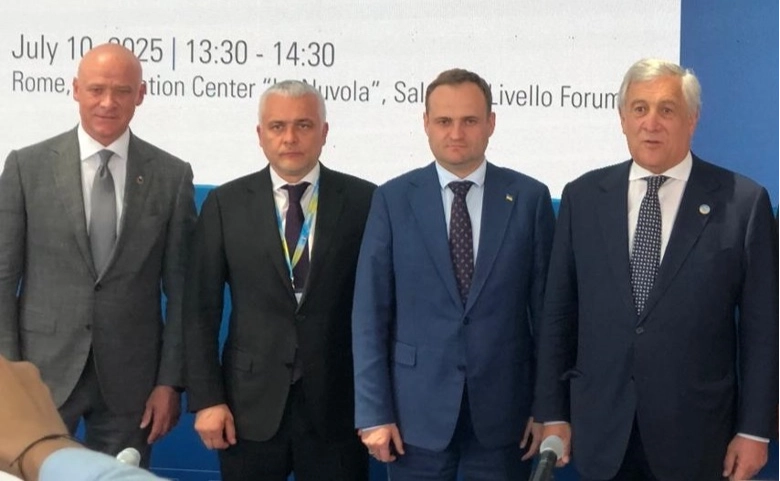
Later in the day, Italian Foreign Minister Antonio Tajani reportedly signed an agreement to support the development of agriculture in the Odesa region with Minister for Development of Communities and Territories of Ukraine Oleksiy Kuleba and the Governor of the Black Sea Region Oleh Kiper.
President Volodymyr Zelensky, visiting Rome after a private audience with Pope Francis and a meeting with Italian President Sergio Mattarella, took that message further. Ukraine’s reconstruction, he said, is not merely a domestic concern – it is “a shared endeavor” that spans industries, governments, and civil societies. The rebuilding of roads, cities, and industries is not just about restoring what was lost, but about mutual growth. Companies that invest in Ukraine today, he added, will not just be contributing to peace – they will be opening new economic frontiers. Echoing Meloni, Zelensky issued a thinly veiled warning: Ukraine will remember its true partners.
Germany’s Chancellor Merz offered his own sharp intervention. In what seemed a carefully choreographed nod to both Donald Trump and Vladimir Putin, he reminded participants that Europe remains united – and will stay that way. His declaration – “We will not give up” – was less a reassurance than a rebuke to those hoping for Europe’s fatigue.
Poland’s President Donald Tusk put it more bluntly. “There will be no reconstruction of Ukraine without victory,” he told the hall. That sentiment –part threat, part promise – set the tone for the day’s many announcements.
Among the most significant was the creation of a European Reconstruction Fund for Ukraine, announced by Meloni and underscored with a formal signing ceremony attended by Italy’s Foreign Minister Antonio Tajani, EU Commissioner for Enlargement Marta Kos, and Ukraine’s Minister for Communities and Territorial Development Oleksiy Chernyshov. SIMEST, an agency that supports Italian businesses abroad, will launch a €300 million export credit line. A memorandum of understanding was also signed between Ukraine’s Ministry of Economy and Italian financial institutions CDP, SACE, and SIMEST, aiming to coordinate efforts in identifying recovery needs and target sectors.
European Commission President Ursula von der Leyen, who also addressed the conference, praised Ukrainians for their ability to rebuild infrastructure even while under fire. She announced a fresh €2.3 billion package in agreements for reconstruction – both a financial gesture and a signal of enduring political commitment.
But Italy was not alone in stepping up. Belgium’s Deputy Prime Minister Hadja Lahbib signed six new partnership agreements with Ukraine, including five memoranda of understanding. Belgium’s reconstruction efforts are already tangible: around 400 public buildings have been rebuilt, schools and hospitals supplied with boilers and heating systems, and generators installed in critical facilities. Belgium also pledged €1 billion per year in aid from 2025 to 2029 – adding to the €2.2 billion already committed between 2022 and 2024.
Outside the conference hall, business deals quietly took shape. A dedicated pavilion for Ukrainian, Italian, and international companies allowed for hundreds of B2B meetings, where potential partners negotiated preliminary agreements for infrastructure, energy, and agricultural recovery.
The conference in Rome was as much about memory as it was about money. In the struggle to rebuild Ukraine, Europe is also redrawing its moral map – one that differentiates not only between aggressors and victims, but between allies and opportunists. That, perhaps, was the clearest message from the Eternal City.
The views expressed in this opinion article are the author’s and not necessarily those of Kyiv Post.
You can also highlight the text and press Ctrl + Enter