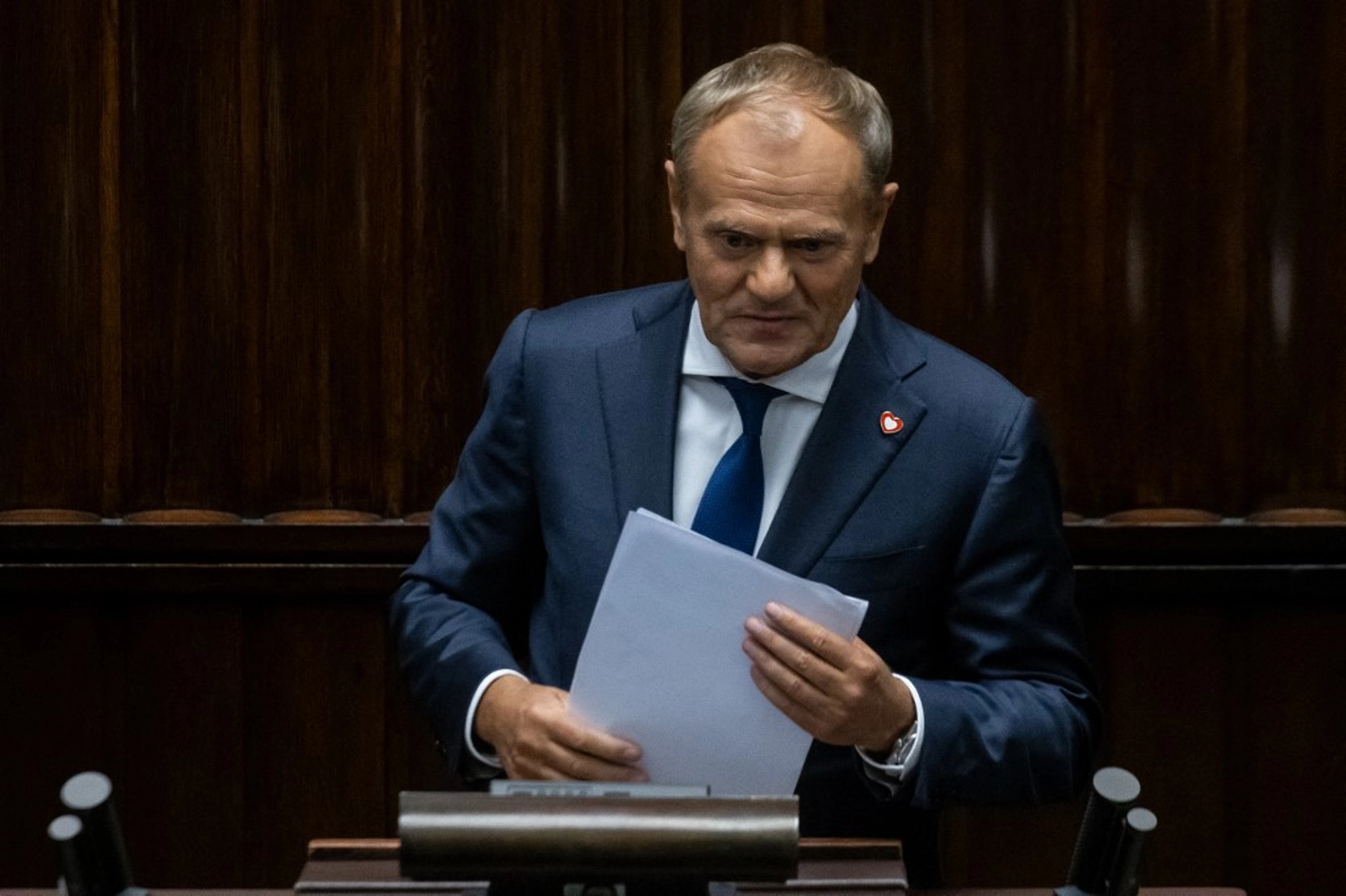
Poland’s prime minister, Donald Tusk, on Wednesday announced a long-delayed government reshuffle, unveiling a leaner, restructured cabinet designed to restore authority and stability after weeks of turmoil inside the ruling coalition.
At a press conference in Warsaw just after 10am local time, Tusk set out a plan to slim down the number of ministerial portfolios, create two “mega-ministries” — the Ministry of Energy and the Ministry of Finance and Economy — and send a message that his government is still capable of governing effectively despite internal discord and falling approval ratings.
JOIN US ON TELEGRAM
Follow our coverage of the war on the @Kyivpost_official.
“I said that one of the goals would be to slim down the government. We have slimmed down the government from 26 to 21 constitutional ministers,” said Tusk.
He announced that Poland’s foreign minister, Radosław Sikorski, will be promoted to deputy prime minister while retaining his foreign affairs portfolio.
A surprising change came at the Ministry of Justice. Adam Bodnar, one of the most recognizable faces of the government’s efforts to unwind the legal reforms imposed by the former Law and Justice (PiS) government, has been replaced by the judge Waldemar Żurek.
A vocal critic of PiS-era judicial reforms, Żurek’s appointment marks a new phase in the government’s approach to judicial reconstruction. Critics inside the coalition argued that progress on key reforms had stalled.
Czech Party Seeks to Strip Zelensky of Country's Highest Honor
“Mega-ministries”
Tusk also outlined several key changes aimed at boosting the effectiveness of the coalition.
The most important among them includes the creation of two “mega-ministries”. The new Ministry of Energy merges elements of the environment, industry, and climate ministries into a single, centralized body and will be headed by Miłosz Motyka of the Polish People’s Party (PSL).
The new Ministry of Finance and Economy consolidates responsibilities previously spread across the finance, development, and technology portfolios. It will be led by erstwhile finance minister Andrzej Domański from Civic Coalition.
Who else made it to the new government?
Marcin Kierwiński of Civic Coalition, previously minister for post-flood reconstruction, returns to the interior minister, replacing Tomasz Siemoniak, who shifts to the role of coordinator of special services, overseeing Poland’s intelligence and security apparatus.
Tusk announced that the new Minister of State Assets will work on “depoliticising” state companies. The ministry will be headed by Waldemar Balczun.
In agriculture, Stefan Krajewski of the Polish People’s Party (PSL) replaces veteran party figure Czesław Siekierski, under pressure from within PSL for more active leadership. The move was internally driven and marks a generational shift in the party.
At the Ministry of Sport and Tourism, Sławomir Nitras of the Civic Coalition (KO) steps down after his high-profile role in Rafał Trzaskowski’s failed presidential campaign. He is succeeded by KO MP Jakub Rutnicki.
In health, Jolanta Sobierańska-Grenda, a non-partisan hospital executive, takes over from KO’s Izabela Leszczyna. Her appointment is seen as part of a broader effort to refresh the government’s image.
Marta Cienkowska of Polska 2050 has been appointed minister of culture and national heritage, replacing Hanna Wróblewska. Previously a deputy minister, Cienkowska was praised by Tusk for her “boundless energy” and forward-looking approach.
You can also highlight the text and press Ctrl + Enter