“I don’t know what death looks like, but I’ll never forget how it sounds. The sound of a missile hitting your home is lodged inside me, crushing something in my chest, not letting me breathe freely, whispering from deep within that we too could have gone in an instant.
“It’s unbearable to stand near the impact site. A wave of grief and pain crashes over you, alongside the sharp undeniable feeling that death is still here.”
JOIN US ON TELEGRAM
Follow our coverage of the war on the @Kyivpost_official.
Social media post by Olga Bidenko, Aug. 1, 2025
Returning to Kyiv’s Svyatoshyn apartment block 48 hours after witnessing the aftermath of the horrendous Russian ballistic missile attack in which 31 residents died and almost 160 were wounded things look very different: the police lines are down, and victim identification has ceased, the National Guard has departed, the parts of the building still standing have been declared stable – or stable enough.
The area is alive with much movement: an excavator is removing rubbish and rubble, survivors of the damaged section are searching for their valuables and whatever can be safely recovered, while residents of the adjacent section are moving furniture and reevaluating their future plans.
Neighbors in some adjacent sections of the same block, however, will stay on despite the gas supply having been immediately switched off because water was kept flowing and the electricity has been switched back on. The immediate need is how to cook without gas. Olga, who lives about 30 meters away from where the missile hit, is working on a solution.
Ukraine Aims to Fill Up to Half of Assault Infantry Positions With Foreign Recruits
Electric Cooking Stoves
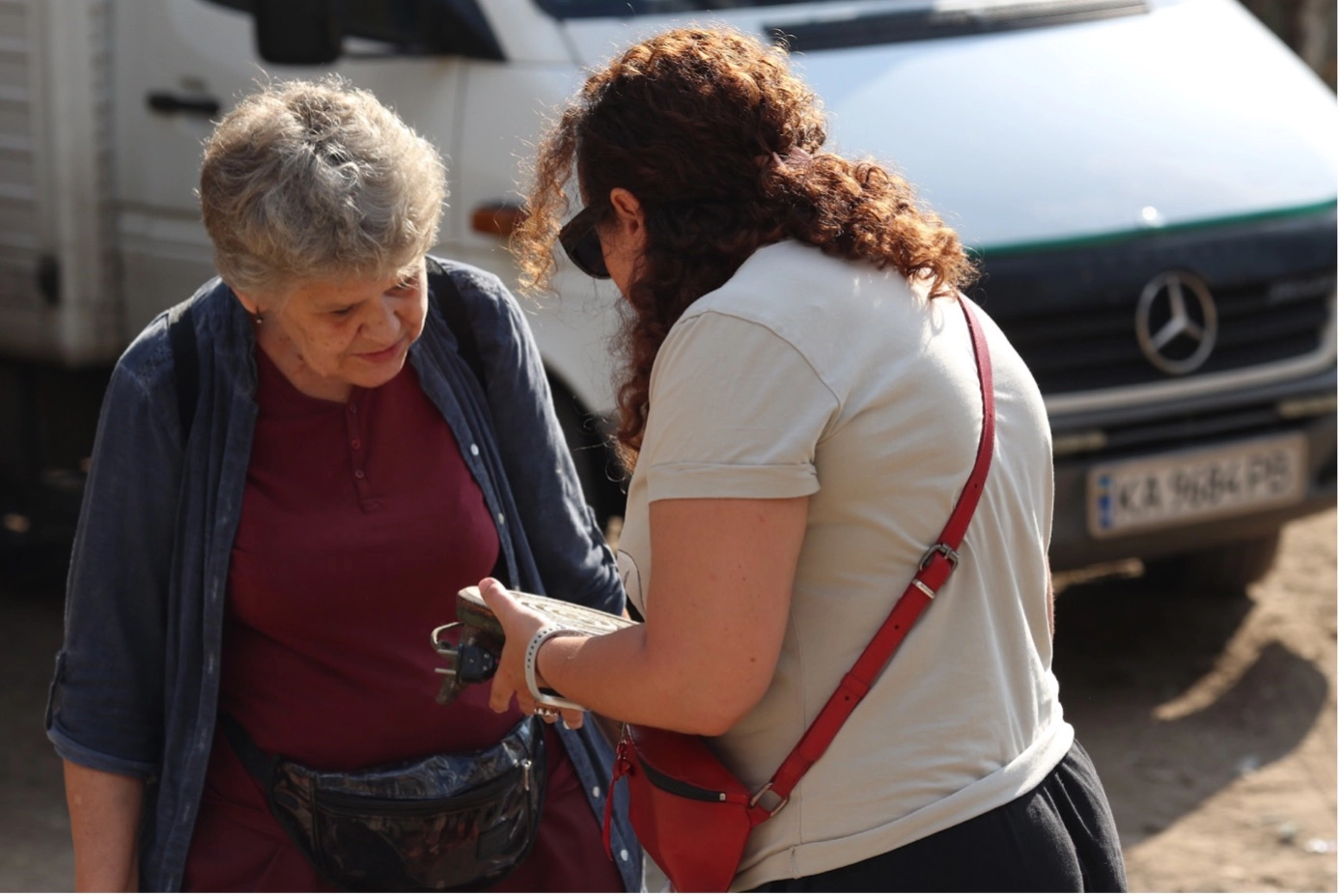
Olga has been running around all day on Saturday Aug. 2. Together with her husband Maks, another neighbor Zhenya and some others, they set up a Facebook group to receive donations from Kyiv residents wanting to help – a key request being a call for electric cooking stoves to allow food to be prepared in the absence of gas.
The response has been very positive – strangers have been bringing both second-hand and brand-new kitchen appliances. Others bring cooked food for those unable or too exhausted to cook, or those simply unable to afford a restaurant.
Maks comments that previous apartment blocks hit by Shahed drones have often had to wait over a month for gas to get reconnected, so a more immediate fix was very much needed.
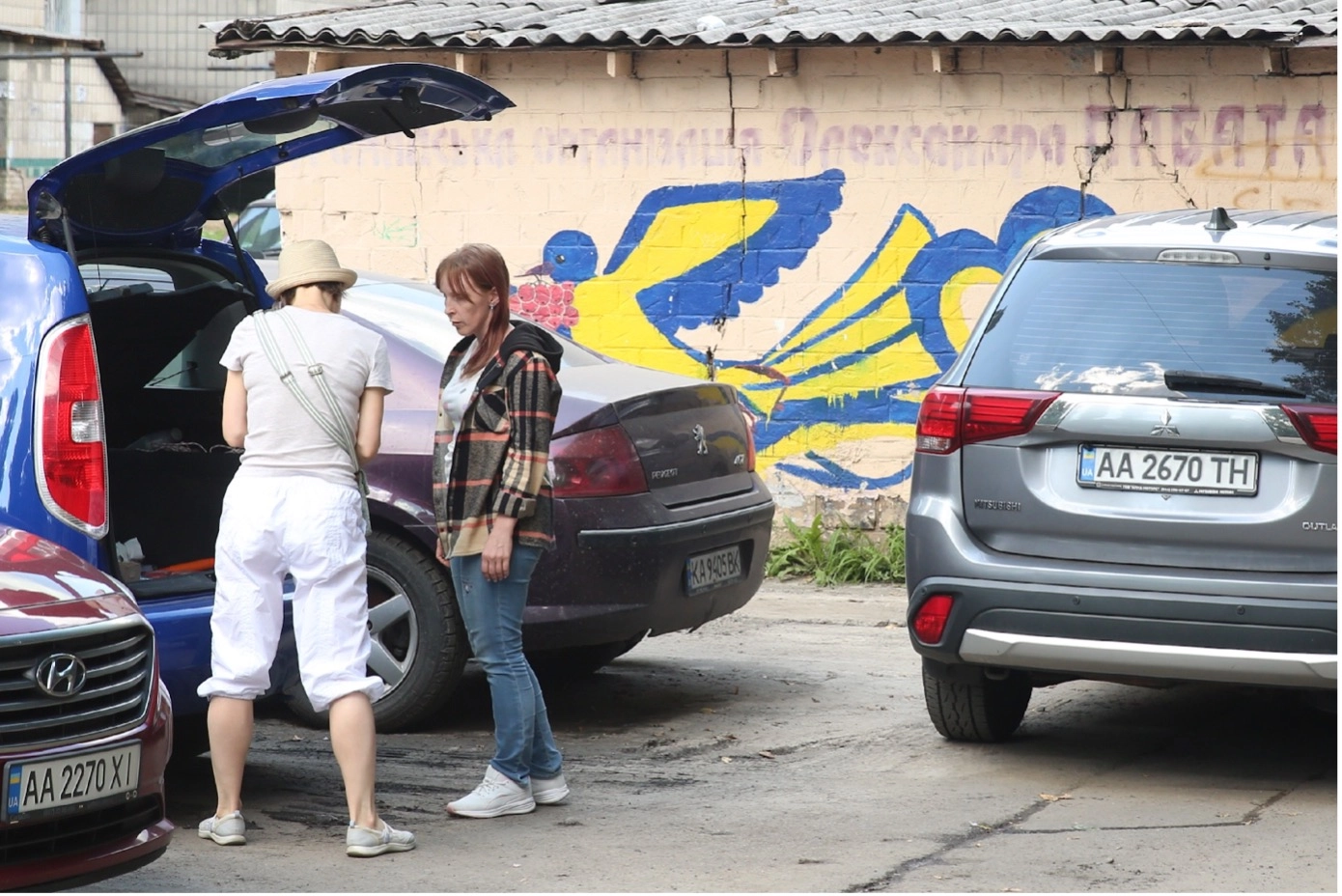
Olga explains that many elderly residents are lonely and disconnected from social media; simply not knowing how to re-equip a kitchen they had used for decades. The elderly often ask when receiving a gift. “Do I have to pay? Are you sure
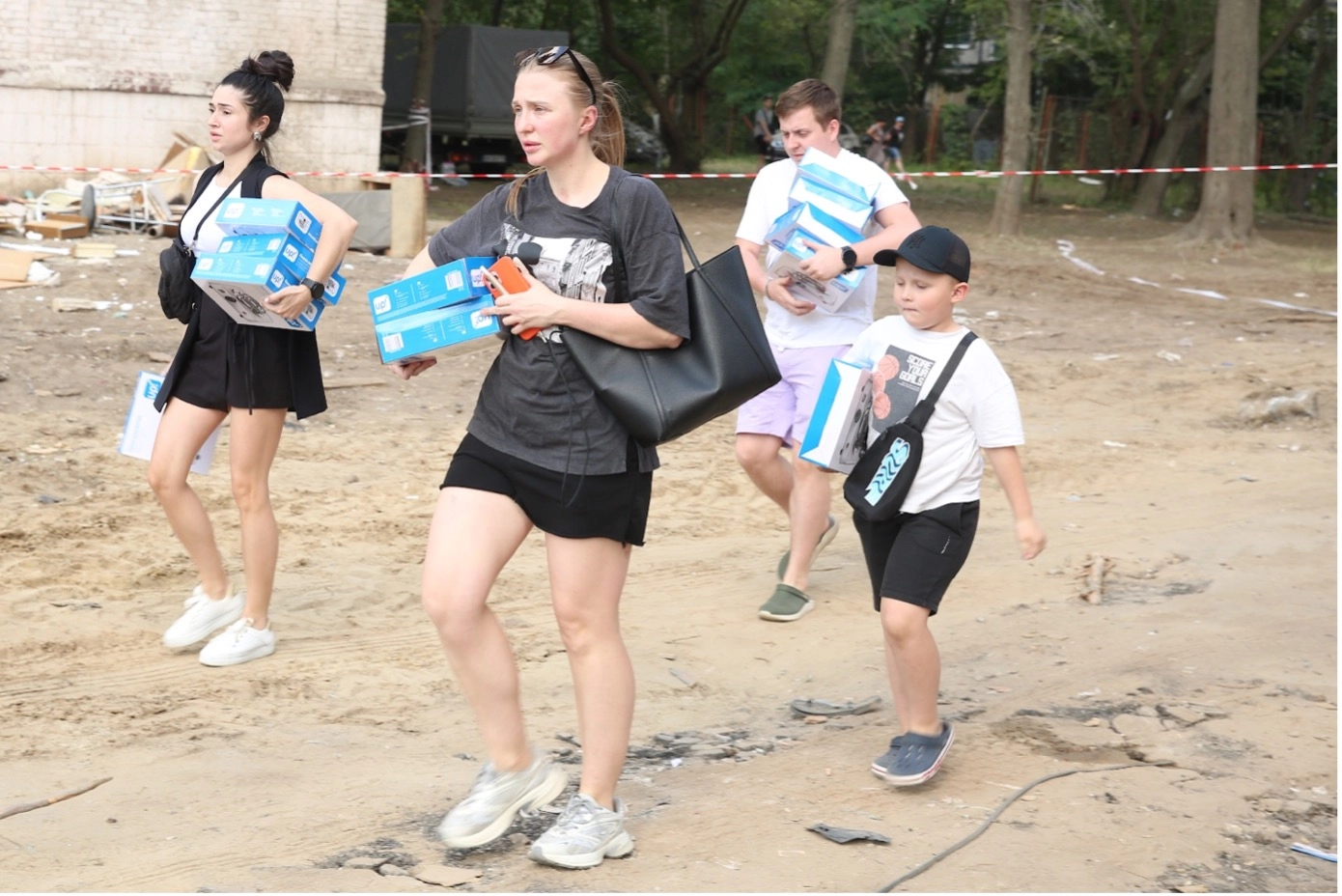
As Olga is giving directions to the drop-off point on the phone to another donor, a family from Kyiv, working independently from Olga’s Facebook group, arrives carrying as many electric cooking stoves as they can physically manage. Lacking local contacts, they go from door to door, finding grateful recipients that way.
The night of the attack
Olga finds her community work to be therapeutic. “There is still a lot of work for the evening, but it’s good”, Olga says, “Because when I sit in the quiet, I can’t think. The sound of the explosion is inside me. When I close my eyes it’s inside me. I can’t do anything with it. It’s like Hell was opened. So, when I stay busy, I don’t hear it.”
Olga lives with her husband Maks, their daughter, and also her 80-year-old father. She recounts that when the first air raids sounded, they just shifted to their own corridor – to ensure two walls separated them from the outside, a slightly safer option. They did not go to the shelter as Telegram channels suggested the drone strike would be a couple of kilometers away – there was silence after the drones hit elsewhere in the capital.
“Imagine. It was like half-an-hour. It was quiet. And it was 4am in the morning”, Olga remembers. “Everybody wants to sleep. Everybody was exhausted, especially children. They say: ‘Can we go home now?’” They all returned to their bedrooms as many others from the apartment block who had gone to the shelter did.
Olga tells me about 6-year-old Matviyko, who went to her daughter’s school. The youngest of three boys, his elder brothers were away on holiday, but he had stayed at home with his parents. They left the shelter once the drone attack ended and returned home – he died in his sleep when the missile struck.
Olga tells me that the missile hit within five minutes of the second alarm. “So, nobody was able to reach the shelter. It was impossible in this short period of time. They [Russia] knew people would not stay all night in the shelter.” In addition to such cruel intentions, Maks says the missiles low trajectory made it spractically impossible to detect and counter.
The blast left Olga paralyzed with shock while Maks, a military veteran was able to comfort their daughter – telling her they were alive and ok. “Even as a veteran, I cannot remember such a large explosion”, Maks recalls. “There was a lot of light, so we thought it was close, but not on our building.”
A friend called to check on Maks, saying: “…your building was destroyed, we saw it in the news!” It wasn’t until Maks looked outside, and saw the dust, smoke and flames that reality hit home.
Olga’s father is unable to walk, which would have made evacuating him from the sixth floor extremely difficult. Olga says that with his usual dark sense of humor his reaction was to shout: “Go! I was born in war, and I will die in war. You can go!”
Public grief
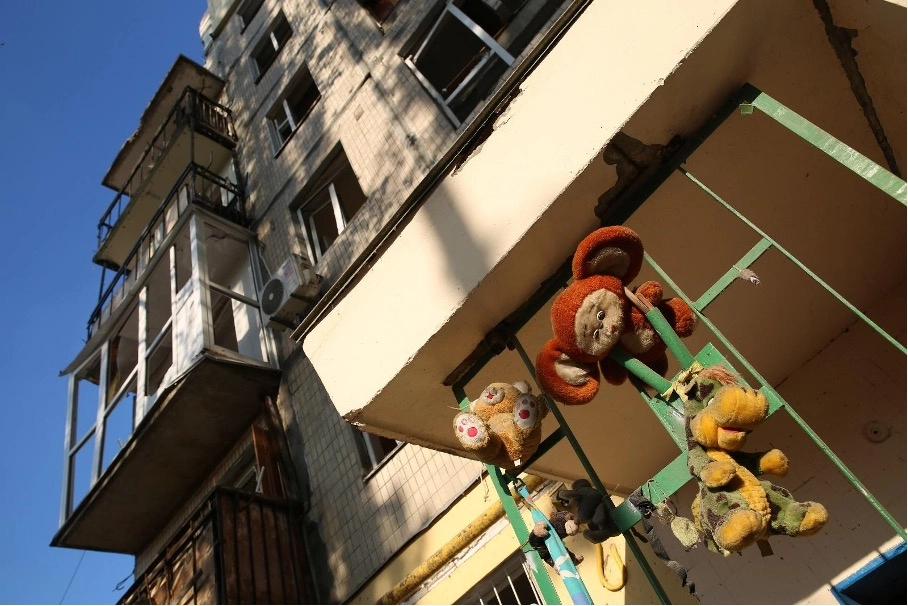
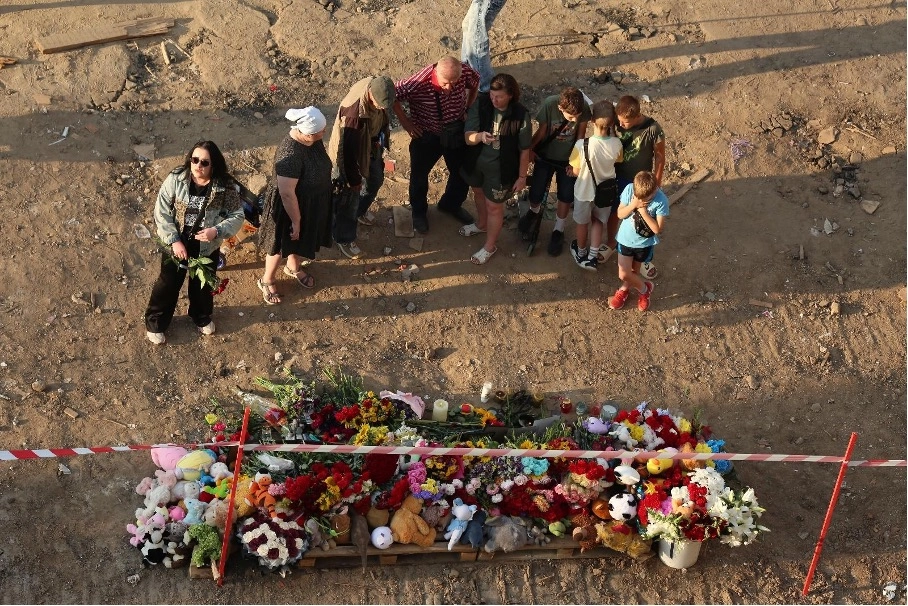
“It’s impossible to understand this, to think about it and to see it. It can’t be. It can’t be in the middle of Europe in the 21st century”, Olga says as we approach the flowers, toys and photo tributes that have been growing throughout the day.
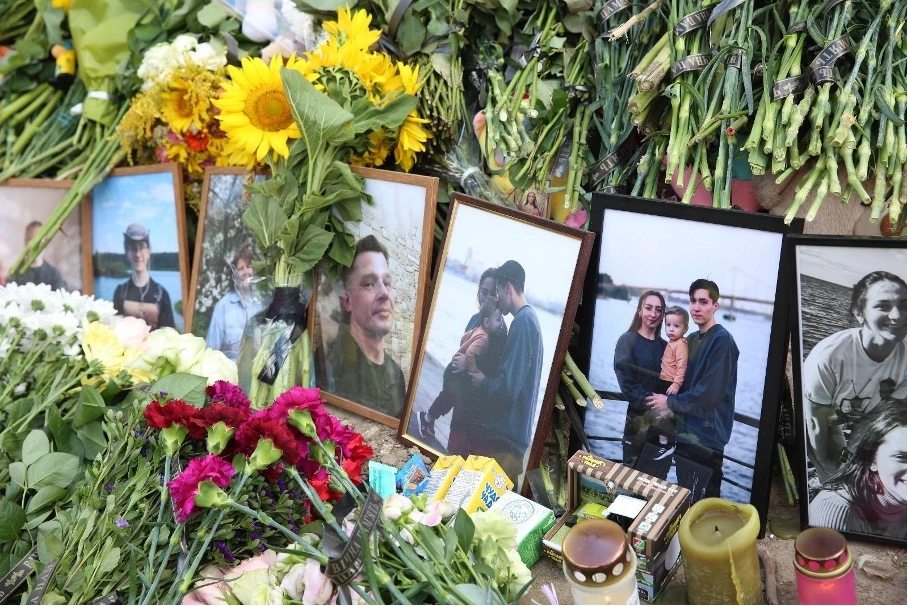
“They were not my close friends, but they were my neighbors. I saw them like every day,” Olga laments as we contemplate photos of the young family. “I actually saw this little boy, the day before. Two years old. He was laughing just there. Running and laughing and riding his balance bike. They were a very gentle family. They loved each other. Not only mama with child, no. This boy Nikita, he was also very involved.”
Ironically, Sofia and Nikita had fled Sloviansk in the east for a safer life in “peaceful” Kyiv. Nikita worked as a security guard at the ATB supermarket, less than a block away. In addition to the child, Sofia was pregnant at the time of the attack. “I had my life already, I don’t need anything”, an old lady is heard sobbing nearby. “Why not me? Why this child? He had his whole life ahead.”
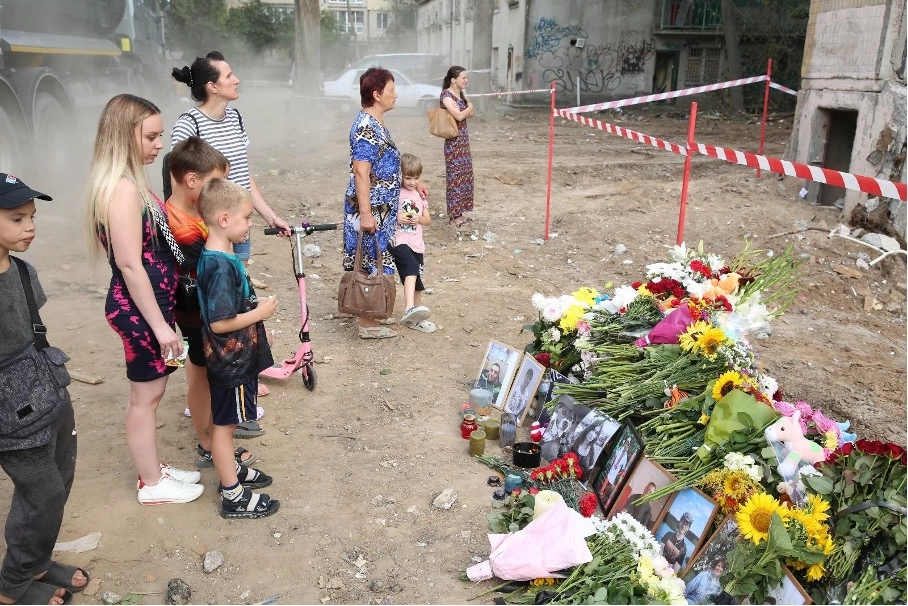
Such themes of fortune are common. Indeed, a healthy dose of fatalism allows many Ukrainians to function while at war.
“It’s just destiny”, Olga ponders. “Because on the sixth floor over there was my older brother’s classmate. He’s 45 now. His wife and child were off in the countryside for some football something. He was sleeping. I thought he was dead for sure, but no. He has no injuries; he is completely fine. There was an explosion. He didn’t understand what happened. He decided to come out and see from the kitchen. But when he opened the door, there was no kitchen.”
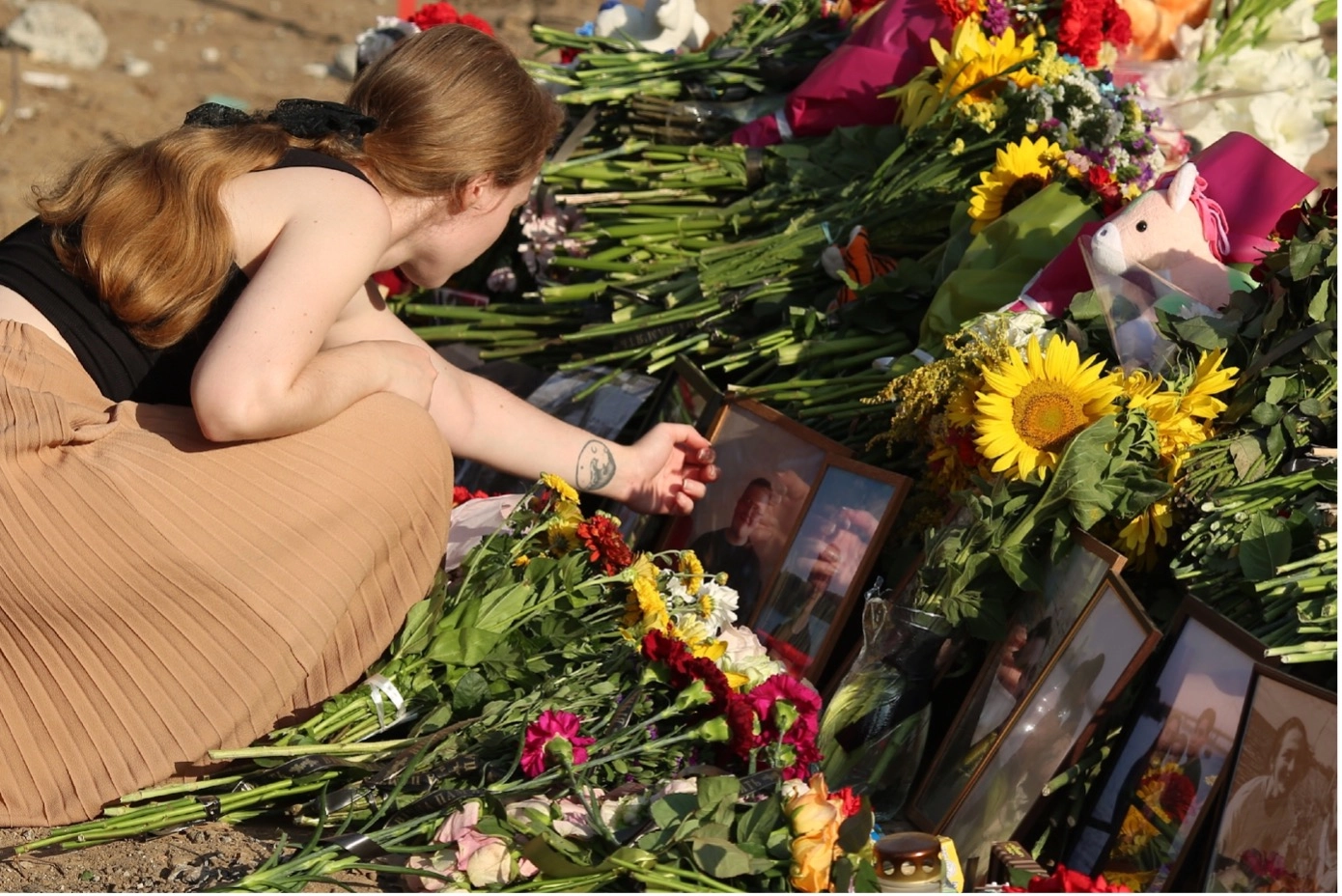
I recognize a young lady from the previous Thursday who was inconsolable. I witnessed the moment the police confirmed the death of her loved one, after hours of waiting. Today she remained distant but calm, quietly stroking the photograph her deceased in his photograph. Her mother stood close-by. The black bow in her hair, further confirmation that she had lost somebody very close.
Igor’s invitation
One of the residents of Section 2 of the building comes to greet me. His windows were destroyed, but he is unscathed. His name is Igor, and he had once studied English in Bournemouth on the UK’s south coast.
“So many people killed at once. I know these people. Not my friends but I know them because they live here. I saw them every day”, Igor says. “Show this to everyone. It’s horrible. As many people in Europe as possible should see this. Putin khuylo.”
He goes on to invite me into his apartment block, to photograph what is left. He explains that the police are now allowing people in, amidst all the residents shifting their furniture, I start climbing up the nine stories.
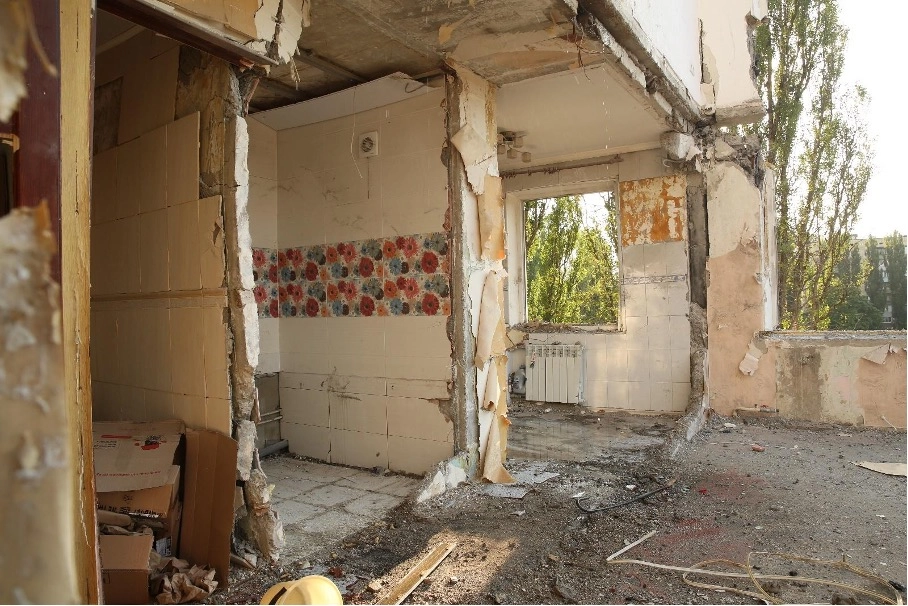
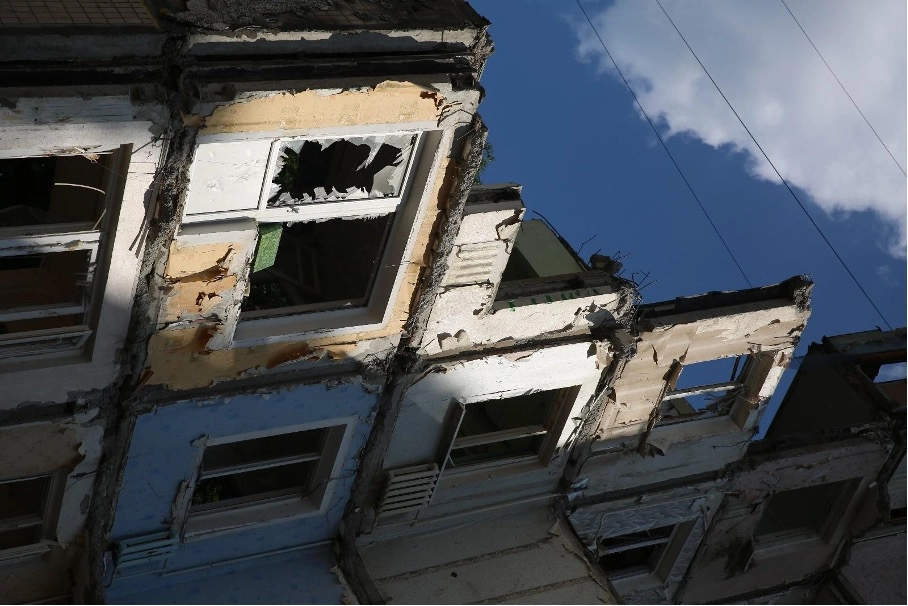
I had witnessed burnt-out apartments in Irpin, Hostomel and Saltivka. But here there were no ashes. This was a different level of destruction. The missile completely obliterated whole floors, leaving a serrated edges and open-air ‘terraces’. As the water supply had not been disconnected, there was a continuous drip and trickle from the ceiling – with puddles on many floors.
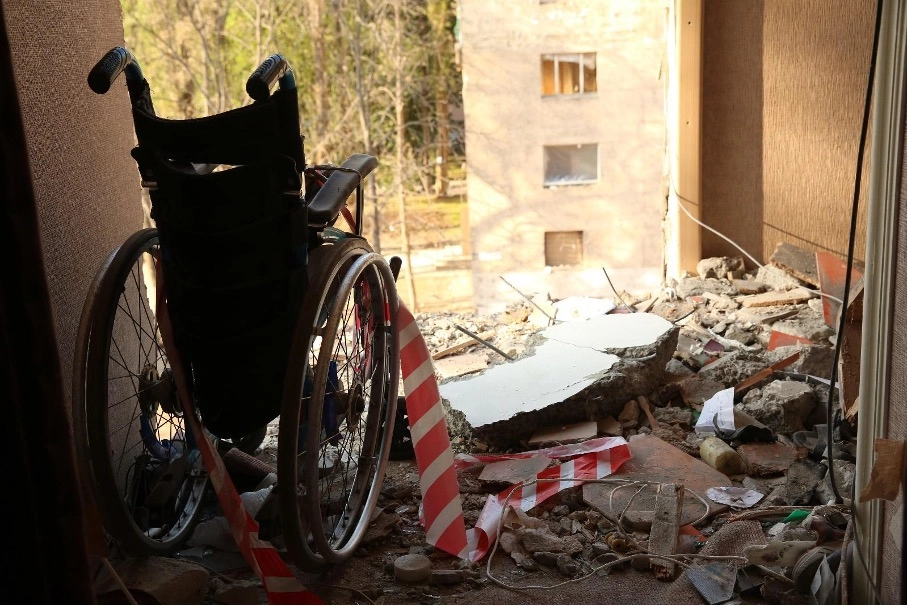
All kinds of belongings were still in place: coats hanging on hooks, mugs on kitchen shelves, an abandoned a wheelchair – would they be collected or left to ruin?
Standing in one “unwrapped” kitchen, it was easier to focus on the reflections of the gaping hole behind me in saucepans than to accept that from this same void families as well as their homes had been instantly removed. The washing machine was still there itself, reminding me of the images of so many appliances being looted by Russian troops in 2022.
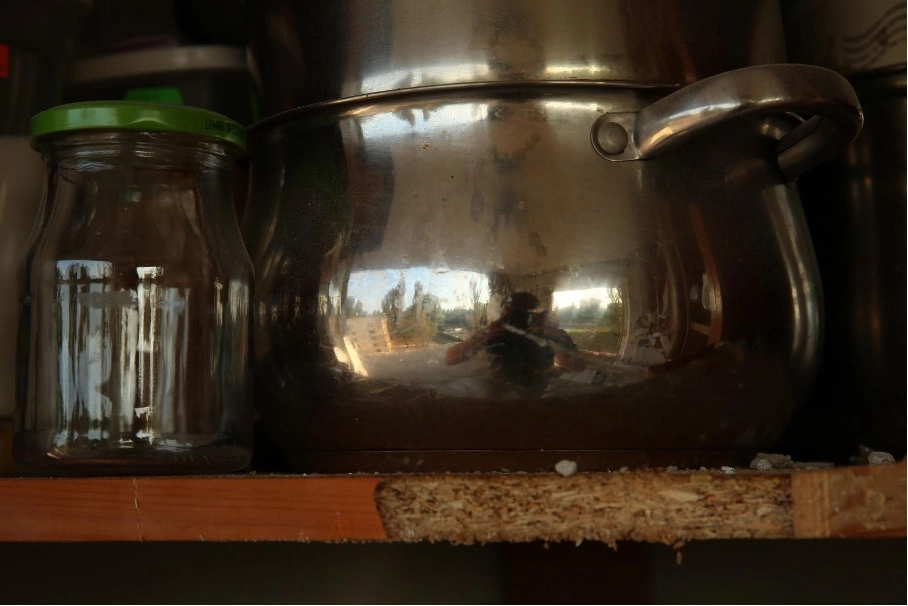
The saucepan reflects the lack of apartment, behind what was once a kitchen
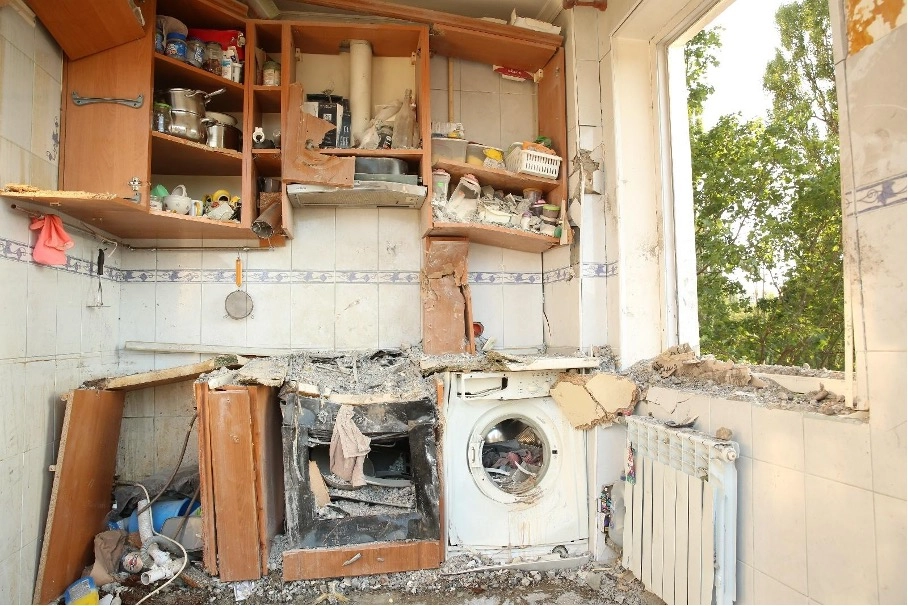
Walking along the corridor leading to another apartment, I find a doorway to the void. The intercom phone hangs, as if to indicate an uninvited guest still lingering outside. That front door is missing whereas apartment 44 has its front door firmly shut, still locked as if in denial of what had occurred just beyond – what a truly surreal environment.
I saw a young man moving what seemed to be intact furniture from one side of his apartment to the other, afraid the side closer to the damage might collapse –it was hard to take an informed decision on whether to stay or leave.
He told me that of the next two doors down that corridor – one neighbor was killed immediately while the other happened to be outside Kyiv on the day of the tragedy.
The school
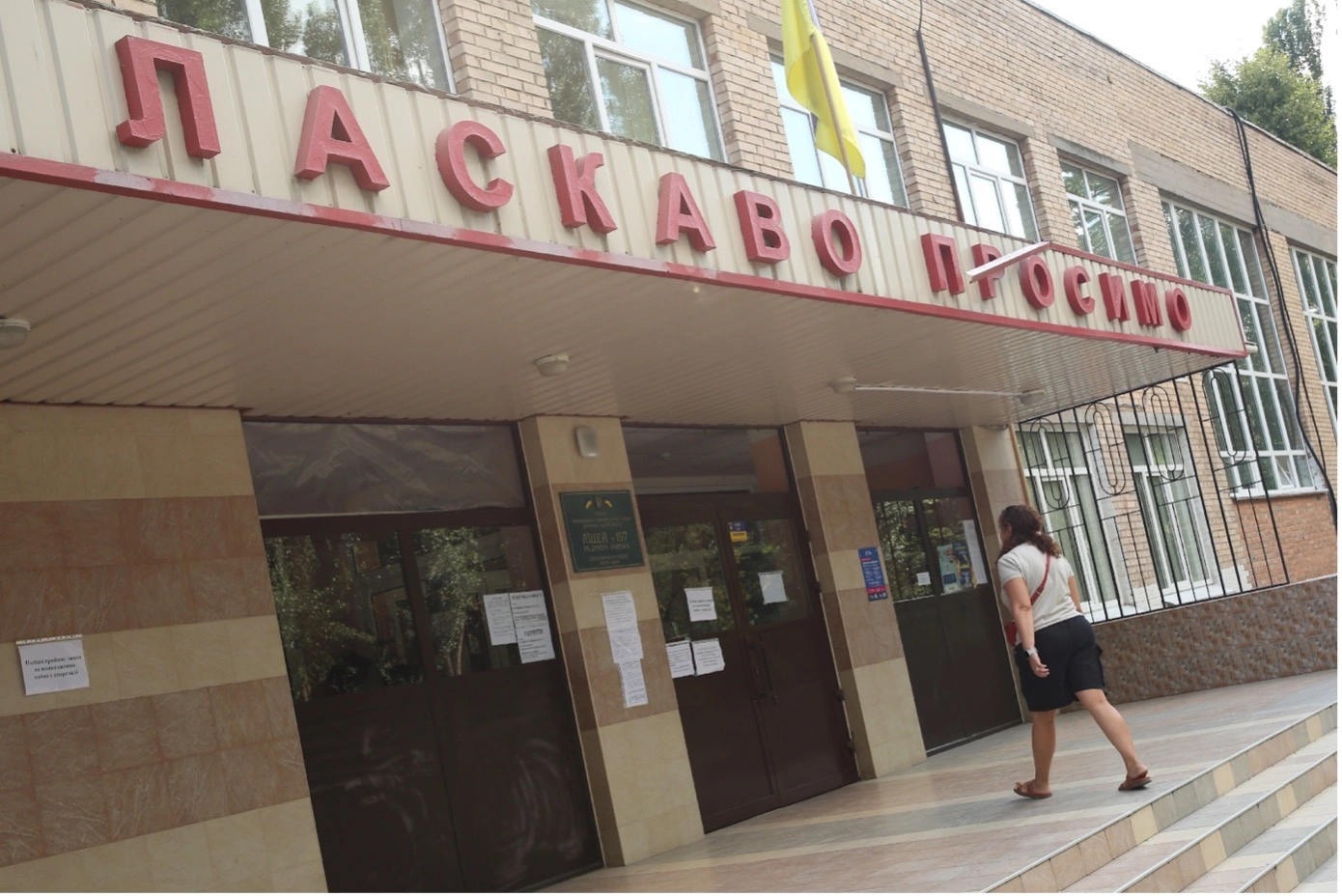
Olga was born in a hospital within a kilometer away, and has lived her whole life at the same address. Her daughter now attends the same school that she attended, a few minutes away, around a corner.
Olga and Maks wanted to show me this school, where all the windows including those in the recently renovated sports hall have gone – it seems unlikely they will be restored by the start of the near school year, only a month away.
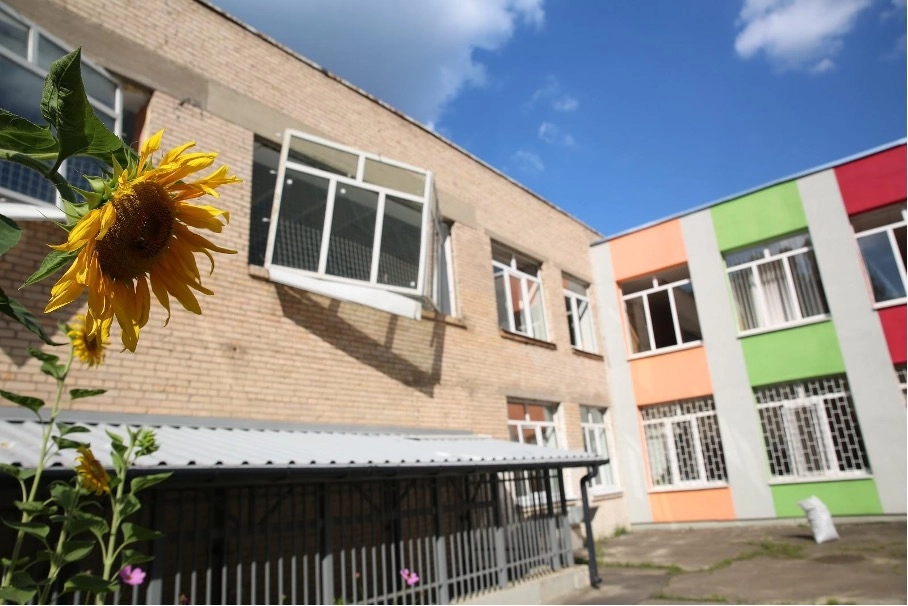
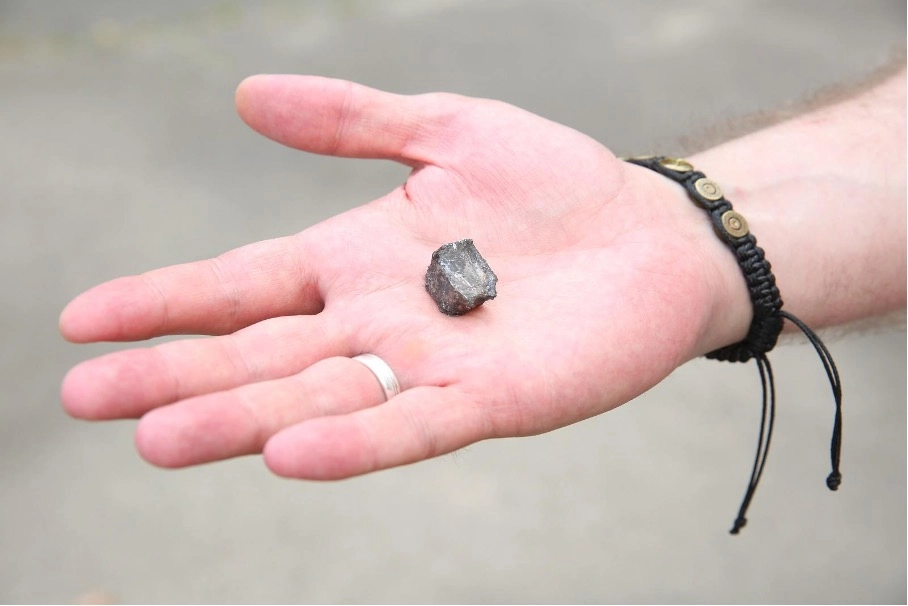
As we cross the playground, Maks picks up a metallic cube from the floor. He looks at it before explaining: “This iron was added to the missile to cause even more damage, to make the blast more efficient at killing.”
It is a timely reflection on the nature of Russian tactics, the use of cluster munitions on civilians – further evidence, if any were needed, of the intent behind such war crimes.
With special thanks to Olga & Maks who took much time out to talk to me on a hectic day at a difficult time.
Dedicated to the memory of all 31 victims
You can also highlight the text and press Ctrl + Enter