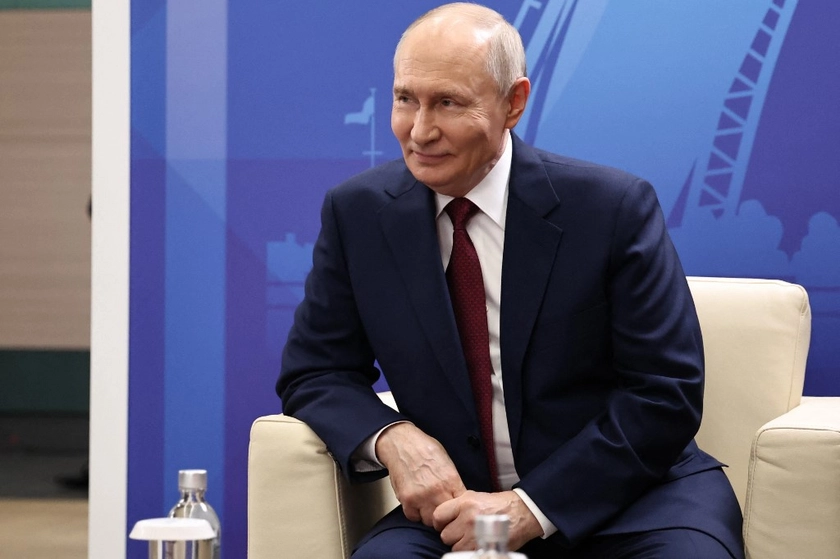
US President Donald Trump has threatened Russia with “very severe consequences” if Russian President Vladimir Putin does not make concessions on ending the war in Ukraine during their upcoming meeting in Alaska on Friday.
Trump also suggested there is a strong chance of a second meeting with Putin – this time joined by Ukrainian President Volodymyr Zelensky.
JOIN US ON TELEGRAM
Follow our coverage of the war on the @Kyivpost_official.
Speaking Wednesday at the Kennedy Center in Washington, Trump initially fielded questions on domestic policy. Later, turning to global affairs, he declared:
“I would be very proud to end the war,” while admitting: “No, I don’t think I can convince Putin.”
Critics say this statement is a preemptive lowering of expectations, allowing Trump to portray even minimal progress as a major achievement.
In the run-up to the meeting, German Chancellor Friedrich Merz hosted Zelensky in Berlin and convened a virtual gathering with the leaders of the UK, France, Poland, and Finland, along with EU officials and the US administration, to ensure that the voices of the EU and Ukraine are heard at the Alaska summit.
What can we expect from the Alaska talks?
The Trump-Putin dialogue raises as many questions as it does hopes. Several scenarios are possible:
The meeting’s most tangible outcome may be nothing more than a set of photo ops and headlines about Trump “saving the world,” without any real breakthroughs. Trump’s own remark – “I don’t think I can convince Putin” – points in this direction.

Tsikhanouskaya Adviser on Fighting the Belarusian Regime, Lukashenko’s Preparations for War Against NATO
For Putin, any high-profile engagement with Washington is a way to reinforce his image as an indispensable global player while continuing to consolidate positions on the Ukrainian front, using diplomacy to stall.
If the second summit indeed takes place with both Putin and Zelensky present, it is likely that Trump will push Ukraine toward concessions “in the name of peace” – a move that would align with the Kremlin’s objectives but pose serious risks to Ukraine’s security.
Trump’s claims that he has ended “five wars in the past six months” and spent “trillions on defense” are clearly aimed at US voters. The priority may be less about securing a lasting agreement and more about boosting his own image.
The Alaska meeting is likely to be loud and highly publicized but may not deliver a genuine path toward ending the war. The optimistic scenario is that it leads to technical talks and some humanitarian arrangements. The pessimistic scenario is that it strengthens Moscow’s hand and increases pressure on Ukraine under the guise of “peace negotiations.” As Zelensky has stressed, any decision made without Ukraine cannot be considered a decision at all.
The views expressed in this opinion article are the author’s and not necessarily those of Kyiv Post.
You can also highlight the text and press Ctrl + Enter