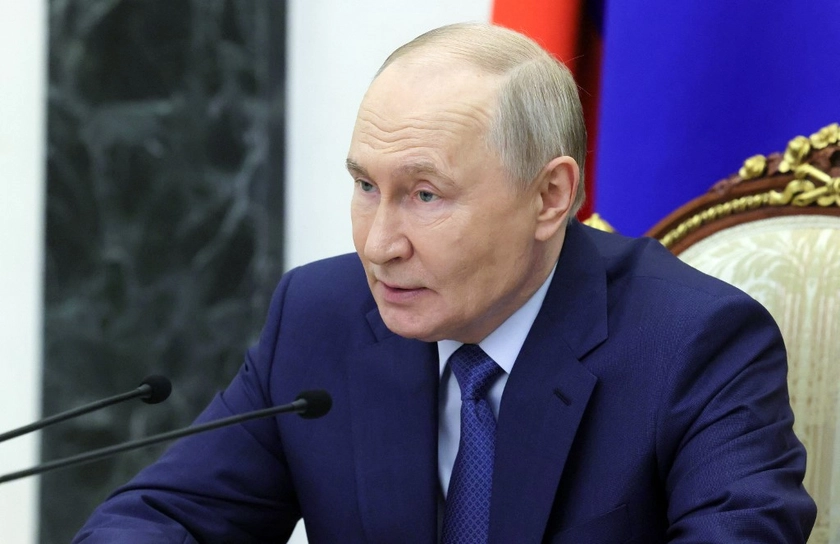
Kirill Dmitriev, a special envoy for Kremlin leader Vladimir Putin, hinted at a potential deal to construct a tunnel between the US and Russia via the Bering Strait.
Dmitriev said an agreement could be signed on Friday to initiate the design stage.
JOIN US ON TELEGRAM
Follow our coverage of the war on the @Kyivpost_official.
“Regarding the tunnel, we’ll have news tomorrow: We’re signing an agreement to continue designing the tunnel. The tunnel will happen,” Dmitriev said on Thursday, according to Russian media Kommersant.
The proposed tunnel would connect Russia’s Chukotka peninsula to the US state of Alaska, purchased from the Russian Empire in 1867, via the Bering Strait, the narrowest point of which measures around 85 kilometers (55 miles).
Dmitriev first floated the idea in October 2025, describing it at the time as “a 70-mile [112-kilometer] link symbolizing unity.”
Dmitriev’s post included diagrams referencing earlier proposals and estimating costs of $65 billion or more.
.@elonmusk, imagine connecting the US and Russia, the Americas and the Afro-Eurasia with the Putin-Trump Tunnel - a 70-mile link symbolizing unity. Traditional costs are $65B+, but @boringcompany's tech could reduce it to <$8B. Let's build a future together! 🇺🇸🤝🇷🇺🧵 👇 https://t.co/boCVb8xqjl pic.twitter.com/QXmTYAduqm
— Kirill Dmitriev (@kadmitriev) October 16, 2025
However, he argued that new technology from Elon Musk’s Boring Company could potentially reduce the price to under $8 billion and shorten construction to less than eight years.
US President Donald Trump, appearing unaware of the proposal at the time, described the tunnel project as “interesting” during a meeting with President Volodymyr Zelensky two days later.
Trump asked Zelensky how he felt about it, to which the Ukrainian leader replied he was “not happy with this,” earning a laugh from Trump.
Ukraine Hits Targets 1,300 km Inside Russia, Striking Ufa Oil Refinery and Penza Missile-Linked Plant
However, the exact purpose of the tunnel remains unclear.
What’s the point of the tunnel?
Beyond the vague gesture of “unity,” there’s likely little practical value to the tunnel.
The remote Chukotka Autonomous Okrug is disconnected from the rest of Russia by road or rail, meaning the only means of transportation are either by air or sea.
Assuming the cargo or passengers can move between the two countries via the tunnel, arriving and leaving the regions still pose major hurdles due to the harsh climate and lack of infrastructure.
Questions also remain about cost and efficiency.
As of 2025, seaborne cargo accounted for over 80 percent of global trade, according to UN data. Cargo tankers can carry a substantial amount of goods compared to other modes of transportation, which generally lowers the average cost.
Shipping routes via the Bering Strait also exist.
The major advantages of tunnel transport are delivery times and schedule reliability, but at the expense of volume.
If cargo must still reach Chukotka by air or sea, the tunnel just becomes an expensive fixed link – one that existing shipping routes already handle more cheaply and flexibly.
You can also highlight the text and press Ctrl + Enter

OPINION: The New Line Kyiv Quietly Built Into NATO