Newly leaked documents from a Russian aerospace components manufacturer provide a rare look inside the country’s ongoing struggle to circumvent international sanctions – and expose how Moscow continues to rely on foreign precision machinery to build its next-generation military aircraft.
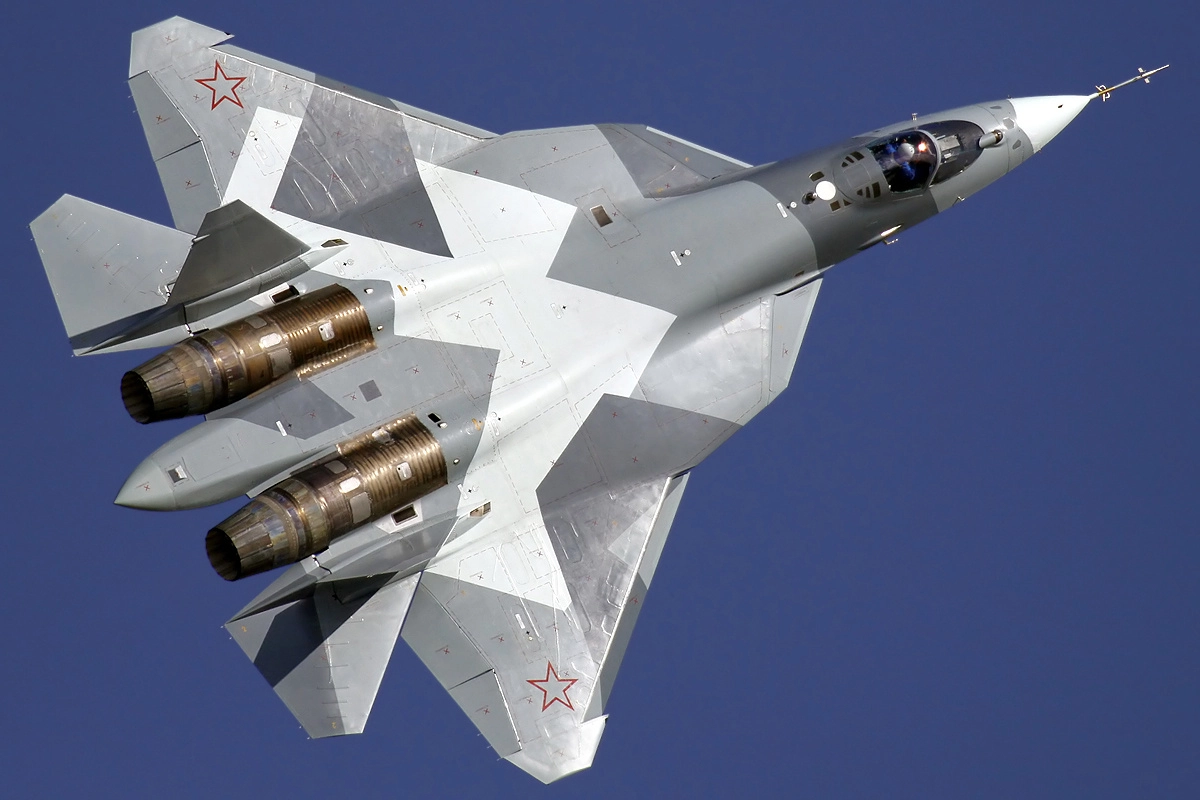
The investigation, published by InformNapalm and supported by cyber-analysis from the Fenix team, shows that the Russian company OKBM remains deeply dependent on imported CNC (computer-numerical-control) equipment to manufacture classified parts for both the Su-57 (NATO: “Felon”) fighter and the upcoming PAK DA Poslannik strategic bomber.
JOIN US ON TELEGRAM
Follow our coverage of the war on the @Kyivpost_official.
Despite sweeping Western restrictions and public claims of “import substitution,” the internal documents suggest Russia has quietly relied on state-subsidized procurement channels to source foreign machines from Taiwan, Serbia, and other countries – equipment now essential to producing advanced aircraft.
Leaked files show what Russia cannot build on its own
The breach revealed classified technical documentation describing critical aircraft components:
- For the PAK DA bomber, OKBM designed parts labeled 80RSh115 / 80RSh, specialized geared hinges integral to operating the bomber’s internal weapons bay doors.
- For the Su-57, Russia’s flagship purported fifth-generation fighter, the company manufactured Rsh-65 geared hinges, used to actuate the aircraft’s internal weapons bay.
These systems are small but vital – any failure in the hinge assemblies directly affects the aircraft’s ability to deploy weapons or to maintain a stealthy RCS (radar cross section).
The documents confirm OKBM’s official role in both programs via state contracts and technical addenda. They also reveal that similar hinge technology is being adapted across platforms – a sign of consolidated production inside Russia’s aerospace sector.

EU's 'Biggest Mistake': Peskov Slams Talks From 'Position of Strength'
Sanction-evasion through “state-subsidized” imports
While Russia claims to have replaced Western machinery with domestic alternatives, OKBM’s own internal audit contradicts this narrative.
The leaked files show that the company depends on foreign CNC machines for high-precision milling and grinding, including:
- Hartford HCMC-1100AG (Taiwan)
- Johnford SL-50 (Taiwan)
- Grindex BSD-700U cylindrical grinder (Serbia)
Audits cited in the leak describe Russia’s machine-tool sector as unable to meet the precision and reliability required for aircraft-grade components. Multiple global manufacturers have withdrawn from the Russian market since 2022, creating production bottlenecks that OKBM attempts to overcome by actively seeking ways around sanctions.
The documents indicate that OKBM has used state subsidies for procurement, allowing it to acquire restricted foreign machinery despite formal bans. The report does not detail the exact channels used, but the presence of these imported systems in OKBM’s active production line demonstrates Russia’s continued ability to bypass restrictions.
Industrial delays undercut Kremlin’s public messaging
Internal assessments in the leak point to systemic problems:
- Shortages of suitable equipment
- Loss of access to global manufacturers
- Production delays triggered by sanctions pressure
These issues directly affect the manufacturing timeline for the PAK DA bomber and Su-57 fighter – flagship programs the Kremlin continues to promote as proof of its military resilience.
The uncovered documentation suggests the opposite: Russia’s most advanced aircraft cannot be built without foreign industrial support.
EU adds OKBM to sanctions list
On October 23, 2025, the European Union included OKBM in its 19th sanctions package.
This move came after the leak exposed the company’s role in sustaining Russia’s high-end weapons production and its use of foreign tooling despite embargoes. InformNapalm states that dozens of gigabytes of additional documents – not yet released – detail further procurement and manufacturing activities.
Window into Russia’s hidden war economy
The OKBMLeaks case underscores a growing reality:
Even as Russia expands wartime production, its defense-industrial complex remains fragile, heavily dependent on precision machinery it cannot produce domestically.
Sanctions are constraining output – but Moscow is still finding ways to acquire restricted technology, raise production, and keep next-generation aircraft programs alive.
The leak gives investigators, journalists, and policymakers rare primary evidence of how Russia continues to evade sanctions from inside its own manufacturing floors. And it raises a central question for Western governments:
If Russia’s most advanced weapons still depend on foreign machines, how are those machines reaching Russian factories?
InformNapalm says this story is only beginning. The rest of the leaked internal archive – still unreleased – may answer that question.
You can also highlight the text and press Ctrl + Enter