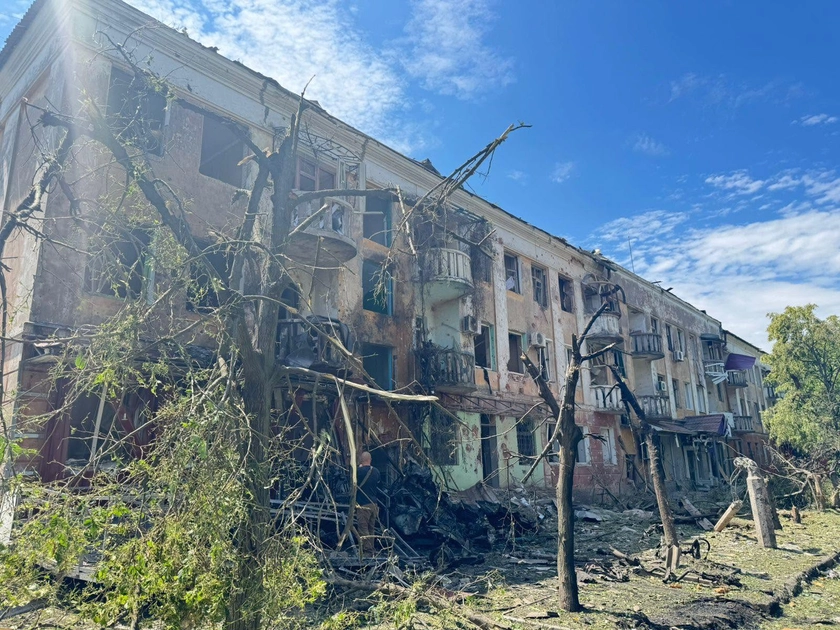
Kyiv Mayor Vitaly Klitschko said close to 3,000 buildings in Kyiv remain without heating as of Thursday morning after a major Russian attack.
Klitschko said after Tuesday’s attack that 600,000 had fled the capital amid the energy crisis spurred by Russian attacks, and advised more residents to leave if possible amid the persistent cold spell.
JOIN US ON TELEGRAM
Follow our coverage of the war on the @Kyivpost_official.
Heating has been restored to part of the more than 5,600 buildings knocked offline two days ago, Klitschko said on Thursday in a Telegram update.
“As of this morning, slightly less than 3,000 high-rise buildings in the capital remain without heat. Last night, heat was connected to 227 houses,” Klitschko wrote, adding that Tuesday’s attack was the second of its kind within days.
On Jan. 9, Kyiv’s energy grid was also pounded by Russian strikes, leaving over 6,000 houses without heating. Tuesday’s strike came just as authorities restored heating to most buildings.
The electricity situation, however, remains difficult as of Thursday, Klitschko said.
“Emergency power outages continue in Kyiv. Utility and energy workers are working around the clock to restore heat and light to Kyiv residents’ homes,” he wrote, providing no timelines for restoration.
Kyiv Post correspondents recorded over 40 hours of continuous blackout in some districts of Kyiv on Wednesday.
On Wednesday, President Volodymyr Zelensky said over a million people in Kyiv had no power, while the infrastructure minister said cogeneration units have been transferred from other Ukrainian regions to Kyiv to provide power and heating.
Oleksiy Leonov on Ukraine’s South: From the Front Line to Cross-Border Cooperation
Scrambling for gas
Alongside the damaged facilities, Ukraine is also importing more gas – though the economy ministry said the situation is fine at present.
Speaking at the World Economic Forum on Wednesday, Economy Minister Oleksiy Sobolev said Ukraine still needs to secure over 4 billion cubic meters of gas.
“Most of the funding for this has been secured. There is a funding gap of approximately $100 million,” he said, according to Interfax Ukraine.
But in a subsequent statement, the economy ministry said there are currently “no threats to gas imports,” saying the 4 billion cubic meters figure relates to the entire heating season for 2025-26, which is scheduled to arrive in the coming months.
“We emphasize: As of today, there are no threats to gas imports,” the statement says.
“The need to import 4 billion m³ of natural gas applies to the entire heating season of 2025-26, half of which the country has already overcome. Accordingly, the lion’s share of this volume has already been purchased by NJSC Naftogaz of Ukraine, delivered to Ukraine and used by our consumers,” it adds.
The ministry said the remaining gas will come in the next two months, though Kyiv is trying to secure the funding.
“As for the remaining volume to be imported in February-March, the Government, together with NJSC Naftogaz of Ukraine and with the support of international partners, provided most of the necessary financing,” it added.
“Unmet needs are estimated at $100 million. Active work is currently underway to find the necessary financial resources.”
In Davos, Sobolev said Ukraine managed to accumulate 13.2 billion cubic meters of natural gas despite the Russian attacks. He added that Russia destroyed half of Ukraine’s gas production capacity in early 2025, though Kyiv managed to restore it in six months with the help of allies.
“In the fall, Russia destroyed another 40%. However, this has already been restored with the help of our partners and many wonderful companies from the US and Europe who are helping with the restoration,” he said.
In the first half of 2025, Ukraine imported more than 19 times the 0.12 billion cubic meters imported in the same period in 2024 after Russian attacks hit domestic production.
.
You can also highlight the text and press Ctrl + Enter

ANALYSIS: Russia’s Air Defense Problems Are Growing