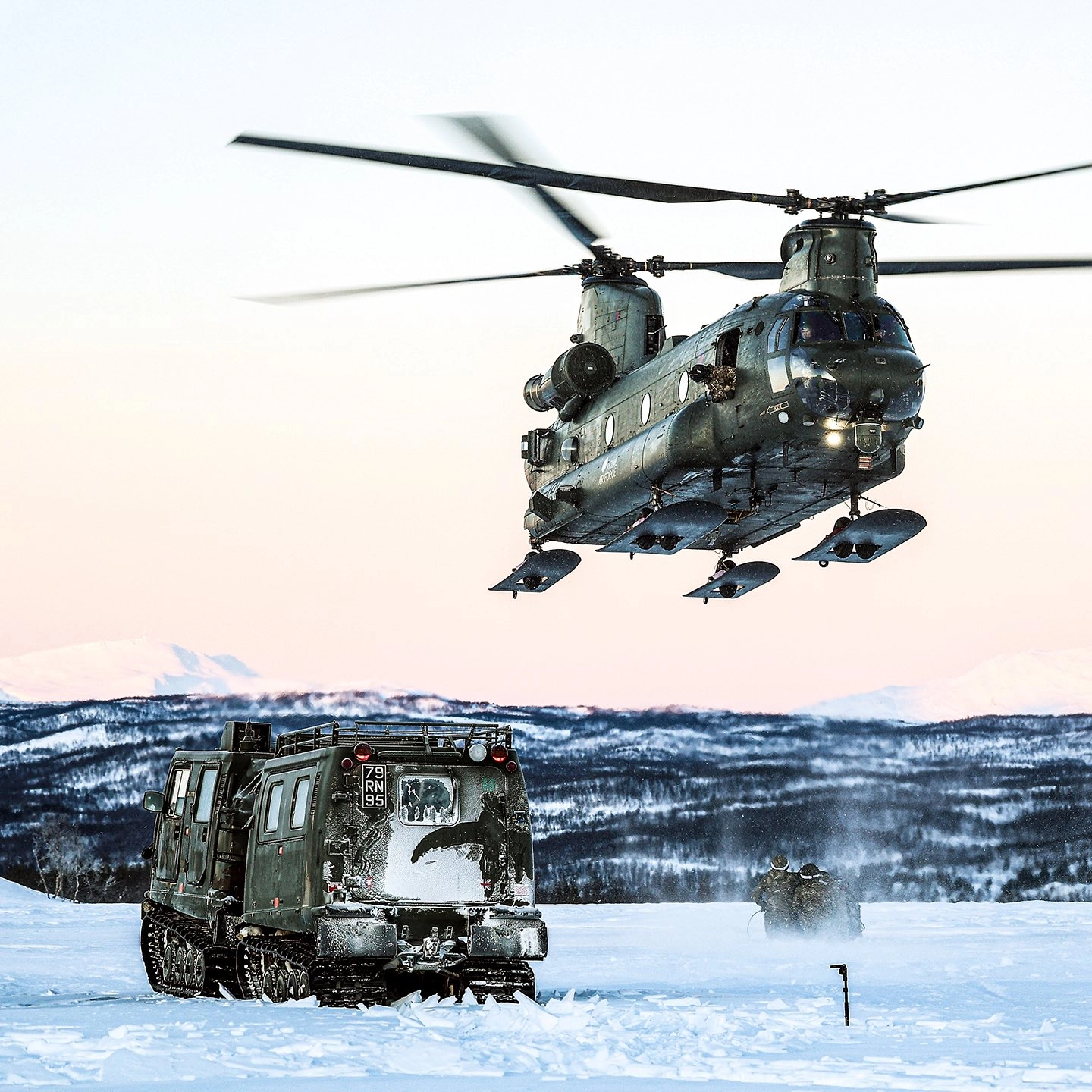
WASHINGTON DC – For decades, the Arctic was NATO’s quietest flank, protected by a wall of sub-zero temperatures and impenetrable ice. But as Russia leans into hybrid warfare and uncrewed tech, the High North is becoming a “denied environment” that the alliance is currently ill-equipped to see, let alone defend, according to a group of Washington analysts.
At a Center for European Policy Analysis press briefing on Thursday, defense analysts described an Arctic transformed by Russia’s invasion of Ukraine and by the growing role of uncrewed systems in modern warfare.
JOIN US ON TELEGRAM
Follow our coverage of the war on the @Kyivpost_official.
“The Arctic region… is no longer an afterthought,” said retired Maj. Gen. Gordon “Skip” Davis Jr, adding, “Deterrence and defense now depend on persistent awareness, integrated capabilities and resilient architecture.”
Translation: if NATO can’t see what’s happening in the High North, it can’t stop it.
Drones as the new icebreakers
The panel’s central message was blunt: humans can’t patrol the Arctic alone anymore.
Uncrewed systems – in the air, on the surface and under the sea – are becoming indispensable for surveillance across vast, hostile terrain.
Federico Borsari, one of the report’s authors, called them “not just complements, but essential” to Arctic deterrence.
Their biggest payoff? Watching what humans can’t.

Artem Dovbyk and Experts Share What to Expect From the 2026 World Cup
From subsea cables and pipelines to oil platforms and satellite ground stations, drones are increasingly tasked with guarding the lifelines of the transatlantic economy. The Baltic Sea’s recent spate of suspicious cable cuts loomed large in the background.
“The point is to deny deniability,” said Minna Ålander, a Nordic security analyst. “Hybrid warfare works best when nobody can prove who did what.”
Cold kills batteries – and plans
The Arctic, the panelists warned, remains an unforgiving enemy.
Batteries drain in minutes. Engines freeze. GPS signals fade or are jammed.
And in a region where winter brings months of darkness and summer brings endless daylight, even hiding becomes complicated.
“In the Arctic, the climate is the real enemy,” said Jan Kallberg, a former Swedish officer. “Any adversary is only a problem 50 minutes a day.”
That reality is forcing NATO to rethink technology from the inside out: heated battery casings, redundant navigation systems, inertial guidance, even old-school map-and-compass backups.
Ukraine’s shadow over the ice
The war in Ukraine hovered over nearly every answer.
Russia’s heavy losses have reduced the risk of a near-term ground invasion in the Arctic, Kallberg argued, but they have not reduced Moscow’s appetite for disruption.
The bigger threat now, several analysts said, is maritime and hybrid: sabotage of cables, pipelines and data routes that connect Europe to North America.
Ireland, Kallberg noted pointedly, “has no navy.” The Arctic and North Atlantic are full of similarly soft targets.
Drones, in this vision, are less about launching strikes and more about cueing defenses – finding trouble early enough for ships, aircraft and missiles to respond.
“Kinetic roles exist,” Davis said, “but they’re secondary.”
NATO’s real problem: Integration, not invention
Perhaps the sharpest critique was aimed not at technology but at bureaucracy.
NATO doesn’t lack drones, satellites or sensors. What it lacks, the panel said, is seamless integration.
“The challenge is not inventing new technology,” Davis said. “It’s integrating and scaling what already exists.”
Without common standards, shared procurement and interoperable command systems, NATO risks building dozens of incompatible drone fleets – fast, expensive and strategically fragmented.
The fastest fix, the analysts argued, is multinational procurement: buying together, testing together and wiring systems directly into NATO command and control.
Thin blue line of sovereignty
For all the talk of networks and sensors, the panel kept returning to an old-fashioned point: sovereignty still requires boots on frozen ground.
Small patrols in Greenland, northern Canada and Scandinavia still “mark the map,” Kallberg said – even if drones now extend their eyes and ears for hundreds of miles.
That matters because, as several speakers warned, Russia and China are probing not with armies but with narratives – quietly testing whether parts of the Arctic can be treated as nobody’s land.
“Change the facts on the ground,” Kallberg said, “and you change the story.”
In an era when wars are fought by algorithms and cables as much as by soldiers, NATO’s next great deterrence test may come not in Kyiv or the Baltics – but in a place where the cold kills batteries, silence hides sabotage, and the future of the alliance is being written in ice.
Ultimately, the Arctic’s greatest defense – its brutal, unforgiving climate – is now NATO’s greatest hurdle.
As Russia and China move to rewrite the rules of the north, the alliance is finding that its future security depends less on traditional battle tanks and more on whether it can keep its algorithms running at 40 below.
You can also highlight the text and press Ctrl + Enter