Lithuania has emerged as one of Ukraine’s strongest supporters. The Baltic nation was among the first to transfer weapons to Kyiv, beginning in the very first days of Russia’s full-scale invasion.
Beyond military aid, Lithuania has been a steadfast advocate for Ukraine within the EU. Having endured decades of Russian-Soviet occupation itself, the country is drawing on its own experience to support Ukraine’s reform efforts, contribute to recovery projects, and advance Kyiv’s path toward EU membership.
JOIN US ON TELEGRAM
Follow our coverage of the war on the @Kyivpost_official.
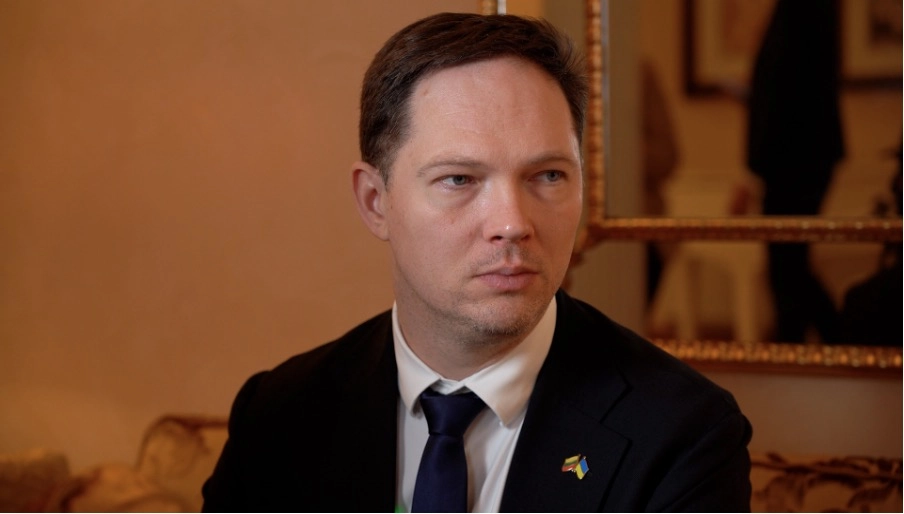
Currently, Lithuania is working closely with European partners on a 20th package of sanctions against the Russian Federation. On this, as well as on the future of Ukraine and the Baltic region, we speak with Lithuania’s Minister of Finance, Kristupas Vaitiekūnas.
KP: Dear Sir! Lets start, maybe from the most interesting thing connected with you. You are working now on the 20th package of sanctions against Russia. What will it look like?
Kristupas Vaitiekūnas (KV): The next package, like any other package, has to make a real impact on Russia and its aggression. It will be great to see the inclusion of its shadow fleet and oil companies. Maybe more cutting of trade chains. It would be good if these sanctions are in line with American sanctions. The main goal is to cripple the Russian war machine and the Russian economy. The ideas of the American administration are very good when you talk about sanctions on portions of oil. Yes, we can talk about how this US administration can become more and more consistent. And our work is to be aligned with this policy.
Syrsky: Russian Maps Show False Advances to Please Top Command
KP: A lot of Ukrainians now feel skeptical about the new American administration.
KV: I think we shouldn’t rush with judgment about it. They have good initiatives that have potential for the future. We have to cooperate in every possible way we can.
KP: Despite all the sanctions, Russia can still spend a lot of money on war, to run the war. Why? And what needs to be done?
KV: The sanctions regime is not constant. It needs improvement every day, every weak spot, every loophole has to be closed. Russia is a very big country and has a lot of resources and a large military-industrial complex. It is a really strong enemy, and it’s not easy way to win. You have to work hard to stop it.
KP: Lithuania is among those countries that have remained a stable ally of Ukraine for four years! Why? What is the interest?
KV: Historical context is very important. As you noticed, once we were together in one big country, and that experience was very important. We understand the problem of the moment; we see not only the past but what is happening today. The sympathy between Ukrainians and the Baltics was very, very warm even before the full-scale invasion. We support your path to Europe, helping you, and now we want to help you because we understand this war. We got into the EU and NATO in a narrow gap. A lot of countries are stuck somewhere in between, as Belarus, our closest neighbor, is. Ukraine is going through this now. I was in Ukraine in 2010, and it was very different. When you compare it with Belarus, you can always see the striving for freedom and democracy. And your enemies see it. They tried to make a Belarus here, but they failed.
KP: But some EU countries are afraid that Ukraine can become part of Europe, like Poland or Hungary. You have said several times that there is nothing to be afraid of, that Ukraine is an opportunity for Europe, not a challenge.
KV: Well, I think Ukraine should have become a member of the EU many years ago. Yes, the EU has many criteria, but I think that’s the wrong policy. It’s better to assess what each country can bring to the EU. Ukraine can bring nothing bad to the EU. Cheap agricultural products? Yes, but it’s a matter of competition, and competition is always good. It’s also good for the customer. Ukraine provides innovation in military technology, and the EU will benefit from it. Also, it’s a big territory, a large population, and many new consumers. Yes, you need to implement reforms and fight corruption, but that takes twenty years. It’s better to include you in the EU and help you with reforms. What’s the reason to keep you behind these doors?
KP: A lot of Ukrainians are blaming our past for what is happening now – that we did wrong in the 1990s, and Lithuania and Poland did better. What experience can you share in reforming a post-Soviet country and society?
KV: What was the difference in the 1990s? We are a small country, and we were all united in what we wanted to be and where we wanted to go. You were a big country, with a big population, powerful on your own. You didn’t know what you wanted to do in the future. But now this problem is fixed, because today most Ukrainians want to become part of Europe and NATO. The rest is rebuilding and fixing other things, but the main thing is that your nation knows what it wants to be.
KP: What is the role of your country in rebuilding Ukraine?
KV: After the war, it’s about normal life, normal work, supporting schools and kindergartens, and helping to keep the country running. But now the main issue is to help Ukraine win this war. It’s important because the war is in Ukraine, but it is against all of us, against our way of life. Putin invaded you because you chose another way of life. You didn’t accept what Putin was offering you – cheap gas, oil, stability, probably. You rejected that. If you win this war, that is the most important thing now – to help you win and to help you run your country.
You can also highlight the text and press Ctrl + Enter