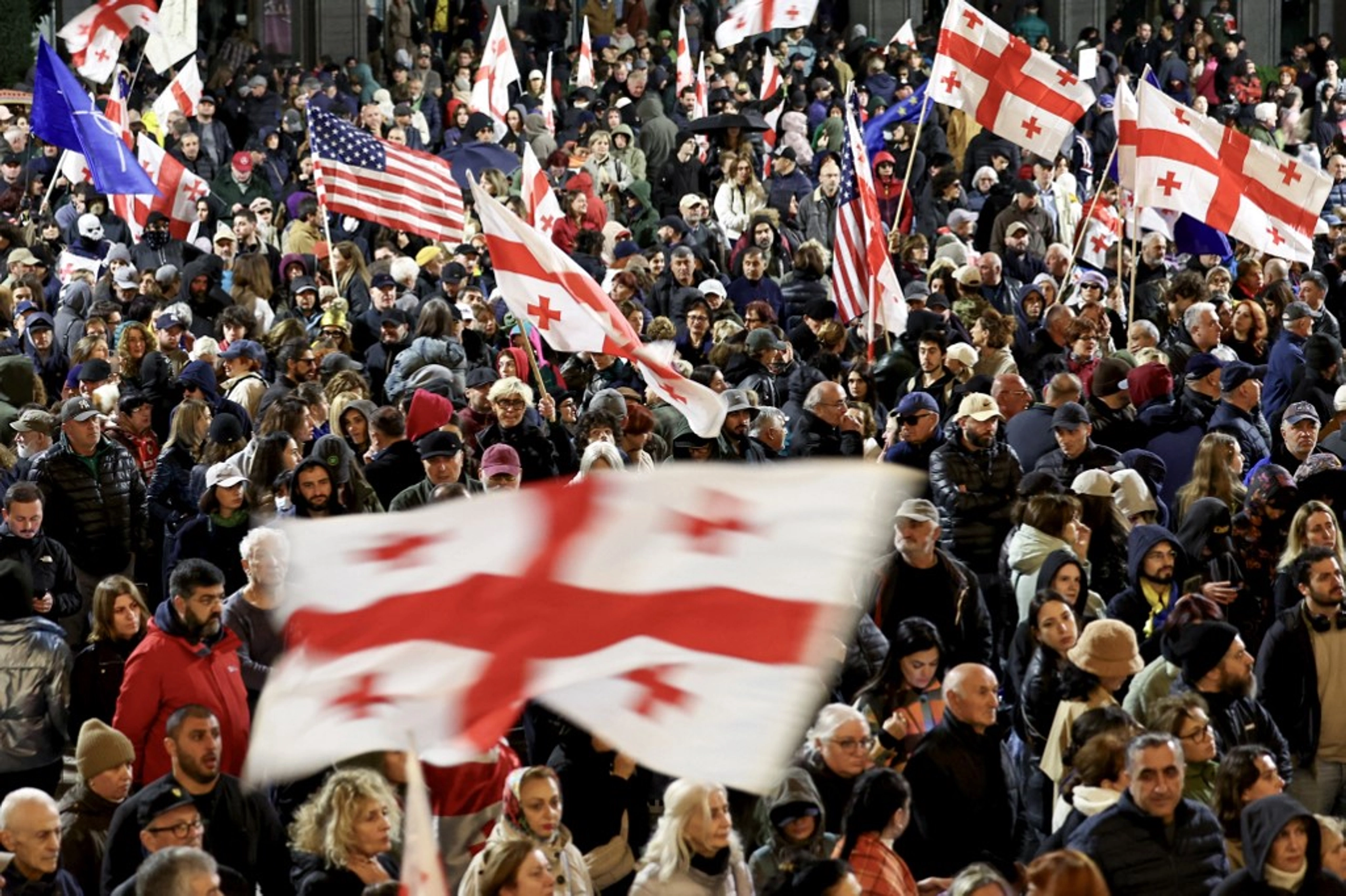
Protesters in Tbilisi marked the 500th consecutive day of anti-government demonstrations on Saturday, April 11, with a massive march to the Georgian parliament ahead of Orthodox Easter services.
Gathering initially at the city’s Philharmonic building, participants marched through the capital carrying Georgian and EU flags. The milestone event culminated at the parliament building, where demonstrators joined an ongoing sit-in to reiterate demands for new parliamentary elections and the release of what they term “prisoners of conscience.”
JOIN US ON TELEGRAM
Follow our coverage of the war on the @Kyivpost_official.
“For the second year in a row, citizens involved in the protest are celebrating Easter with candles in their hands on Rustaveli [Avenue],” TV station Pirveli reported, adding “more than 40 political prisoners are marking Easter in prison.”
I can hardly believe this, but this is Day 500 of protests in Georgia!
— Rusudan Djakeli 🇬🇪🇺🇦 (@rusudanjakeli) April 11, 2026
For 500 days, protesters have gathered every day in 8+ cities despite heavy fines, mass arrests, and abuse.
The pro-Russian Georgian Dream regime must end. pic.twitter.com/iqrPwjJJ8q
Following the rally, the crowd moved to the Kashveti Cathedral for Easter services, maintaining their call for democratic reforms. The protest movement, which began on Nov. 28, 2024, was ignited by the government’s pivot away from Euro-Atlantic integration and the introduction of “foreign agent” laws modeled after Russian legislation.
The major endurance of the rallies comes amid a significant consolidation of the opposition. In March, nine pro-Western parties formed a unified alliance to challenge the rule of billionaire Bidzina Ivanishvili’s Georgian Dream party, which has overseen a violent crackdown on dissent involving tear gas, water cannons, and thousands of administrative arrests.
Serbia to Reintroduce Mandatory Military Service by Next March
Yes, Hungary votes tomorrow. Yes, democracy is being squeezed in Serbia and Türkiye. But tonight, in Tbilisi, something even more powerful is happening: for the 500th straight day, people are risking arrests, violence and intimidation just to claim their European future. This is… pic.twitter.com/QSmfT3SB1x
— European Democrats (@democrats_eu) April 11, 2026
International pressure on the Georgian government has also intensified. While the EU recently held back on sanctioning the Kulevi oil terminal following “positive commitments” from Tbilisi to stop handling Russian crude, rights advocates have criticized the government for the recent deportation of independent Azerbaijani journalist Afgan Sadigov.
As the 500-day mark passes, the opposition continues to frame the struggle as a “democratic alternative” to an increasingly autocratic regime. For many in Tbilisi, the Easter vigil served as a symbolic reminder of a protracted political crisis that has left the country’s EU membership bid effectively on hold.
You can also highlight the text and press Ctrl + Enter