Russia’s spending on its war against Ukraine is expected to exceed this year’s budget by 2 trillion rubles ($28 billion), according to a report citing an internal government document.
The Financial Times report, published on Friday, May 29, is based on a letter sent by Russian Finance Minister Anton Siluanov to the government in February, in which he warned that rising military expenditures were creating increasing pressure on the federal budget.
JOIN US ON TELEGRAM
Follow our coverage of the war on the @Kyivpost_official.
According to the document, Russia may need to freeze planned spending in other areas to cover the growing costs of the war.
The warning comes as Moscow is allocating 16.84 trillion rubles ($238 billion) to defense and security in its 2026 budget – nearly 40% of total government spending.
Budget deficit already exceeds annual target
The Financial Times reported that Russia initially projected a budget deficit of 3.8 trillion rubles ($53 billion) for all of 2026.
However, during the first four months of the year alone, the deficit reached 5.9 trillion rubles ($82 billion), equivalent to roughly 2.5% of GDP and the largest shortfall recorded since the start of the Kremlin’s full-scale invasion of Ukraine.
According to the letter, the Finance Ministry estimated in February that the immediate funding gap created by additional military spending stood at 2 trillion rubles ($28 billion) but could expand to 4 trillion rubles ($56 billion) under a negative scenario extending through 2027 and 2028.
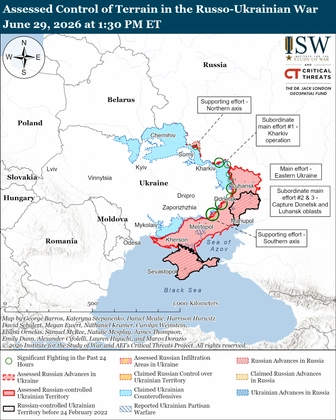
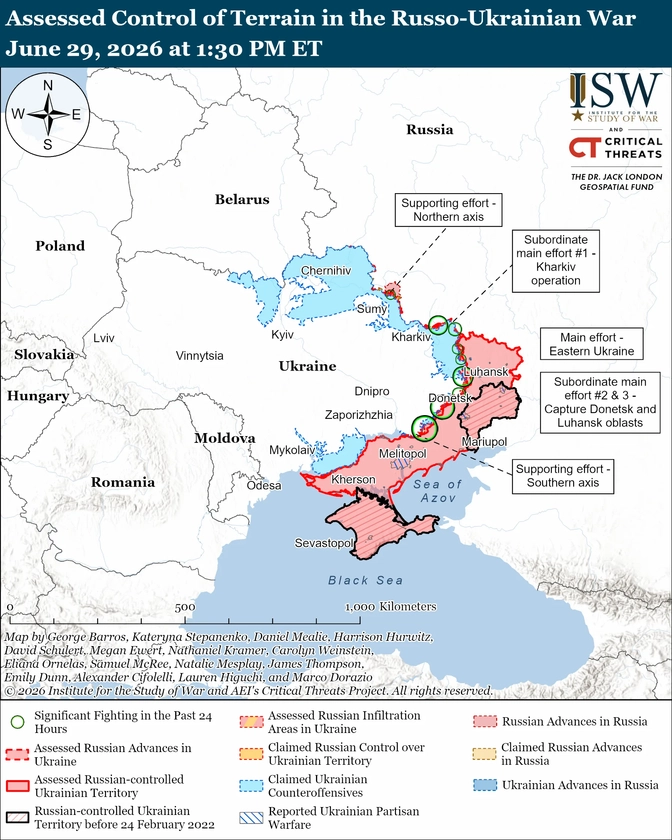
ISW Russian Offensive Campaign Assessment, June 29, 2026
To offset the pressure, Siluanov reportedly asked the government to freeze 2.9 trillion rubles ($40 billion) in planned spending this year.
The document suggests the required cuts could increase to 7.1 trillion rubles ($99 billion) by 2028 if military expenditures continue to rise.
War spending takes priority
The report said the Kremlin’s financial position has received temporary support from rising oil prices linked to the war in Iran, with crude prices surpassing $100 per barrel for the first time since 2022.
However, the Financial Times noted that additional energy revenues are unlikely to fully offset the growing cost of Russia’s war effort.
Alexandra Prokopenko, a former official at Russia’s central bank, said the letter illustrates how military spending has become Moscow’s overriding budget priority.
“The document shows that war spending is being prioritized over everything else,” Prokopenko said.
Russia’s wartime economy faces increasing fiscal challenges despite continued energy revenues and sustained military production. The remarks come amid growing signs of strain inside Russia’s economy and financial system.
According to a recent assessment by Ukraine’s Foreign Intelligence Service, citing an internal report from Moscow’s pro-Kremlin Center for Macroeconomic Analysis and Short-Term Forecasting (CMACP), the share of non-performing and toxic assets in Russia’s banking sector has remained above the internationally recognized crisis threshold for a third consecutive month.
Under International Monetary Fund (IMF) standards, a banking system is considered to be in systemic crisis once non-performing assets exceed 10% of total sector holdings. The CMACP report described the crisis as still having a “latent character,” with Russia’s state-controlled banks masking defaults and restructuring bad corporate debt to prevent broader panic.
The report also warned that corporate liquidity across Russia is rapidly deteriorating. Nearly half of Russian businesses reportedly identified severe payment delays from business partners as their biggest threat heading into mid-2026, creating a growing chain of default risks throughout the economy.
President Volodymyr Zelensky on Monday said Ukraine’s long-range strikes have also cut Russian oil refining by 10% in recent months and forced energy companies to shut down wells. He said Russia’s deficit has already exceeded full-year projections and that “Putin is leading Russia toward bankruptcy.”
While recent US sanctions waivers under Trump have allowed Russia to monetize oil assets, Ukraine’s domestic “long-range sanctions” appear to be having a more direct impact. By physically disabling refineries meant to process those resources, Kyiv’s deep-strike campaign is putting fresh pressure on the Kremlin’s war chest.
You can also highlight the text and press Ctrl + Enter

Russia Hit by 660-Drone Overnight Barrage Targeting Moscow, Crimea and Key Military Sites