What is Donald J. Trump’s most obvious, most provably wrong fib about Ukraine?
US President Donald Trump has repeatedly claimed that the United States, from 2022-2026 gave Ukraine $300-$350 billion in military aid, without ever offering evidence.
Pentagon internal figures, Ukrainian official records, academic research and independent media all have concluded the actual figure is about one-third to one-fifth what Trump has been saying.
JOIN US ON TELEGRAM
Follow our coverage of the war on the @Kyivpost_official.
A typical Trump declaration alleging giant US support to Ukraine, along with minimal assistance by other allies, making the US unfairly mostly responsible for helping Ukraine, took place during a White House meeting with French President Emmanuel Macron on Monday, Feb. 17, 2025.
Trump said:
“The United States has put up far more aid for Ukraine than any other nation, hundreds of billions of dollars. We’ve spent more than $300 billion, and Europe has spent about $100 billion. That’s a big difference.”
During a March 4 Congressional address, Trump escalated the number to $350 billion and again accused Europeans of being deadbeats on Ukraine.
“We’ve spent maybe $350 billion... And they [collective Europe] have spent $100 billion... Biden has authorized more money in this fight than Europe has spent.”
The blue-ribbon Kiel Institute for the World Economy estimates that by the time the Trump team took power, the US had allocated about $119 billion in direct aid to Ukraine, of which about $63 billion had been military aid.
Syrsky: Russian Maps Show False Advances to Please Top Command
According to the US government’s Ukraine Oversight Working Group estimates at the time, the total value of all US assistance committed to Ukraine was $183 billion, of which $76-90 billion has actually been disbursed to Ukraine, with the remainder going to US defense corporations to replenish America’s arsenal after older weapons stocks were pawned off to Kyiv.
Ukrainian President Volodymyr Zelensky challenged Trump’s figures, and simultaneously matched US government internal tracking and Kiel Institute estimates, stating in February 2025:
“When I hear that America has given Ukraine hundreds of billions – $177 billion to be precise – I tell you as the president of a country at war that we have received a little more than $75 billion.”
Currently, per the Kiel Institute Ukraine Support Tracker, Europe has allocated to Ukraine $248 billion worth of assistance – making actual European assistance to Ukraine about double actual US help, and promised an additional $202 billion in future aid.
Total US assistance to Ukraine, both committed and promised through March 2026, well into Trump’s second presidency, is equivalent to about $133 billion, or less than one-third of the help to Ukraine by Europe. Trump’s false claim reverses the hard money facts of the relationship almost exactly.
What is Trump’s most opposite-of-reality national security judgment about Ukraine?
Historians almost certainly will point to the Trump White House’s 2025-2026 position that Ukraine cannot defeat Russia militarily and that Russia will inevitably defeat Ukraine as the Trump national security team’s most wrong-headed situational assessment and policy judgment about the war and about Ukraine.
Most infamously, in a Feb. 28, 2025, Oval Office meeting with Zelensky, Trump shouted at the Ukrainian leader that he must capitulate to Russian terms “because you [Ukraine] have no cards.”
Trump, in subsequent statements, declared Ukraine already defeated by Russia (Feb. 21, 2025: “He [Putin] wants to make a deal. He doesn’t have to make a deal because if he wanted, he’d get the whole country,” asserted that Ukraine has been absolutely dependent on US military assistance, “Without our military assistance, Ukraine wouldn’t be alive to fight today…They wouldn’t have lasted one or two days,” and predicated that “Russia is so big it will prevail over Ukraine no matter what.”
“They’re [Russia is] much bigger. They’re much stronger in that sense. I give the people of Ukraine and the military of Ukraine tremendous credit for the bravery and for the fighting. But you know, at some point, size will win, generally.” – Trump to Politico, Dec. 9 2025.
Most obviously, Ukraine’s defeat of Russia’s winter 2025 and spring 2026 offensives, along with a relentless drone bombardment campaign hitting strategic targets thousands of kilometers deep inside Russian Federation territory, are undeniable proof that the Trump claim Ukraine could not survive against Russia without US assistance was improbable at the time and now is just historically wrong.
Possibly the single most spectacular Ukrainian operation demonstrating Ukraine’s ability to fight back and harm Russian capacity took place just over three months after Trump berated Zelensky in the White House.
In a stunning series of strikes using more than 100 attack drones concealed in civilian tractor-trailer rigs, Ukrainian drone pilots and special operators on June 1, 2025, simultaneously attacked four Russian Air Force bases, targeting strategic bomber warplanes.
Ukrainian and NATO assessments estimated about 40 aircraft were hit and between 10 and 20 destroyed, eliminating about 20% of Russia’s heavy bomber fleet in about an hour of attacks.
At the moment that Trump yelled at Zelensky about Kyiv having “no cards,” the Ukrainian president displayed what we now see as a resolve to ensure success by maintaining operational security. As we know now, planning for the operation, called “Spiderweb,” had been in progress for more than a year, under Zelensky’s direct oversight.
Most recently, Ukraine’s drone forces have opened an ambitious mid-range strike campaign targeting roads, rail, and shipping moving Russian military supplies.
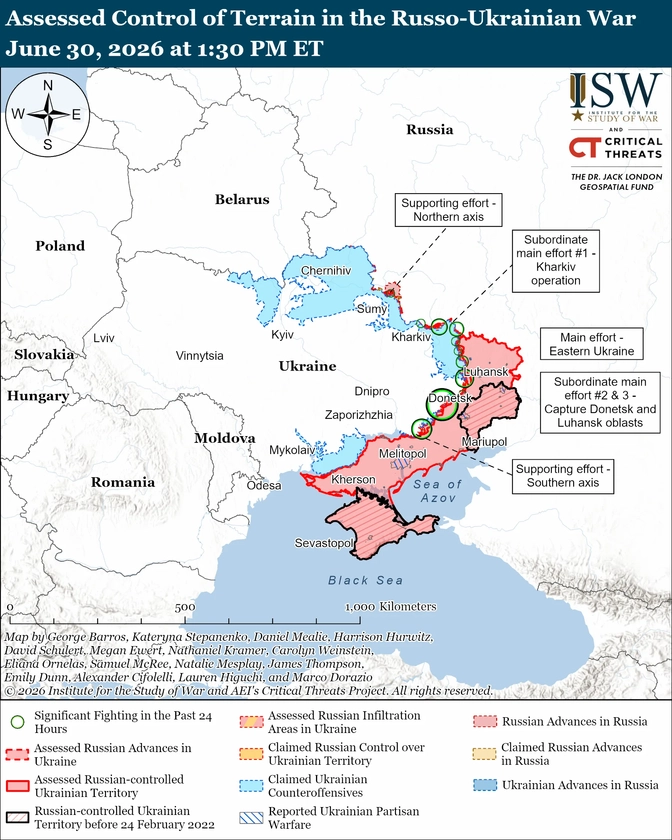
Meanwhile, on the front line, Russian attacks have been effectively stalled since fall 2025, Russian casualties have outstripped Russian recruiting for the past five months, and since early 2026, Ukrainian counterattacks have liberated (slightly) more ground than Ukraine’s military has lost.
What has been Trump’s most morally indefensible lie about Ukraine?
If the metric is on where one takes a stand on life-and-death matters, President Trump’s repeated defense of Russia’s invasion of Ukraine and readiness to blame Ukraine for being invaded are probably the Trump declarations most likely to appall voters and people affected by the Russo-Ukraine War.
During a Feb. 18, 2025, press conference at Mar-a-Lago, Florida, Trump asserted that Russia was not engaged in a war to destroy Ukrainian sovereignty, and claimed the Kremlin was pulling its punches against Ukraine on humanitarian grounds.
Trump said:
“Russia does not intend to destroy Kyiv. If they had wanted to, they would have done it. Russia is capable of wiping out Ukrainian cities 100%, including Kyiv, but right now, they are only attacking at 20%.”
Trump’s “good friend” Vladimir Putin, Russia’s president, has repeatedly criticized the existence of an independent Ukraine, but most specifically called for the destruction of the Ukrainian state and Ukrainians as a nation distinct from Russians in a Feb. 21, 2022, nationally-televised address, Putin’s comments included:
“Modern Ukraine was entirely created by Russia, more specifically, by Bolshevik, Communist Russia…Ukraine never had stable traditions of real statehood…Ukraine is not just a neighboring country for us. It is an inalienable part of our own history, culture and spiritual space.”
Trump, in a Feb. 18, 2025, Mar-a-Lago interview, told the UK’s BBC that Ukraine’s unwillingness to surrender its independence to Russia, and unwillingness to allow Russian police state government be imposed on Ukrainian citizens living in territory invaded by Russia, made Ukraine responsible for the Russian invasion that at that time had probably already killed or wounded a million people.
The remarks in question were made after US-Russian talks in Riyadh that had not included Ukraine. BBC News covered the exchange and broadcast Trump’s comments in full.
The immediate context was Trump’s response to Ukrainian complaints that Kyiv had been excluded from the talks. Trump said of Ukrainians fighting for their country:
“Well, you’ve been there [resisting Russia] for three years. You should have ended it three years [ago]. You should have never started it. You could have made a deal.”
Almost anyone considering freedom and independence as values worth fighting for would probably question Trumpian logic that, if applied during World War II, would see Britain negotiate terms and turn Europe over to Nazi Germany and the Gestapo, or that in 1776 would have had George Washington and the Minutemen abandon independence and accept British rule along with the King’s justice against rebels.
What has Trump said about Zelensky that’s been the most detached from reality?
This US president has regularly accused his Ukrainian counterpart of stubbornness, evading peace talks on US terms, which arguably are fair charges, but he has also applied a tactic Trump has used against domestic politicians – questioning their popularity and legitimacy. Almost without exception, Trump’s attacks were probably libel or slander.
On Feb. 19, 2025, Trump in a TruthSocial post, wrote of the Ukrainian leader:
“[A] modestly successful comedian, Volodymyr Zelenskyy, talked the United States of America into spending $350 Billion Dollars, to go into a War that couldn’t be won, that never had to start…He refuses to have Elections, is very low in Ukrainian Polls…A Dictator without Elections, Zelenskyy better move fast or he is not going to have a Country left.”
The day before, at Mar-a-Lago, Trump said of Zelensky: “The leader in Ukraine, I hate to say it, but he’s down at 4% approval rating.”
Polling data from Ukraine contradicted Trump’s claim and established that in fact Zelensky had consistently high support rating between 57% and 67% across the Ukrainian electorate, depending on the polling company.
At the time, Trump falsely claimed Zelensky’s popular support was 4%, Trump’s own popularity stood at about 45-47%, or roughly 10% LESS popular with Americans, than Zelensky was at the time with Ukrainians. Currently, Zelensky’s popularity is on average rising at a 65-67% public trust level, depending on the poll. Trump’s current approval rating is 36-38%.
When it comes to talking about a foreign country, is Trump on Ukraine the most mendacious president in US history?
That seems possible, but without question, past US leaders have distorted the truth and foisted calumnies on US voters, when talking about another country, to a degree competitive with President Trump’s declarations about Ukraine.
During the early 21st century Republican President George W. Bush – possibly from ignorance or over trust of subordinates, and possibly because a US national leadership wanted a cassus belli – justified US invasion of Iraq in 2003 on the spurious claims that Iraq’s national leadership was within an ace of acquiring weapons of mass destruction (WMD), and that Baghdad was actively working with the group Al-Qaeda to carry out terror attacks in the Middle East and elsewhere, including on US soil.
The Iraq war killed 240,000-600,000 people, the Al-Qaeda link was proved to be imaginary, and neither WMD nor a serious Iraqi intent to develop WMD were ever found.
During the latter half of the 20th century US President Lyndon B. Johnson, probably because of ideological antagonism towards Communism and concern of potential loss of US geopolitical influence in the Far East, put forward as confirmed North Vietnamese motor boat attacks against US naval forces in the Gulf of Tonkin, and ordered troops into Vietnam to prop up a corrupt and unpopular pro-US regime in the south of the country.
Johnson said the intervention was necessary to “prevent the fall of dominoes” in Asia to Communism and because the South Vietnamese government was democratic.
As the war expanded and US forces became mired in jungle fighting against a Vietnamese enemy that by and large considered itself fighting for freedom from foreign control, Johnson and his government misled the US public about the effectiveness of US bombings, the number of Vietnamese civilians killed, and the overall progress of the war.
Many years later, historians concluded that of the two purported Gulf of Tonkin attacks, only one appears actually to have taken place, and even in that incident, it was not fully clear that a US Navy vessel had actually been fired on.
Between two and three million people died in the Vietnam War. The US pulled its ground forces out of the country in 1973 and communist forces took over the southern portion of the later unified country in 1975, after the US reneged on a promise to use air power to protect South Vietnam from North Vietnam.
You can also highlight the text and press Ctrl + Enter