The great philosopher Gottfried Leibniz argued that each individual substance mirrored the entire world. He was proven wrong by modern science, but he may have been right about his native country’s economy: Germany’s current predicament, it seems, reflects Europe’s as a whole.
This is not just because, as the EU’s largest and most industrialised nation, Germany is especially vulnerable to the bloc’s present litany of ailments, including high energy prices, sweeping US tariffs, and fierce competition from Chinese manufacturers.
JOIN US ON TELEGRAM
Follow our coverage of the war on the @Kyivpost_official.
It is also because, much as the EU’s share of global output has declined in recent years, Germany’s proportion of the EU’s total GDP has fallen. Europe matters less in the world – but Germany also matters less within Europe.
According to the International Monetary Fund, the present 27 EU member states’ share of global output has halved since 1980, falling from 27.4% to just 14% in 2025. Germany’s decline has been especially precipitous, dropping from 7.0% to 2.9% over the same period – meaning that Berlin’s share of the EU’s output has fallen from more than a quarter to just over a fifth.
The IMF also expects both of these trends – that is, the EU’s decline relative to the rest of the world and Germany’s within the EU – to continue over the coming years.
US Gives Poland ‘Green Light’ to Negotiate Permanent Military Base
To some extent, this is inevitable; perhaps even equitable.
The EU’s 450 million citizens, after all, account for just 5.5% of the world’s population. Germany’s 84 million citizens make up less than a fifth of this total. In economic terms, Germany and the EU are still punching well above their demographic weight.
What is not inevitable, however, is how rapid Germany’s decline has been. While India, China, and even some EU countries have expanded at a blistering pace in recent years, Germany’s economy has effectively stagnated since 2019. It’s much easier for others to catch up if you’re staying still.
Crucially, Germany’s ebbing economic clout also appears to be weakening it politically.
In 2024, Berlin failed to prevent the EU from imposing tariffs on Chinese electric vehicles. Its push last year to harness €210 billion worth of frozen Russian assets was blocked by tiny Belgium. Its recent proposal to fast-track Ukraine’s accession into the EU was angrily dismissed by Kyiv. And its fierce opposition to loosening the EU’s fiscal rules was blithely ignored by Brussels earlier this month – in order to appease spendthrift Italy.
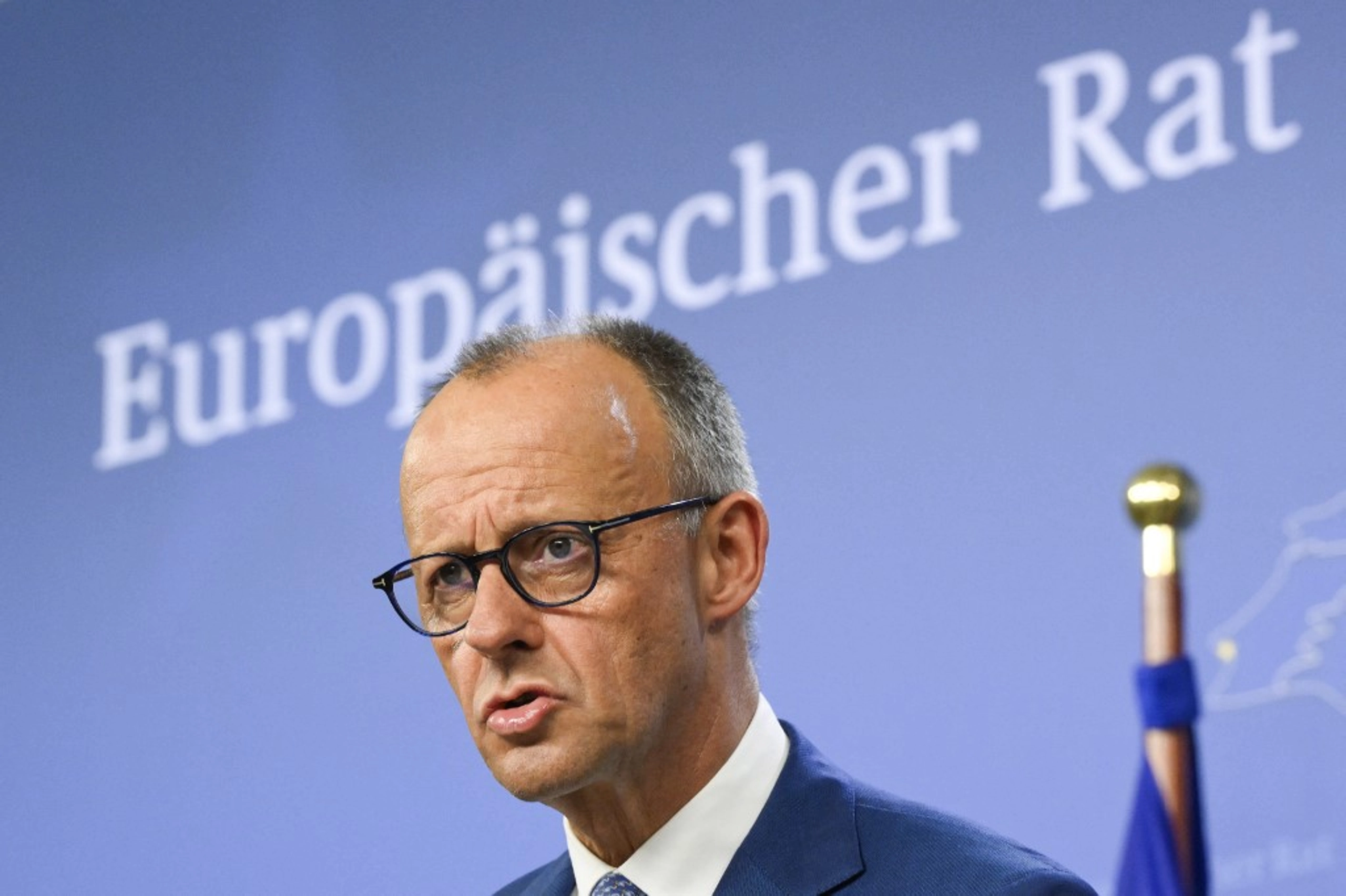
But is this causation or correlation? Couldn’t Germany’s waning political relevance be due to other factors – such as the inexperience or even ineptitude of Friedrich Merz, the country’s chancellor – rather than its diminished economic heft?
Many suspect it might be.
“Economic factors might contribute, but I think that the whole reconfiguration of the European system is more due to the lack of political leadership and political initiative in Germany, and its unwillingness to take risks,” says Linn Selle, head of the Europe Centre at the German Council on Foreign Relations.
Or as Leibniz might have put it: Germany might be suffering from pre-established economic and political (dis)harmony.
Geopolitical entropy
But shouldn’t this be celebrated?
After all, many smaller EU countries have long complained that power has been overly centralised in Germany and the bloc’s other traditional agenda-setter, France.
Moreover, at the global level, many developing nations – particularly those in the 11-country ‘BRICS’ group, which includes China, India, and Brazil – have warmly welcomed the world’s “multipolarisation”, which they argue creates a “less unequal” global geopolitical order.
Although there are certainly reasons to welcome this diffusion of power – developing countries certainly deserve a greater say on the world stage – it also involves significant risks.
One is that other centres of power within the EU don’t seem to be emerging.
This fact is somewhat surprising. After all, one might have thought that Spain – whose economy has far outpaced Germany’s in recent years – would have become an alternative EU power hub by now. Poland’s rapid military expansion and status as Europe’s eastern bulwark against Russia might plausibly have seen it do the same.
But they haven’t.
“I would say that currently power is moving away from Paris and Berlin,” says Selle. “But it isn’t moving anywhere in particular.”
This point was emphatically demonstrated by this week’s EU summit in Brussels, where leaders, in varying combinations and coalitions, disagreed about almost everything. Regardless of the issue – enlargement, migration, Russia, or the EU’s long-term budget – no one in Europe appears capable of taking the reins. And, inevitably, nothing substantive was actually agreed.
“You can have different coalitions for different issues,” Selle says. “[But] there needs to be a driver, because otherwise nothing will move.”
Fragmenting order
Unfortunately, we are likely witnessing a similar dynamic at the global level.
Fabian Zuleeg, chief executive of the European Policy Centre, argues that the current “diffusion” of power means the world is better understood as “fragmenting”, rather than “multipolarising”.
Multipolarisation “implies that power is shifting”, Zuleeg says. “Whereas, actually, what I think we’re seeing is that it is just simply becoming more difficult to have common decisions [and] common actions… I think all the actors have lost collective power to do things together.”
But doesn’t the rise of China, also fruitlessly debated by EU leaders this week, contradict this? Surely, Beijing’s growing manufacturing prowess, dominance over critical supply chains, and increasing geopolitical assertiveness show that it is becoming – indeed, that it has already become – an alternative power centre?
Zuleeg, however, argues that Beijing’s rise at best shows that the world is becoming bipolar, not multipolar.
“If we truly had a multipolar world… we would see a shift then also away from China,” he says. “And I don’t see that happening.”
Unfortunately, the structural forces underpinning this fragmentation – increasing economic nationalism, rising populism, and growing great-power competition – mean that it can probably only be mitigated, rather than reversed.
However, even mitigating this trend would require leaders who have strong domestic support or, even more importantly, political courage – something that Europe’s current cohort of premiers and presidents mostly lack.
“I think we don’t have the kind of leaders who can convince reluctant populations,” Zuleeg says, adding that, ironically, leaders’ political paralysis only strengthens the potency of anti-establishment parties.
“We don’t do anything because we’re too afraid… and then it’s an easy game for the populists to say: ‘You’re not delivering,’” he says.
Such pessimism, of course, wouldn’t have deterred Leibniz – an indefatigable optimist who believed we live in the best of all possible worlds.
Given Europe’s current predicament, one almost wishes he was right.
See the original of this report by Thomas Moller-Nielsen here.
You can also highlight the text and press Ctrl + Enter

Zelensky Reveals Intercepted Intel From Putin’s Desk