Nearly 7,000 Dutch troops are rehearsing how to halt a possible Russian-style NATO invasion by practically and formally integrating Ukraine’s combat techniques, in the Netherlands’ biggest army exercise in two decades.
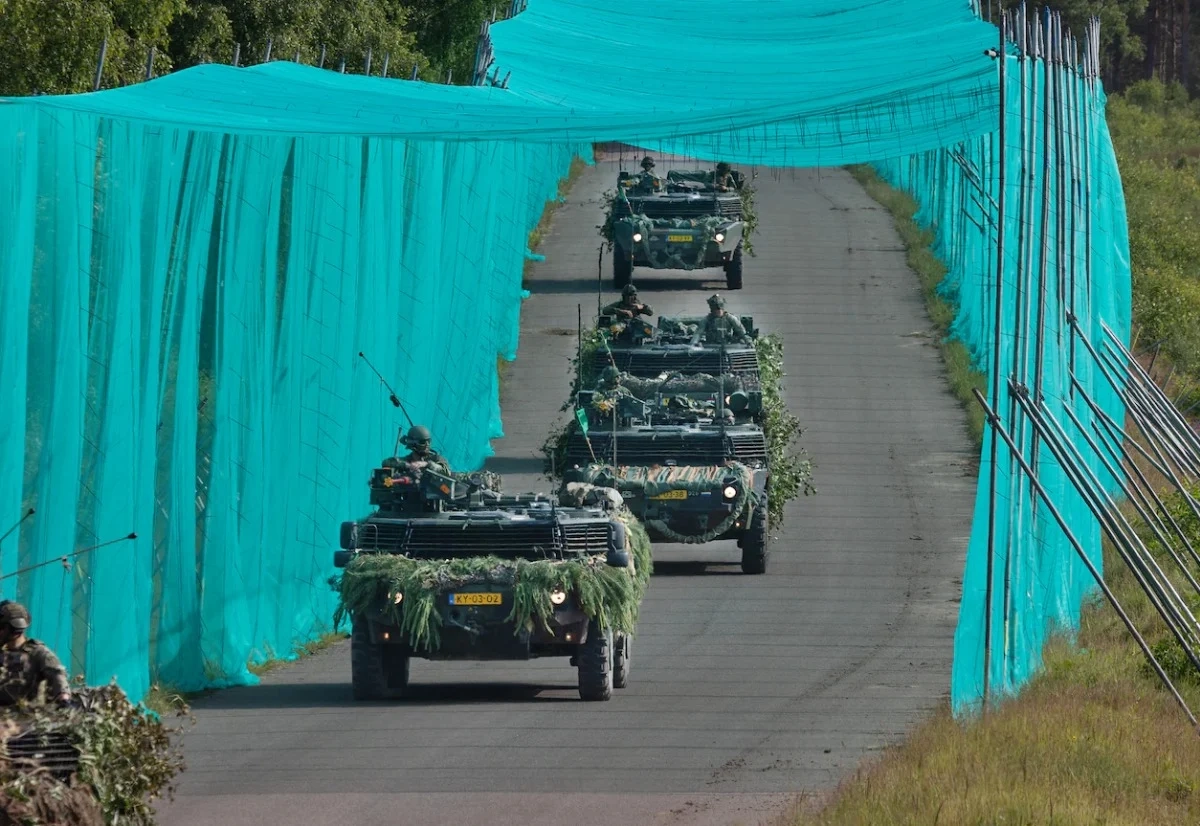
Exercise Fighter Lion was launched on June 1, with the first convoys departing from Havelte, according to the Dutch Ministry of Defense. The exercise runs through early July on the Bergen-Hohne training grounds, roughly 37 miles (roughly 60 kilometers) south of Hamburg in Lower Saxony’s forested lowlands, using fishing nets and anti-drone tunnels, as well as other lessons learned from Ukraine’s battlefield.
JOIN US ON TELEGRAM
Follow our coverage of the war on the @Kyivpost_official.
“It went great. We stopped the attackers,” the commander of the 13th Light Brigade from Oirschot said to regional outlet Eindhovens Dagblad, after completing the exercise’s opening defensive phase.
As per the Dutch Defense Ministry’s statement, the “goal is to maintain combat power during an extended period of time.” The exercise tests “not only combat effectiveness of units, but also their ability to cooperate and remain operational under realistic conditions.”
A war scenario built on reality
According to the Defence Blog, the exercise’s scenario is fictional, but “unmistakably based on Russia,” with the setup closely mirroring the actual defensive challenge NATO has identified along Europe’s northeastern flank.
South Ossetia’s Leader Quits, Becomes Putin Advisor Instead
The fictional enemy, a state called Murinus, crosses the Oder River – the real border between Germany and Poland – driving westward toward German territory. The Dutch army’s task is to stop that advance using the same defensive sequencing NATO planners would expect in an actual large-scale conflict.
“In Fighter Lion, brigades are preparing for a subsequent phase of combat,” the Dutch Defense Ministry said. “After an enemy attack, the 13th Light Brigade from Oirschot is tasked with halting a further advance. The 43rd Mechanized Brigade from Havelte then takes over the fight with heavier assets to defeat the enemy.”This year’s difference is marked in the cooperation – instead of brigades training on their own separately, they are now practicing handing off an active battle to one another, without stopping.
“Taking over an ongoing battle is a new component of the exercise,” the Ministry added.
Fishing nets and anti-drone tunnels
The Bergen-Hohne training area installed covered lanes built from fishing nets and camouflage frames, strung low over vehicle routes to break the line of sight of incoming drones. Ukrainian soldiers invented this out of necessity – after learning that a vehicle moving in the open can be spotted and hit by a kamikaze first-person-view (FPV) drone in seconds.
Reportedly, individual soldiers carry improvised protection as well, including umbrella-style anti-drone screens and personal fishing nets, improvised countermeasures that the Dutch troops are training with before other formal gear arrives.
Dutch troops also trained on armored vehicle and tank simulators, a method exercise director Brigadier General Jos Dirkx called essential for training without the physical damage and disruption of civilian areas.
Drone teams from a new Dutch army unit called “Tech Dev” was formed on April 1, as one of NATO’s first dedicated drone warfare formations, flying attack and surveillance drones throughout the exercise as part of the opposing force, “giving Dutch ground units realistic experience against” threats Ukrainian soldiers “face every hour of the day.”
Lieutenant General Jan Swillens, commander of the Dutch land forces, said the Netherlands leads within NATO on absorbing drone warfare lessons from Ukraine.
Sustaining the fight
The Dutch Ministry of Defense said that Fighter Lion is ultimately about testing not just whether units can fight, but whether they can keep fighting.
Resupply, vehicle maintenance and medical support are built into the scenario, alongside the combat phases, with electronic warfare units jamming communication throughout the exercise. Troops are training to remain undetectable in the electromagnetic spectrum, essentially using a skill that Ukraine has proven matters as much as firepower on a modern battlefield.
To limit disruption for Dutch residents, convoys were spread across multiple routes and timed away from rush hours, with the heaviest equipment shifted to rail transport whenever possible.
The Dutch government pledged €500 million (about $580 million) in new military aid to Ukraine on June 17, splitting the package equally, with €250 million (about $289 million) going toward purchasing drones from Dutch defense manufacturers, while the remainder will be contributed to the Prioritized Ukraine Requirements List (PURL) initiative.
In April, Ukraine and the Netherlands launched a joint drone deal, with the initiative providing for the joint development and production of drones, missiles, electronic warfare systems, and other defense technologies, including coordinated investment in defense infrastructure and research as well.
You can also highlight the text and press Ctrl + Enter

Kremlin Signals Readiness for Talks on Ukraine
Ukraine Secures Over $2.5B in Defense Aid, Zelensky Says