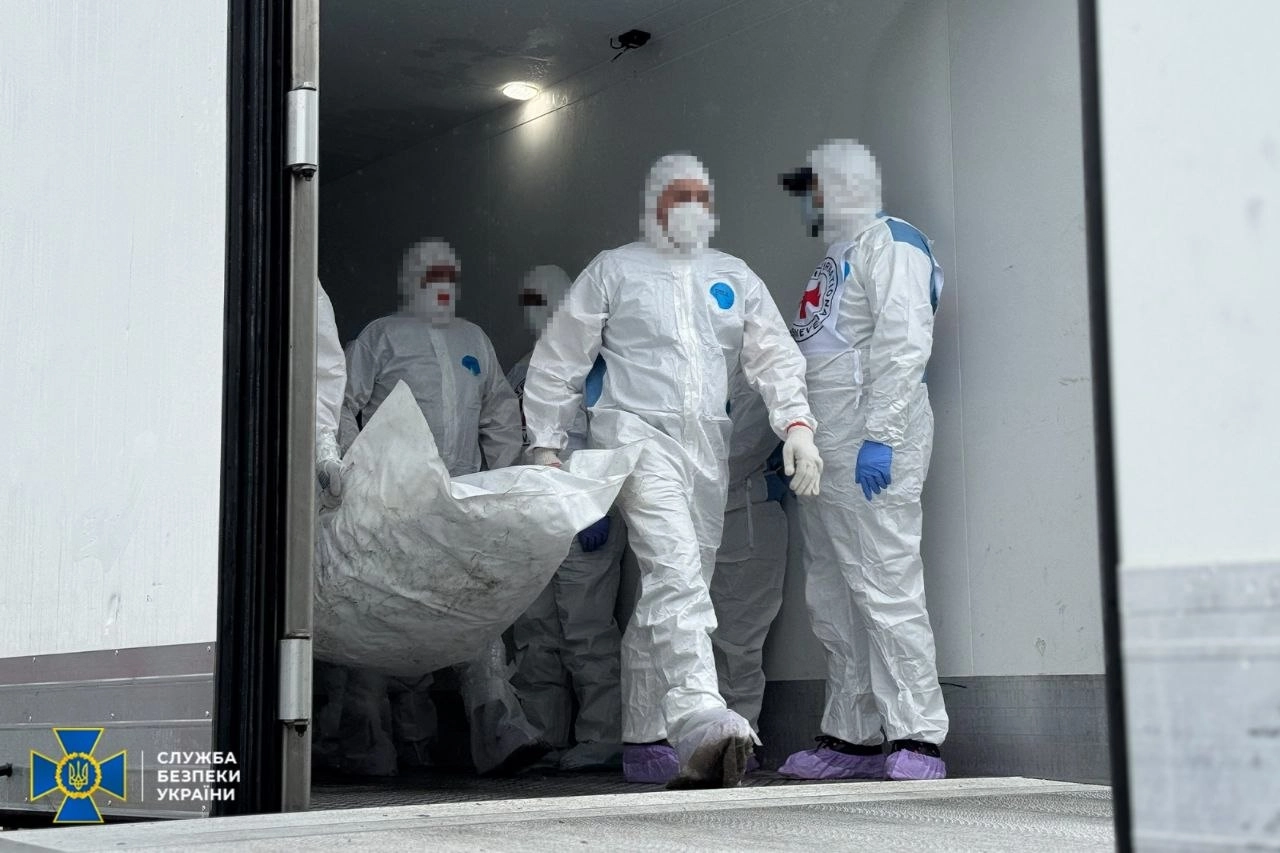
Explosive devices have been discovered multiple times in the bodies of Ukrainian servicemen repatriated from Russia, with investigators now saying they conduct mandatory safety checks before any identification work can begin.
Ukrinform reported on Tuesday, citing an exclusive interview with Taras Tarasenko, the deputy head of the investigative department and head of the unit for crimes against life and health at the National Police directorate in Kirovohrad region, where a significant number of repatriated bodies are being sent for examination.
JOIN US ON TELEGRAM
Follow our coverage of the war on the @Kyivpost_official.
“After the return of the bodies we carry out an initial examination,” Tarasenko said. “First of all, we check whether there are any items that may pose a danger. Such cases have occurred more than once. We have found explosive objects, grenades and other things, so we work as carefully as possible.”
H2:: Identification under threatening conditions
Once cleared of explosives and other hazards, specialists search for documents, mobile phones, dog tags and bank cards before a thorough forensic inspection begins.
According to Ukrinform, investigators record and photograph “special signs,” such as tattoos and clothes.
Tarasenko noted that batches of up to 200 or 250 bodies can arrive at once, making it physically impossible to process all of them in a single day. To maintain the quality of their work, his team aims to examine about 10 repatriated bodies daily.
Ukraine’s Battlefield Medics: Treating the Wounded While War Breaks Them Too
Police report that the remains of several Ukrainian citizens are often found mixed in a single bag, detected either visually or through subsequent DNA testing. In such cases, investigators and forensic medical experts carry out segmentation – separating the remains for further analysis to ensure each individual can be matched to their family.
Years can pass between disappearance and identification
The Kirovohrad Center for the Search for Missing Persons in Special Circumstances and the Identification of Unidentified Bodies of Servicemen was established at the Main Directorate of the National Police in 2024, Ukrinform reports.
“We have 32 people in this center,” Tarasenko said, adding that, in addition to their main work, the experts perform tasks related to the search and identification of unidentified bodies. The center brings together investigators, criminologists, cyber police and other specialists.
The Security Service (SBU) joins the search process as well, alongside the Coordination Headquarters for the Treatment of Prisoners of War and forensic medical services, as the center itself is not a separate body, but a coordinated unit within the existing police structure.
“It takes about 90% of our working time. Yes, there are other current tasks but this direction is now a priority,” he explained. According to Tarasenko, years can pass between a family submitting a DNA sample and a body being returned through repatriation, with the system only generating a match once both profiles are in the database.
“Today, we identified a person who went missing back in 2023. For three years nothing was known about their fate. The body was returned during repatriation much later, and it was only now that we were finally able to establish the identity,” Tarasenko said, adding that some cases remain unresolved since 2014.
Renewed repatriation efforts
Ukraine has recovered the bodies of 522 deceased citizens, including military personnel, following a new repatriation operation, Ukraine’s Coordination Headquarters for the Treatment of Prisoners of War reported on Thursday, June 18.
The remains were returned through a joint effort involving the SBU, the Armed Forces of Ukraine (AFU), the Office of the Parliamentary Commissioner for Human Rights, the State Emergency Service, and other security and defense institutions.
On Sunday, June 27, Ukraine secured release of seven civilians from Russian captivity, some of whom had been detained since 2022. The released individuals, reportedly aged 35 to 66, were captured during the occupation of the Mariupol, Kyiv, Kharkiv, Zaporizhzhia, and Luhansk regions.
The release of the civilians came amid renewed momentum in repatriation efforts. On Friday, June 26, Ukraine and Russia conducted a large-scale prisoner exchange, with each side returning 160 prisoners of war.
You can also highlight the text and press Ctrl + Enter

Russia Hit by 660-Drone Overnight Barrage Targeting Moscow, Crimea and Key Military Sites