The dispute between Poland and Ukraine over the memory of the Ukrainian Insurgent Army, known as the UPA, is not only a quarrel over one military unit or one presidential decoration. It raises a harder question: whether one state can condemn another’s historical commemorations while refusing the same scrutiny of its own.
The controversy followed President Volodymyr Zelensky’s approval of the name “Heroes of the UPA” for a Ukrainian military unit. Polish President Karol Nawrocki responded by deciding to revoke Zelensky’s Order of the White Eagle, Poland’s highest state honor.
JOIN US ON TELEGRAM
Follow our coverage of the war on the @Kyivpost_official.
For Poland, the UPA is associated above all with the Volhynia massacres of 1943, in which tens of thousands of Polish civilians were killed. Polish institutions have described those killings as genocide. For many Ukrainians, however, the UPA is also remembered as an armed formation that fought for Ukrainian independence against both Nazi German and Soviet rule, even though that record is inseparable from crimes committed against Polish civilians.
These two memories cannot easily be reconciled. But they also cannot be reduced to a single sentence.
The present dispute should be viewed through a legal principle: “clean hands.”
The principle is familiar in Anglo-American law and has analogues in European legal traditions. In simple terms, a party accusing another of wrongdoing weakens its claim if it has itself committed comparable wrongdoing. This applies to Polish-Ukrainian historical memory.
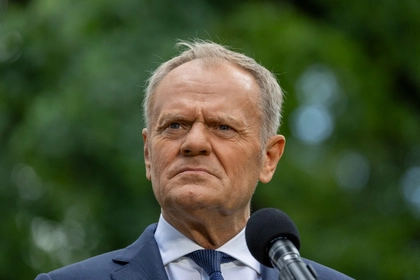
Polish PM Tusk Awaits ‘First Step’ from Kyiv to Ease Bilateral Tensions
It is not that UPA crimes should be denied, excused or minimized. Attacks on Polish villages and the killing of civilians would today be regarded as war crimes. The argument is different: Poland’s own wartime commemorative tradition is not free of the same moral difficulty.
Poland commemorates the Home Army, or Armia Krajowa, as the principal wartime resistance force loyal to the Polish government-in-exile. That commemoration is central to Polish national memory. Yet Home Army-linked and associated Polish underground formations were also involved in atrocities against Ukrainian civilians.
One of the clearest examples is Pawłokoma, where Ukrainian villagers were killed by a Polish military group in March 1945. The village later became part of Polish-Ukrainian reconciliation efforts when Presidents Lech Kaczyński and Viktor Yushchenko attended a joint commemoration in 2006. The importance of Pawłokoma lies not only in the number of victims, but in what it shows about the wider conflict: violence against civilians was not confined to one side.
This does not make the Home Army and the UPA identical. Nor does it reduce the gravity of Volhynia. It does, however, expose the asymmetry in the present argument.
Poland honors the Home Army for its broader struggle against Nazi Germany and Soviet domination, while treating atrocities committed by some units or associated formations as part of a complicated wartime record. Ukraine is being told that it cannot apply a comparable distinction to the UPA: that the movement must be defined only by its crimes against Poles, rather than also by its armed struggle against Nazi German and Soviet rule.
That is where the clean hands principle becomes politically relevant. If Poland reserves the right to commemorate a wartime formation despite crimes committed against Ukrainian civilians, it is difficult to claim that Ukraine has no right to commemorate the UPA for its fight for independence while also acknowledging its crimes against Polish civilians.
This is not an argument for moral equivalence. Scale matters. The Volhynia massacres occupy a specific and central place in Polish memory. But legal and moral reasoning do not depend only on arithmetic. If the question is whether one state may impose a single moral reading of another state’s symbols, then reciprocal historical responsibility becomes unavoidable.
The dispute also touches on the work of the French magistrate and legal philosopher Antoine Garapon, whose book Crimes Which Can Neither Be Punished Nor Forgiven examines the limits of justice when crimes are too grave to forget, but too historically complex to settle through punishment alone. Garapon’s formulation is relevant here because the Polish-Ukrainian argument is not a trial. No court is being asked to determine individual guilt. The dispute concerns memory, commemoration, honor and the moral language of the state.
Such questions cannot be resolved by symbolic punishment alone. They require acknowledgement, reciprocity and the refusal to erase victims on either side.
Since Ukraine’s independence in 1991, Polish and Ukrainian presidents have repeatedly tried to build that language of reconciliation. In 2016, then Ukrainian President Petro Poroshenko said both sides should say “we forgive and ask for forgiveness,” adding that historical questions should be left to historians. In 2023, Presidents Zelensky and Andrzej Duda jointly marked the victims of the wartime massacres.
Those gestures did not remove the dispute. But they established a political framework in which both nations could acknowledge suffering without turning the past into a weapon.
The danger now is that this framework is being displaced by unilateral accusation. That matters not only for Poland and Ukraine, but for Europe. Russia has a direct interest in any quarrel that weakens trust between Warsaw and Kyiv. A dispute over the Second World War, reopened during Russia’s war against Ukraine, is therefore not only a historical matter. It is also a strategic vulnerability.
For Ukraine, the challenge is to acknowledge that the struggle for independence included episodes that cannot be defended. For Poland, the challenge is to recognize that its own commemorated wartime formations were also implicated in violence against Ukrainian civilians. For both, the task is to prevent unresolved history from becoming a gift to the Kremlin.
The principle of clean hands does not settle the argument. It does something more useful: it prevents either side from treating history as a courtroom in which only the other party stands accused.
The views expressed in this opinion article are the author’s and not necessarily those of Kyiv Post.
This article is an adaptation from EU Today with the author’s permission.
You can also highlight the text and press Ctrl + Enter