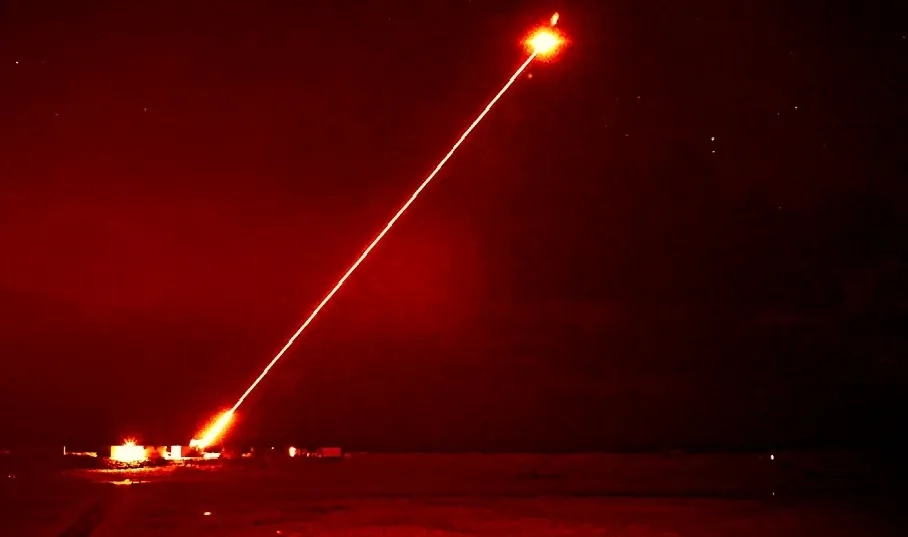
In the silent, split-second flash of a laser beam, Great Britain has rewritten the rules of modern air defense, taking a decisive step into the next era of warfare with this revolutionary laser system. It is a directed-energy weapon built by British engineers that can strike targets at the speed of light. Having successfully burned through drones in live testing, it will soon sit on the decks of Royal Navy warships. And, importantly, it also proves that Great Britain still holds the ability to deliver advanced capability when it applies clear intent fully backed by adequate investment.
This British-built system arrives at a turning point in the evolution of warfare. The war in Ukraine has shown the world how cheap drones can force major armies to rethink their assumptions.
Drones costing a few hundred pounds have destroyed modern tanks. They have taken down multi-million-dollar helicopters, and they have forced aircraft to adapt their flight patterns. Drone warfare has rewritten the economics of the battlefield. And this has revealed a central, lasting, strategic truth: battlefield advantage is not guaranteed by expensive equipment, but by superior speed of adaptation.
The system is a direct response to this adaptation – it reverses the cost equation that drones created. A defender who once had to fire a missile worth hundreds of thousands of dollars to stop a drone worth a fraction of that cost can now do the job with a laser that costs only a few dollars per shot. That changes the calculus of air defense. It frustrates saturation attacks, makes drone swarms far less sustainable, and critically, it gives the defender back the initiative.

Syrsky: Russian Maps Show False Advances to Please Top Command
The arrival of hyper-modern warfare
This reversal marks the arrival of what can be described as hyper-modern warfare. Modern warfare was defined by precision munitions, drones, networked forces, and rapid maneuver.
Hyper-modern warfare is defined by energy weapons, autonomous platforms, near-instant engagement cycles, and the blending of digital and physical battlespaces. The core of this new era is speed – speed of detection, speed of decision, and speed of engagement.
The UK’s directed-energy weapon fits this environment perfectly; it removes the lag between decision and effect as it reaches its target in less time than it takes to blink, quite literally.
On a tactical level, the laser system is disruptive as the beam has no recoil, it leaves no visible signature, and it requires no ammunition. And crucially, it does not warn the target. It simply burns through sensors and control surfaces until the drone fails. It offers sustained fire for as long as the system has power.
For a commander, this means a constant inner shield that cannot be exhausted in the same way that missile stocks can. It gives ships a reliable and persistent way to defend themselves against the fast and cheap airborne threats that now define the modern battlespace.
A dangerous world demands credible capability and credible investment.
Strategically, the significance is deeper. Britain has been criticized for not taking defense seriously enough, and senior military leaders have raised concerns about underfunding and overstretch. Recent reports described tense meetings as generals warned that the armed forces were being asked to pursue “moonshots” without adequate fuel behind them. That frustration reflects a wider concern across NATO. The unvarnished truth is that a dangerous world demands credible capability and credible investment.
This is where this cutting-edge capability becomes more than a weapon; it becomes an argument. While hurdles remain – such as ensuring the technology can maintain full effectiveness in all weather conditions and handle immense power requirements – its successful demonstration shows what the UK can achieve when it commits resources with clarity and focus. It demonstrates that sovereign technology is still within reach and that Britain can develop systems that will shape future conflict rather than simply respond to it.
The will was there; the funding was present, and industry delivered. This achievement is the proof.
Placing the system on Royal Navy ships is a strong start, with a stated goal to have them onboard by 2027. The real transformation, however, will come when directed-energy weapons are mounted on land vehicles.
A mobile platform equipped with a stable power supply and a reliable laser would shift the balance again. Armored units could defend themselves against drones without exposing their positions. Infantry units could disrupt reconnaissance drones, and logistics convoys could neutralize threats without relying on missile-based air defense. Once the technology matures to the point where it is rugged, reliable, and weather-resilient, the effect on ground warfare will be truly profound.
The new calculus of defense
This development reflects a wider, enduring truth: that warfare never stops evolving. Cheap drones disrupted modern forces, and now directed-energy weapons disrupt the drones. Hyper-modern warfare is no longer a theoretical future; it is the present reality, and Great Britain is helping to usher it in.
The significance of this development transcends mere military hardware. It is a declaration of national intent: the UK remains a sovereign technological power, capable of developing the systems that will define future conflict.
Crucially, DragonFire is more than a display of domestic capability; it is a reassurance to allies around the world. The successful creation of a system that rewrites the air defense cost-equation proves the UK is still a serious player and a powerful, indispensable ally to its partners in Europe, the Indo-Pacific, and further afield.
For London, the message is clear: the success of DragonFire must be a catalyst. Parliament must not just admire this capability but push forward with the funding and industrial strategy required to proliferate this defensive equipment, and tech like it, across all UK services – on land, at sea, and eventually in the air.
Finally, in a world where global risk and instability are rising, we must re-evaluate how we perceive strategic investment. It is time to consider the uncomfortable, yet vital, truth that Environmental, Social and Governance (ESG) principles cannot remain silent on the “S” of security. A stable, peaceful society is the fundamental prerequisite for any market to function. Investment in cutting-edge defense technologies, like this, is not an expense; it is a critical investment in the stability of democracies and the global economy.
Great Britain’s DragonFire is more than a weapon; it is the opening shot of a new era, confirming the UK’s place at the forefront of hyper-modern warfare and demanding a new, decisive commitment to national defense.
The views expressed in this opinion article are the author’s and not necessarily those of Kyiv Post.
You can also highlight the text and press Ctrl + Enter