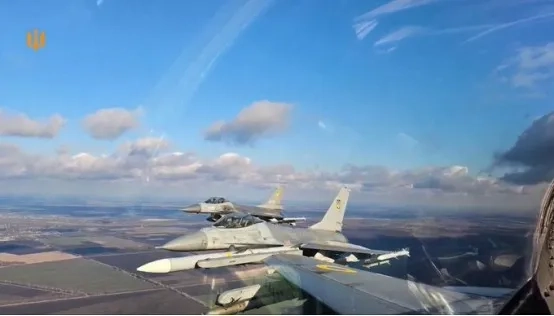
I’ll start this off with a screen grab from the first Ukrainian official Air Force video interviewing an F-16 pilot. There’s not a lot of useful information. The pilot says F-16s are great and the Russians are afraid of them, and he doesn’t say anything about the Americans cutting off spare parts and targeting information, so no surprises there.
But among the images in the video was a shot of three (!) Ukrainian F-16s flying somewhere. I’m pretty sure that’s the biggest multi-ship visual we have of Ukrainian F-16s, ever. So, image.
JOIN US ON TELEGRAM
Follow our coverage of the war on the @Kyivpost_official.
If you are outside Ukraine, I suspect it looks like nothing is happening and the war’s over because the news is all about the Trump top advisors and their collective face plant on discussing air strikes vs. Yemen on Signal with a pro-journalist invited to the chat.
On that scandal, my only direct comment is I TOLD you these guys were idiots. Let’s not forget, right after they got into power, they released an entire email list of every CIA staff member onto the internet. Pretty recently I ended a review with a picture of a rake to illustrate Trump administration diplomatic competence. Since others have done it in detail, and are continuing to do so, for sure there’s no need for me to dissect the Signal scandal here.

UK Royal Marines Intercept Russian ‘Shadow Fleet’ Tanker in the English Channel
Still, from the Ukrainian point of view, one of the US government’s biggest lies told this week – and as we have seen, there was a LOT of competition – was tied to the Signal scandal, or more specifically, an attempt by US National Security Advisor Mike Waltz.
Most of you will know he’s the guy who actually set up this stupid chat group. On Wednesday, in a Fox interview, Waltz went on TV, took a bunch of softball questions, and told viewers the White House isn’t getting fair treatment in the media, because reporters are ignoring all the huge positive news that is out there.
The reality on the ground in Ukraine is that there is a huge war still in progress, and that the fighting intensified this week.
Among the many recent major government successes engineered by the Trump Team that is not getting enough reporter love, Waltz said, is that the Trump administration negotiators had just stopped the fighting in Ukraine by “getting a ceasefire” and “ending” the biggest war since World War II.
Even by the historical standards of the White House, which we should recall has been inhabited by the likes of Richard Nixon (Watergate), Ronald Reagan (Iran-Contra), Lyndon Johnson (Tonkin Gulf), William McKinley (Remember the Maine!), George W. Bush (Weapons of mass destruction) and William Clinton (Never Inhaled), Waltz’s lie was right up there with the Great Ones.
The reality on the ground in Ukraine is that there is a huge war still in progress, and that the fighting intensified this week.
The Russians launched a new round of ground attacks in the east, the Ukrainian incursion into the Belgorod region got bigger, and the sides traded beefy and multiple long-range strikes.
I’ve deleted the update on ceasefire talk progress, discussing it is a waste of time in my view.
Conservatively, 3-8,000 Russian soldiers were seriously killed or wounded this week. Rough count, Russian drone strikes caused major damage and injured 300-800 civilians in a half dozen Ukrainian cities.
My back-of-the-envelope figures, this week I’d guess the Russians launched something like 1,000 drones and missiles at Ukrainian rear area targets, and the Ukrainians probably sent about half that the other way. Weather’s nice, so us civilians got to hear plenty of shooting and explosions out our windows.
So no, not a ceasefire. In that spirit I’ve deleted the update on ceasefire talk progress, discussing it is a waste of time in my view.
Belgorod
The Ukrainian incursion into the Kursk region is effectively at an end. The Russians recaptured the border checkpoint by the city of Sudzha. And of that salient, all that appears left is a 1-3 kilometer (.6-1.8 mile) wide slice of Russian territory still held by the Ukrainians.
In neighboring Belgorod region, the new Ukrainian invasion into Russia – which we flagged two weeks ago – seems to be possibly expanding a bit, but mostly digging in and then chewing up what the Russians are throwing at it.
The main Ukrainian objective here clearly is to inflict casualties, although for sure, there is a media messaging “See! Ukraine can take the initiative!” aspect of it as well.
Russian sources say the Ukrainians have invaded with a force of about 4,000 men. They primarily are moving on foot, as infiltrators, but armored units are making raid-type attacks as well.
Video has surfaced of Ukrainian engineers cutting gaps through Russian dragons’ teeth on the border and combat vehicles moving through. The heart of the Ukrainian position is still around the village of Demidovka. Mainstream Western media is saying this is a 3-to-4-kilometer (1.9-to-2.5-mile) penetration into Russian defenses.
Basically, we spotted this more than a week ago. The primary Ukrainian units involved seem to be, mostly, forces pulled from the Kursk incursion.
The list includes 225th Separate Assault Regiment, 47th Mech Brigade (these are the ZSU’s two main Bradley operators), 33rd Assault Regiment, 24th Assault Battalion (i.e., the current military version of the 2014-15-era Aidar volunteer group), and the Russian Volunteer Corps (RDK).
This is evidence of some discipline in those units and of a fairly organized withdrawal from Kursk.
Taken together, these are all proven attack units, but they are nothing like a proper, well-rounded combat brigade or two. This is a pretty textbook example of Ukrainian hodge-podge operations. Up to you to decide if that’s because the generals in Kyiv decided these particular units had just the right skill sets and aggressiveness for this particular operation, or if it was just grabbing available units.
I think it’s worth noting that most of these units were in heavy combat in the Kursk sector and retreated from there. Since we are now seeing them attack about a week later, I would say that this is evidence of some discipline in those units and of a fairly organized withdrawal from Kursk. Had it been a rout, bad units would have dissolved and been useless for at least a month.
Also in the area, and clearly at times operating behind the Russian lines, are special ops teams from HUR and the SSO. There is some pretty strong evidence that some of them are carrying laser designators, as we can strongly suspect the Ukrainian air force has put in some very precise bomb on targets in the Russian rear area that normally wouldn’t be that accurate, unless somehow the Ukrainians had a way to guide the bomb in.
Russians report a brutal Ukrainian drone presence.
The teeth of this operation are very clearly the 414th Unmanned Aircraft Brigade, whom most of you will recognize as our old friends, Ptakhi Madyara.
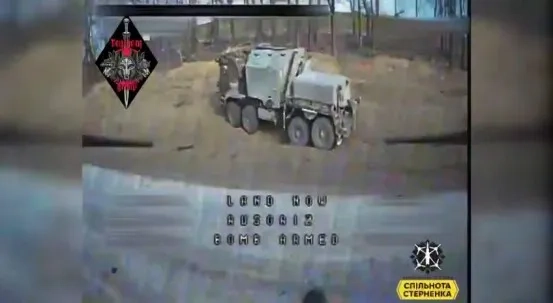
Unit information feeds (Commander Robert Brovdi) report a very target-rich environment and many kills and that we have to wait for video because of security. Russians report a brutal Ukrainian drone presence. Image of a Ukrainian drone flown by the SSO, zeroing in on a Russian truck modified to be an armored troop transporter, Belgorod sector. Probably this was a crew for a BM-21 rocket artillery battery being sent to deal with the Ukrainian incursion.
A fairly odious Russian journalist lady named Anna Prokofieva – she was a glam war reporter for RT-1 – died in a mine strike near Demidovka on Tuesday. Over the past three years, Prokofieva built a pretty solid career in mainstream Russian news thanks to her looks and willingness to report from near the fighting. Her work was very much in outspoken support of Russia’s invasion of Ukraine. The day before she died, she told viewers she was in the field near “Country 404,” a common Russian propaganda term for Ukraine – the idea is Ukraine doesn’t exist like a missing page on the internet. Image.

We know the 414th’s tactics: once they are in a sector, they mine approach roads systematically. Since even an RT-1 crew probably wouldn’t be so crazy as to try driving cross-country near the fighting line. I’m guessing Prokofieva hit one of those mines. Her cameraman and driver were badly injured but are still alive, I read.
There are unconfirmed reports that the Ukrainians have positioned three powerful conventional units (22nd and 61st Mechanized and 17th Heavy Mechanized) brigades in the area but I’m not clear what they’re up to.
To the west, it appears the Russians pushed a counterraid into Ukraine’s Sumy region around the villages of Zhuravtsy and Novenky. This looks less like a major operation and more like a reinforced foot incursion, but reports aren’t clear. The Ukrainians are saying they stopped it cold and killed Russians. Maybe. What is clear is that reinforcements, at least one sizable Ukrainian infantry unit, got deployed there towards the end of the week.
The East: Ukrainian Defensive Operations
The main news here is that the Russians have intensified the frequency and scale of their ground attacks in the east, simultaneously with the “ceasefire.”
On the statistical side, the Ukrainian army is counting about a 17-20% increase of confirmed engagements in the sector, and day-by-day, they are counting 180-200 individual attacks – it was close to 50% more than a week ago.
Putin, in a televised meeting on Thursday, said that Russia had thought it would just outlast Ukraine, but, these days, Russia is of the opinion that it has the manpower and resources simply to defeat Ukraine.
Overall, results for the Russians have at best been mixed.
Part of this was very clearly messaging intended to match the White House view that Ukraine has no chances and should give up, but also quite clearly, the Kremlin has determined the ground is dried enough and spring is progressed sufficiently for more offensive operations aimed at exhausting the Armed Forces of Ukraine (ZSU).
Overall, results for the Russians have at best been mixed. Over the week, Russian daily casualties, as reported by the Ukrainians, shot up from an average of 1,200 a day a couple of weeks ago to 1,700-1,800 a day.
The main objectives appear to be to gain ground and eventually cut off the cities of Pokrovsk and Kostiantynivka – these are both long-term goals that the Russians have been pushing towards for months.
From what I gather, about 10 square kilometers (3.9 square miles) were gained to the south of Kostiantynivka, but along the other 99% of the line in that sector, the Russians made no progress. There were plenty of reports of attempted Russian assaults that failed. Most appear to have been infantry moving in light vehicles, a few were proper combined arms assaults.
One of the bigger Russian attacks of the week was a battle in the Kupyansk sector, 77th Airmobile Brigade was defending.
On Friday, they published video and claims saying that after staying quiet for three weeks, the Russians hit Ukrainian positions with artillery, mortars, multiple launch rocket systems (MLRS), dumps, first-person view (FPV) drones, and Russian glider bombs (KABs), and after four hours of bombardment pushed 16 armored vehicles out into the open, at about midday.
The bombardment either missed or hit strong fortifications, but in any case, the 77th was able to drop mines in the column’s path, call in its own artillery, mortars, and drones, and once the column was stopped and the Russian infantry went to ground, the FPV drones moved in to hunt down survivors.
The Russians fell back, no ground gained. Estimated Russian losses: 60 dead, 28 wounded, 12 light armored vehicles, and one tank destroyed. The main source is a battalion commander talking on the unit information feed but the Khortytsia Group of Forces confirmed the action as well.
Screen shot of multi-spectral over-watch of the battle in progress, courtesy of 77th Brigade tactical HQ. To be clear, this isn’t slapdash volunteers fighting. This is, what in NATO would be called, a combat-tested battle intelligence fusion cell. It’s hard to see the Ukrainians be competent like this and then have someone point out that Ukraine is losing. It’s pretty obvious the ZSU has combined defensive operations down to a pretty efficient drill.
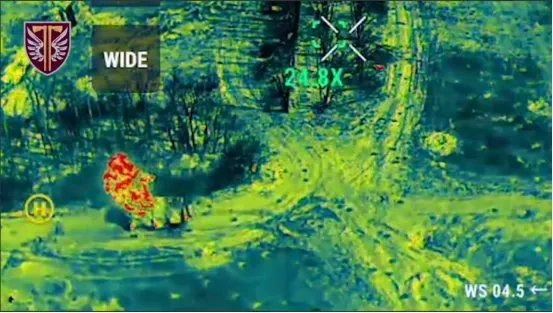
Here’s a link to a smaller fight. This morning, 72nd Mech Brigade claimed five Russian vehicles were destroyed, 26 men killed, and 33 wounded. The tactics are exactly the same: wait for the Russians to come out into the open, stop the column with drones, mines and artillery, then finish off survivors with drones. It seems 59th Shock, 35th Mech and 414th Drone (this is Ptakhi Madyara again) also were in on the fighting.
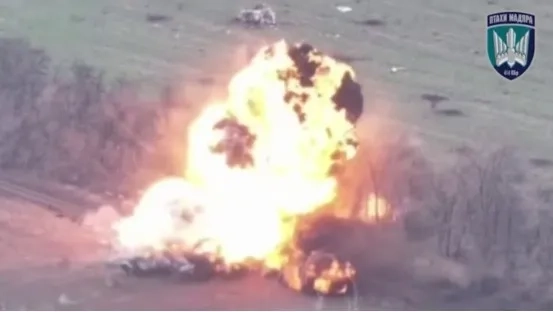
In separate stats, the 414th said its pilots operating in the Pokrovsk sector recorded on March 27: 192 successful drone strikes, including 28 destroyed vehicles and 60 Russian soldiers killed or seriously wounded. Image from one of the strikes.
Also, over the week, it appears local Ukrainian attacks have taken ground back from the Russians to the south-west of Pokrovsk near a village called Kotlyne.
I don’t want to give the impression that every defensive battle fought by the ZSU is lop-sided like this, but nonetheless, the overall picture is – the Russians attacking in lots of locations and getting cut up almost everywhere. The big picture is that Ukrainians aren’t losing, they’re basically holding strong, and the Russians are really struggling to gain ground and taking serious casualties in the process.
The east: Toretsk, Russian POWs and drones for all
If you count the number of attacks reported across the line on a given day, it seems like Russian attacks outnumber Ukrainian ones ten or even twenty to one.
In some places this week, the Ukrainians attacked in the east and were successful.
But if you count the number of attacks that seem like they gained ground, then here is some news: This week, roughly speaking, my read of things, the Ukrainians were pretty close to on par with the Russians. This is not a scientific conclusion, I’m basing that on a close reading of the battle reports, geo-location where it’s possible, and due weighting for which sources I think are trustworthy and which less so.
At minimum, the evidence is clear, in some places this week, the Ukrainians attacked in the east and were successful. Like the Russians, relative to the overall front, the scale of the ground gains were minor.
The most visible and easy-to-document Ukrainian success came from the Toretsk sector where, for those of you who like to recall such things, the Ukrainians supposedly were defeated and kicked out of the town about two months ago. Then it turned out that the Russians were exaggerating a bit, then it turned out that actually, the Ukrainians were hanging on to the western edge of Toretsk, and then it became pretty obvious that actually, there was a nasty fight going on, house-to-house, inside the city. In the past ten days, the Ukrainians clearly have gained ground, but it’s just as clearly ruined buildings still under heavy Russian fire.
On Thursday, March 27, a unit we know well and that is in the sector, 12th National Guard Brigade a/k/a Azov, announced its offensive operations around Toretsk were proceeding well, and as proof, published video and images of 20 recently-captured Russian prisoners of war, including a lieutenant.
By the standards of this war, 20 POWs captured in a single battle is a lot. Units defeated by Azov seem to be mostly elements of Russia’s 9th Motor Rifle Brigade and a few men from the 20th Motor Rifle Regiment. The soldiers mostly said they were from central or western Siberia, which matched those two formations. Irkutsk, Chita, Tiumen, Perm – places like that. Some from Cheliabinsk. Zero from west Russia and/or big western cities like Krasnodar, Moscow, or Petersburg.
Here’s what a Ukrainian officer-blogger says of the situation in Toretsk:
”In Toretsk, frankly, it’s a big mess in the city. Either we or the f*ckers are pushing for positions, houses are changing hands, it is difficult in such a situation to put something together and talk about a specific situation.”
Azov is one of the best-trained and most-disciplined units in the entire ZSU, and if there is a more aggressive one, I don’t know it. The easiest explanation is that Azov recon found an isolated platoon of Russians and 12th Brigade staff put together an operation to surround them. This is something you expect a professional infantry brigade to do day in/day out. In the ZSU, this is (still) rare. But in any case, the capture probably happened, and the POW video I think is real.


Russian video says that 150th Guards Division is attacking in Toretsk. They are supposed to be a better unit, not least because by pedigree they are the guys that took the Reichstag.
That video confirms the Russians see drones as the threat and that the best defense is to drive fast at night. This is from the Russian propagandist Simon Pegov – he wasn’t there, but he says it’s authentic.
It’s a pretty accurate video on trying to get somewhere when there are drones in the air. I’ve also stuck a link from Ukraine’s 28th Mech Brigade trying to defend themselves with shotguns – also Toretsk sector. Drone terror is real. Getting hyper about hearing buzzing in the air somewhere is a real thing on both sides of the lines.
I think in passing it’s also worth noting the airborne troops command put up a video of six Russian POWs recently captured in Kursk sector, all from 1427th anti-tank brigade. It appears they got captured by SSO special operators. The 100th Mech Brigade today posted a video, another POW, 130th Regiment, also from Toretsk sector.
Russia bombs Ukrainian cities even more
This week has seen a clear spike in Russian drone strikes against residential regions of cities.
This is Dnipro, Kharkiv, Krivoi Rih (Iskander), Kherson, Kyiv, Poltava.
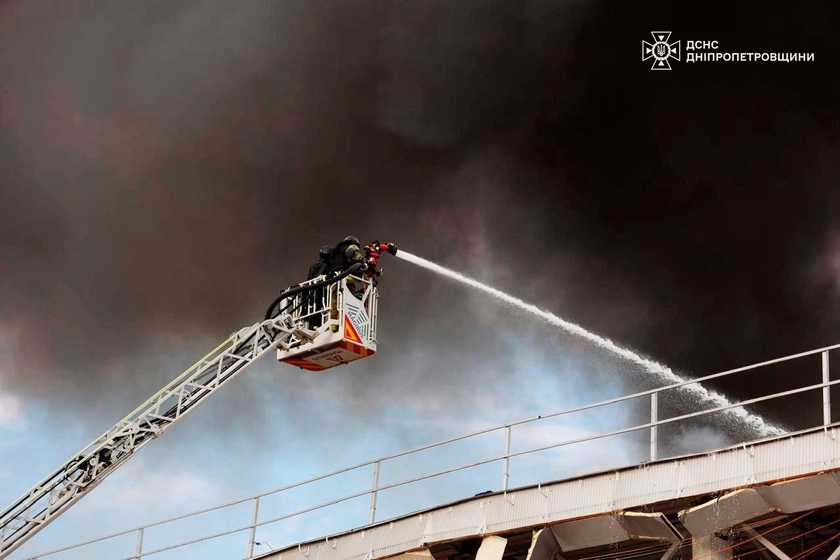
In Dnipro, four dead, about 30 injured. Buildings hit include hotels and restaurants. The image is before/after of a Dnipro restaurant that was a fashionable venue for weddings and rich people shindigs. I hear they had excellent seafood.

I’ve seen reports that the Russians have changed up their tactics and instead of sending drones in waves, they’re trying to have the drones show up all at once. Also, more at a time – last night it was 172 drones launched of which 94 were shot down and 69 were supposedly jammed and made ineffective. It seems like more than nine got through, but those are the official numbers. Launch sites are Millerovo in Kursk region, Primorsko-Akhtarsk on the Sea of Azov and Cape Chauda in Crimea.
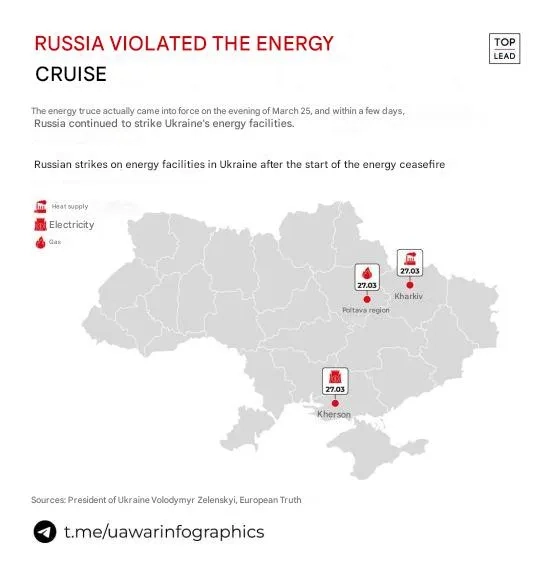
For the record, over the week, the Ukrainians concluded, three of these massed attacks hit Ukrainian energy infrastructure and so violated the theoretical-verbal-it’s-what-the-Americans-said “ceasefire” on strikes by both sides on that particular target.
The Russians and the Ukrainians hit power infrastructure in Crimea and Kursk regions. Image of the Russian attack locations.
Ukraine to make its own anti-aircraft missiles
Zelensky announced this week Ukraine has received licenses for the production of air defense systems from some European countries, as well as access to (chance to purchase? draw from stockpiles?) their ammunition depots.
Earlier, Ukraine tried to obtain licenses from the US for producing Patriot missiles but was refused. It’s not clear what missile types are being discussed here, although logical would be the shorter-range but highly-effective IRIS-T and/or NASAMS air defense systems.
It’s worth recalling that General Oleksandr Syrksy, in February, said Ukraine was going ahead with producing its own anti-aircraft missiles.
Given the way the European states seem to be enthusiastic about manufacturing arms in Ukraine and unable to get up to do the same thing quickly at home, this report points to Ukrainian manufacture of a European anti-aircraft missile somewhere down the line.
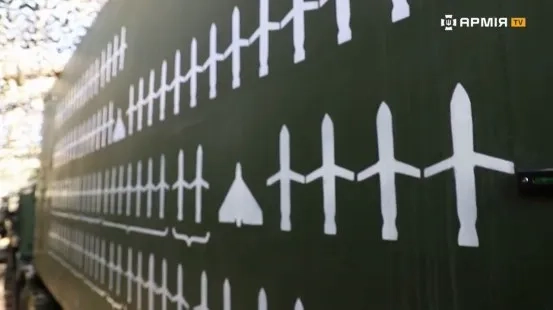
Screen grab of a Ukrainian IRIS-T system with kill markers.
Where are the rubles?
A news report from Khakassia, Russia – down by Mongolia – said that salaries are running short for teachers. This, because salaries are due to be paid at the start of the month, but taxes are collected at the end of the month.
This is a pretty accurate acid test, proof positive that in the region Khakassia, Russian local government is now so cash-strapped that it is living “paycheck-to-paycheck,” meaning it already has probably cut whatever services it can – like road repair, public building maintenance, and support to state propaganda.
Those of us old enough remember well the chaos that hit Russia in the ‘90s when state employees didn’t get paid for months at a time, and when they did, a lot of the money had been eaten up by inflation. This is a precursor. Tourist-friendly Khakassia image.

Man, that’s some flexible goal posts
OK, President Trump’s “I’ll get peace between Russia and Ukraine in 24 hours” has now transformed to “We’ll tell you.” To wit, this week US Secretary of State Marco Rubio said the US would try to achieve peace in Ukraine “as long as it takes,” and gave no guarantee that peace could be achieved anytime soon.
His answer to a reporter asking what about the quick peace the president has been promising was: “That doesn’t mean I can guarantee you an agreement in a week or a month. I just can’t put a time frame on it because it’s not up to us.” Peace depends on the Ukrainians, Russians, and Europeans, he said.
Rubio didn’t say it directly, but he made clear that a big stumbling block is that the Russians are demanding all sanctions lifted and the Europeans are saying no sanctions lifted until Russia leaves Ukraine.
Rubio is not a leading figure in the Trump administration, but, if he says it out loud, then it’s safe to say it’s what the others admit to themselves when they think reporters aren’t listening. Since the Ukrainian national leadership follows the US news, the upshot is that the Zelensky administration is going to be in even less of a hurry to give Trump a quick peace deal than it was before.
CIA boss points out, yes, the Ukrainians will fight
On Wednesday, during the Signal scandal fracas, multiple administration officials were getting hauled over the coals in front of Congress, and among them was John Ratcliffe, America’s top spy.
He did his share of you can’t pin that on me copper tap dance (“I just don’t recall,” and, “I didn’t say that,” and, “Well, maybe it was sensitive information but it wasn’t the same as classified information,”) when legislators tried to pin him down on the giant security breach the Signal scandal was. But also, almost in passing, he said this:
”With regard to the Ukrainian resistance, the Ukrainian people and the Ukrainian military have been underestimated for a period of several years now. And ultimately, from my reflections in observing, from an intelligence standpoint, I’m convinced that they will fight with their bare hands if they have to, if they don’t have terms that are acceptable to an enduring peace.”
This is, of course, diametrically opposed to the position of Vice President JD Vance, who told Volodymyr Zelensky to his face that Ukraine is defeated, and Ukraine should surrender. Congress didn’t ask Ratcliffe directly, he volunteered the statement. This is a pretty serious crack in the Trump administration’s official narrative on Ukraine.
The Trump team isn’t monolithic.
It could be Ratcliffe sees the administration’s policy of selling Ukraine down the river will fail and he’s trying to distance himself from it, and it could be that his boss, the Hawaii National Guard Military Police Major Tulsi Gabbard, isn’t passing on that evaluation to the White House and talking to Congress was a way for Ratcliffe to bypass her.
But bottom line, if you look closely, the Trump team isn’t monolithic, it’s individuals and power groupings competing for the dictator’s favor. Image of Gabbard and Ratcliffe.

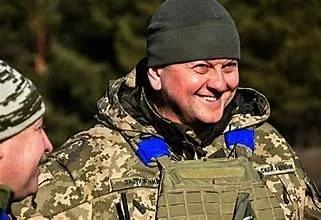
General Zaluzhny thinks NATO is sort of funny
General Valery Zaluzhny, the former ZSU top commander, was giving a talk in Europe somewhere this week and the discussion came around to Russian strikes against Ukraine spilling into Romania, and more generally, how effective he think NATO’s Article 5 is at protecting a country in the Atlantic Alliance.
Zaluzhny is known for a well-developed sense of humor and this is what he said: “There is no Article 5. They called me from Romania, and they asked not to say that the Russians were sending Shahed drones against us [Ukraine] that were hitting Romania. The Romanians said ‘Why are you jamming the Russian drones? They’re flying into our air space!’.”
“I told them ‘Shoot them down yourselves, you have 40 F-16s standing by, why are you asking me to defend NATO?… The Baltic countries understand that there is no Article 5 of NATO [on collective defense] and never was. Poland understands this, where periodically our missiles fall, then Russian ones. Romania understands everything, but is silent.”
Why invade Ukraine to keep Ukraine out of NATO if NATO is useless?
I would say Zaluzhny’s view is very much the conventional wisdom on NATO among people who think about it these days.
Honest people point out that Russia’s theoretical casus belli and justification for war – that Ukraine might join NATO – is obsolete and irrelevant, because NATO credibility to stand up to Russia already was weak, and that was before the US government changed and the Trump administration threw NATO and American commitment to NATO under the bus. So why invade Ukraine to keep Ukraine out of NATO if NATO is useless?
Reprinted from Kyiv Post’s Special Military Correspondent Stefan Korshak’s blog. You can read his blog here.
The views expressed in this opinion article are the author’s and not necessarily those of Kyiv Post.
You can also highlight the text and press Ctrl + Enter