A humanitarian evacuation intended to shield Ukrainian orphans due to Russia’s full-scale invasion has become a legal battlefield, pitting the government in Kyiv against the Italian judicial system over who ultimately holds the legal right to determine the children’s future, CNN reported.
The Sumy evacuation
The dispute centers on a group of 25 minors evacuated from a children’s home in Sumy, northern Ukraine, during the chaotic early weeks of the war. Liubov Rudyka, director of the home and the children’s legal guardian under Ukrainian law, transported the group to Naples in the summer of 2022, believing it to be a temporary measure.
JOIN US ON TELEGRAM
Follow our coverage of the war on the @Kyivpost_official.
“I thought it would be like a summer camp: the children would spend some time in Italy and then return,” Rudyka explained.
However, upon arrival, Italian authorities applied domestic child protection laws formulated during the European migrant crisis. According to legal records, Italian courts did not recognize Rudyka’s Ukrainian guardianship. Instead, the courts classified the evacuated youths as “unaccompanied minors,” granted them official refugee status, and assigned them Italian legal guardians and host families.
‘No different from the Russian position’
Over the past four years, as the Ukrainian government has attempted to organize the repatriation of the children to stabilized regions of Ukraine, they have been repeatedly blocked by Italian juvenile courts.
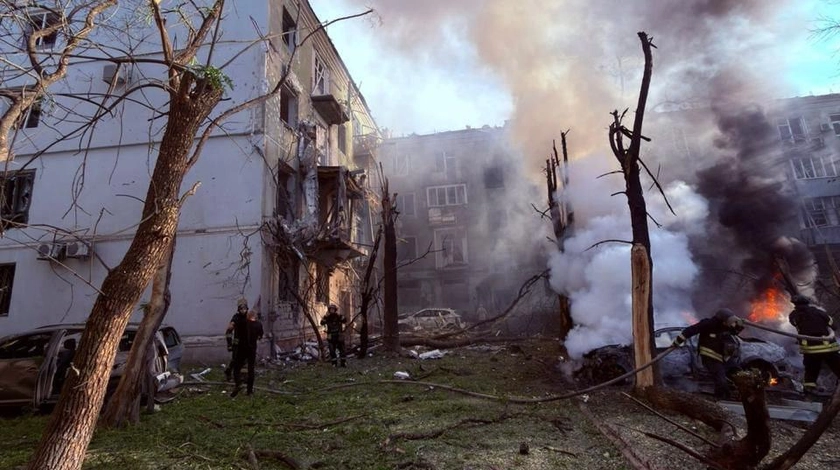
Russian Strike on Dnipro Injures Seven and Damages Industrial Facility
The standoff reached a boiling point in April when Kyiv discovered that a 15-year-old Ukrainian boy named Sasha had been legally adopted by his Italian host family – despite having a biological mother in Ukraine who actively sought his return.
Dmytro Lubinets, Ukraine’s Human Rights Ombudsman, issued a condemnation of Rome’s approach, accusing the Italian government of intentionally shutting Ukrainian authorities out of the welfare checks and legal processes.
“[Italy’s] attitude is, in fact, no different from the Russian side’s position… they have taken our children away and are denying us access to them,” Lubinets stated, drawing a parallel to Moscow’s systemic deportation of over 20,000 Ukrainian children. “The Italian representatives are telling us that the judiciary is independent and that they cannot influence this decision. But I demand that they intervene.”
The “best interests” dilemma
Italian lawyers and host families argue they are adhering to international and domestic laws designed to shield children from being forcibly returned to active war zones.
Rosa Emanuela Lo Faro, an Italian lawyer representing some of the minors, confirmed that in certain cases, Italian courts enacted a total ban on the children communicating with their Ukrainian guardians or friends. While she petitioned the Italian Supreme Court of Cassation to overturn some of these extreme guardianship orders, she noted that the core legal argument remains complex.
The UN Refugee Agency (UNHCR) maintains that returns to Ukraine should only happen voluntarily and if the host country determines it is in the “best interests” of the child. Italian foster families argue that returning youths – many of whom have spent years integrating into Italian schools and forgetting their native language – to a nation still facing daily bombardment is unsafe.
Volodymyr Ivanyuta, a representative appointed by the Ukrainian government to advocate for the children in Italy, rejected this argument, warning that the Italian courts are ruling against repatriation even when there is no adoptive family involved.
“There are children in our care who are in children’s homes, they have no specific people interested in them, and yet these children are still not allowed to return,” Ivanyuta said.
According to Ukrainian authorities, more than 4,800 children were evacuated from residential schools to European nations in 2022. Today, over 300 of those children are actively being prevented from returning by local authorities, with the vast majority held up in the legal systems of Italy, Germany, and Austria.
Russia has killed at least 707 Ukrainian children since the start of its full-scale invasion in 2022. More than 2,500 children have been injured and more than 2,300 remain missing as a result of Russia’s war against Ukraine.
The youngest confirmed victim was a two-day-old baby who was killed in a maternity hospital.
Ukraine and its partners have repeatedly accused Russia of illegally transferring children from occupied territories and attempting to erase their Ukrainian identity through re-education programs and forced adoption schemes. In April, Ukrainian authorities charged three people over the deportation of 35 children from the occupied Donetsk region, in a case Kyiv says amounts to a war crime.
You can also highlight the text and press Ctrl + Enter