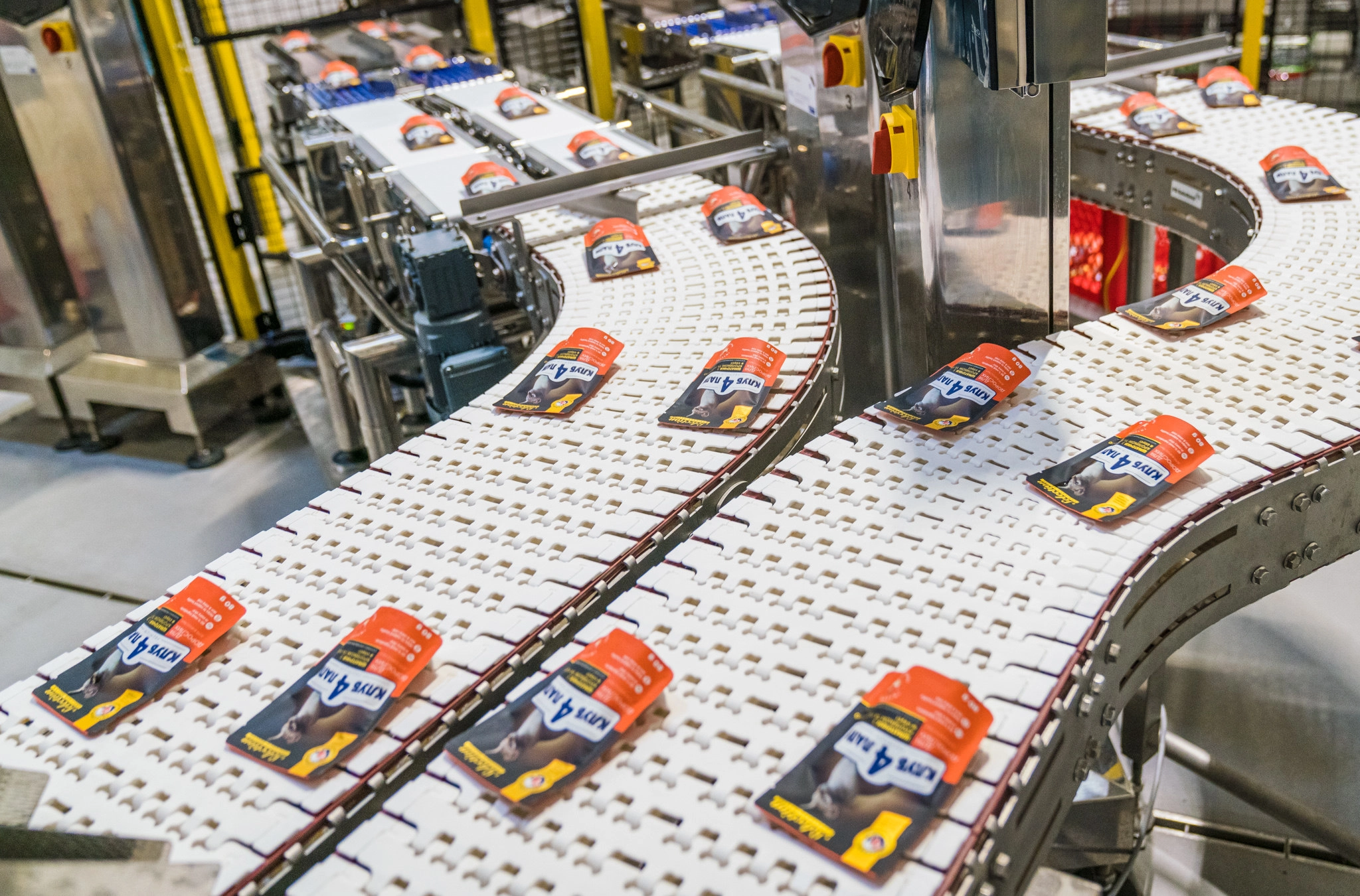
The Ukrainian pet food manufacturer Kormotech plans to increase production by 2.5 times over the next three years, from 100,000 tons to 250,000 tons of pet food per year by 2028, Kormotech’s Chief Operating Officer Igor Paranyak told Interfax-Ukraine in an interview.
Kormotech intends to expand production in Lithuania and Ukraine and is also considering opening a new facility in Romania to reach these aims.
JOIN US ON TELEGRAM
Follow our coverage of the war on the @Kyivpost_official.
“In addition to the favorable conditions for setting up production, we also see that our sales in Romania will grow. This country will become our key market in the near future,” Paranyak said.
Kormotech already operates a plant in Lithuania, which started production in 2020 and manufactures 20,000 tons of wet pet food in pouches annually.
In February this year, the company announced plans to build a new plant in Lithuania with an investment of €60 million ($66 million), of which €40 million ($44 million) was provided by the European Bank for Reconstruction and Development (EBRD).
The project consists of four expansion phases, with a total production capacity of 40,000 tons. The first phase of the factory is expected to be launched in the second quarter of 2026, with the second phase to follow by the end of 2026, Paranyak said.
By 2028, all phases of the project should be completed, increasing the total production capacity of Kormotech’s Lithuanian plants to 60,000 tons.
Oleksiy Leonov on Ukraine’s South: From the Front Line to Cross-Border Cooperation
After construction is completed, 61% of the total volume of Kormotech’s “wet feed” will be produced in the Lithuanian city of Kedainiai, Kyiv Post previously reported.
The company chose Lithuania because it supports investors through grant assistance for large-scale projects.
“Since the budget of our project exceeds $66 million, we can receive a 20% cashback from the state,” Paranyak told Interfax-Ukraine.
The company is committed to creating at least 176 jobs, though Kormotech plans to employ 200 people.
The new plant in Lithuania will feature almost full automation – up to 99% of production processes, compared to approximately 80% at the first factory, Paranyak said.
The new facility will also be using a new packaging line that will replace plastic packaging with eco-friendly cardboard.
The company plans to diversify energy sources, setting up the new plant with solar panels. Its first Lithuanian plant already operates a solar power station with a capacity of 630 kW.
By 2027, Kormotech aims to generate 15% of its electricity consumption from renewable sources, the companyʼs Chief Operating Officer said.
For pet food production, the company uses frozen raw meat materials. In Lithuania, about 25% of these are sourced from local suppliers, with the rest coming from Poland, Germany, and the Netherlands. Packaging materials are supplied from Ukraine and Austria.
In Ukraine, Kormotech operates two plants – one for wet pet food and one for dry pet food. In 2023, the wet food plant was modernized with an investment of €8.5 million ($9.3 million).
The key challenge for the Ukrainian plants is mobilisation and possible energy deficit, Paranyak said. To tackle this, Kormotech launched courses for women aiming to take jobs that were previously considered more fitting for men.
You can also highlight the text and press Ctrl + Enter