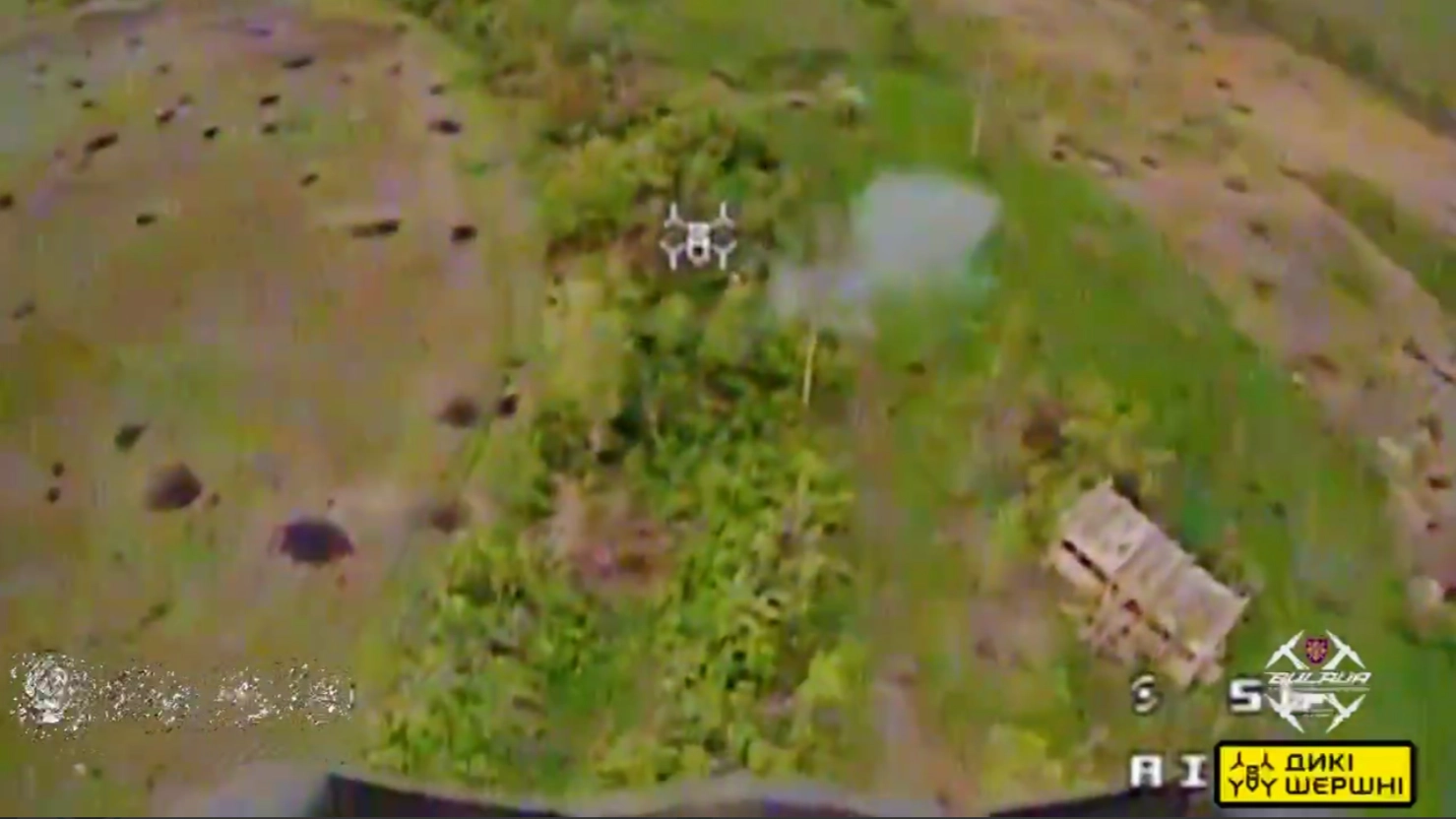
The Armed Forces of Ukraine (AFU) have unveiled the first recorded combat use of a drone equipped with a grenade launcher, according to Wild Hornets [Dyki Shershni], a Ukrainian mil-tech company that develops and produces combat drones.
The company published a video on its Telegram channel, reportedly showing the drone killing a Russian serviceman.
JOIN US ON TELEGRAM
Follow our coverage of the war on the @Kyivpost_official.
According to the post, drone pilots from the BULAVA unit of the Separate Presidential Brigade named after Hetman Bohdan Khmelnytsky mounted a grenade launcher onto their “Queen of Hornet” drone and successfully used it against Russian infantry.
“The moment when the occupier received an exclusive death,” reads the caption under the video.
Additionally, the brigade released another video showing not only strikes themselves, but also the design of the modified drone. They also clarified that the combat took place in the Novopavlivka sector of the front line.
Kyiv Post reached out to Ukrainian military personnel for insight into this battlefield innovation and its potential impact.
A Ukrainian reconnaissance drone operator with the Unmanned Systems Forces, call sign Diego Rodriguez, told Kyiv Post:
“I don’t understand why this wasn’t done earlier – and why it isn’t being used on a mass scale already. It absolutely should be.”
Ukraine Expands Procurement of Long-Range 155mm Shells
Rodriguez said the technical advantage of these drones is that a grenade launcher delivers faster and more precise hits compared to first-person-view (FPV) drones.
“Logically, a drone like this can fly in, fire, turn around, and reload. It’s already effective. A grenade launcher round flies faster than any FPV drone, so the accuracy is higher. You can strike from farther away and face fewer electronic warfare countermeasures.”
He also said there’s a key tactical difference: kamikaze drones are loud and visible, giving Russian troops time to react.
“But a grenade round arrives almost instantly – you can’t dodge it. That means more accurate hits.”
Vadym “Sonik” Feshchenko, a former grenadier and current drone operator, told Kyiv Post he believes this could mark the next stage in drone warfare evolution.
“Infantry is used to drones hovering overhead, preparing to drop something. They time their movement around the drone’s range. But if the drone starts shooting mid-flight, it drastically shortens their window to regroup outside the trench.”
Feshchenko added that this will likely force Russian infantry to retreat or take cover at the mere sound of a drone.
“Modern grenade launcher rounds also offer a wide range of capabilities, including cumulative warheads that can penetrate up to 7 centimeters of armor.”
In mid-September 2024, a video circulated on social media showing Ukrainian forces testing an FPV drone armed with an RPG-18 grenade launcher.
The footage captures the drone lifting off the ground and flying several meters with the launcher attached.
“The use of different weapons on these drones has opened a new chapter in battlefield tactics,” a Ukrainian aerial scout told Kyiv Post, speaking on condition of anonymity.
At the time, the scout described the modification as “raw,” but full of potential. If mass-produced, such technology could significantly reduce the risk of injury to Ukrainian personnel involved in arming kamikaze drones or improvised explosive devices, he disclosed.
“The risk of injuries to engineers while equipping kamikaze drones is quite high, but it’s not commonly discussed,” the scout added.
The Ukrainian outlet, Telegraf, reported that the idea of mounting a grenade launcher on a drone had previously been proposed by the Belarusian design bureau Display during Russia’s Army-2021 exhibition.
Telegraf also outlined the key technical challenge: because most copters are lightweight, firing a weapon can destabilize them. Guiding the grenade accurately while maintaining drone control poses an additional hurdle.
However, the heavier “Queen of Hornet” drone used in the recent Ukrainian footage appeared to solve the recoil issue. The video shows the grenade being fired with no noticeable destabilization.
Earlier in 2024, the Ukrainian tech site Portaltele reported that engineers had also modified a DJI Agras T30 agricultural drone – originally designed for crop spraying – to track and destroy military targets.
Armed with a 7.62x54 mm PKM machine gun and a Bullspike-AT grenade launcher, the Agras T30 can now engage tanks, self-propelled artillery, armored vehicles, and fortified enemy positions.
You can also highlight the text and press Ctrl + Enter

Attack on Moscow Oil Refinery: Putin Under Pressure?