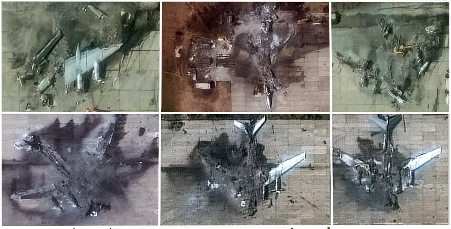
A senior Russian official has sought to downplay the effects of Ukraine’s audacious operation Павутина (Spiderweb) on Sunday.
Kyiv reports – that it destroyed more than a dozen of Russia’s strategic aircraft: Tu-95MS, Tu-22M3 bombers, and A-50 airborne early warning aircraft, and damaged more than two dozen more – are supported by satellite imagery, NATO, and other assessments.
JOIN US ON TELEGRAM
Follow our coverage of the war on the @Kyivpost_official.
Despite this mountain of evidence, Russia’s Deputy Foreign Minister Sergey Ryabkov doubled down on the Ministry of Defense’s statement that “no irreversible losses were sustained,” by telling TASS on Thursday that “the equipment in question was not destroyed, but damaged. It will be restored.”
The pro-Kremlin milblogger Fighterbomber, a serving Russian air force officer said immediately after Sunday’s attack that it was a “black day for [Russian] aviation” and a “very heavy blow” that highlighted “serious shortcomings” by its intelligence services. On Thursday, however, he had fallen into line, saying that the destroyed aircraft were obsolete “non-flying airframes from the iron row” and that Spiderweb should be renamed Феникс (Phoenix).
Even Ryabkov’s assertion that the damaged bombers can be returned needs to be taken with a huge pinch of salt. Russia’s Tu-95, Tu-22M3, and Tu-16 strategic bombers are complicated, aging aircraft from the Soviet era, what the International Institute for Strategic Studies (IISS) has categorized as a “non-renewable strategic resource.”
Ukraine Approves National Pantheon Law to Honor State Builders, Military Leaders and Cultural Icons
The Tu-95 was introduced in the 1950s and the TU-22s in the 1970s – neither are any longer in production and Russia is unlikely to have the industrial resources to manufacture the spares needed to repair damaged fuselages, engines, avionics, and weapon stations. The only option could be to cannibalize parts from other aircraft which, even if Russia has the necessary expertise, will result in further reductions in the size of the heavy bomber fleet.
The IISS Military Balance+ database, published in February, estimated Russia’s strategic bomber fleet consisted of 58 Tu-95M and 54 Tu-22M3 bombers – though it did not differentiate between operational, those awaiting maintenance, or those which are unrepairable.
Ukraine’s Security Service (SBU) said numbers aside, Spiderweb disrupted an imminent missile attack – published drone footage showed hits on Tu-95s fitted with Kh-101 cruise missiles. On Thursday, Russia again attacked Ukraine with large numbers of drones and missiles but, tellingly, this only involved four strategic bombers – two Tu-95s and two Tu-160s.
Despite Moscow’s attempts to minimize the outcome of Sunday’s attack on its strategic bomber armada, analysts suggest the long-term strategic cost will be more difficult for the Kremlin to swallow and cover up.
You can also highlight the text and press Ctrl + Enter