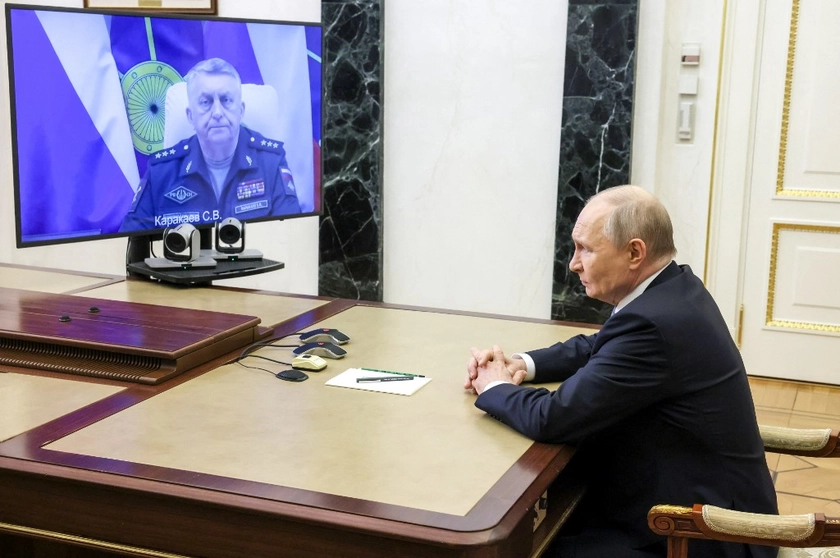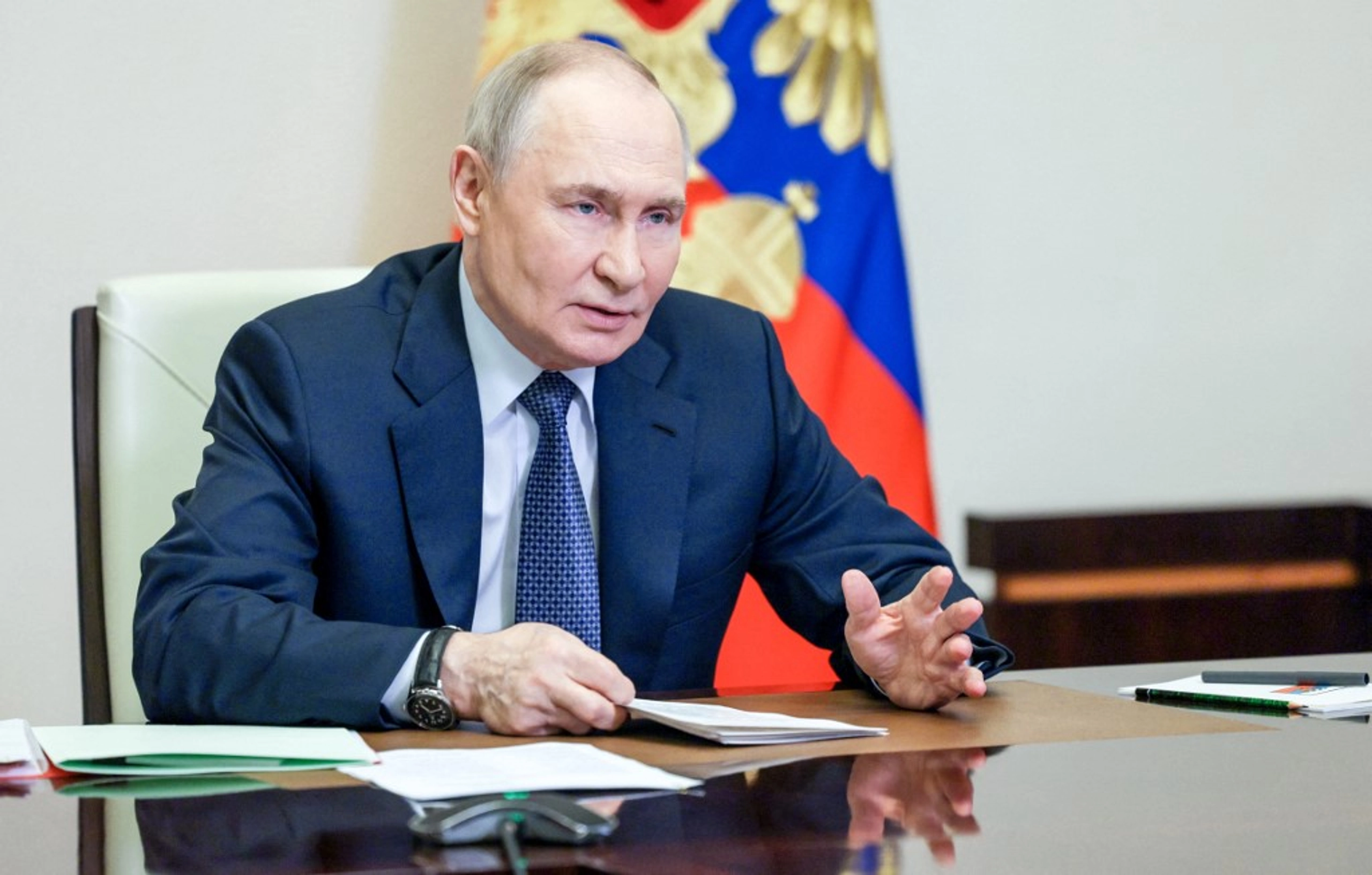
President Vladimir Putin spoke about his vision for the implementation of Russia’s state armament program over the next decade at a meeting in the Kremlin on Wednesday. His comments were made to an audience that included his defense and other ministers as well as the commanders of Russia’s strategic rocket, ground, aerospace, and naval forces.
According to TASS, Russia’s state-owned news agency, Putin directed that the new state arms program was to become the key tool to provide Russia’s armed forces with the most modern weaponry available in the next decade.
JOIN US ON TELEGRAM
Follow our coverage of the war on the @Kyivpost_official.
He said that there was agreement in April to increase deliveries of weapons and equipment needed to support “the special military operation” [Russia’s term for Putin’s war on Ukraine] and that these measures are carried out “here and now.”
Putin went on: “Our task today is to shape a new long-term program covering the entire range of weapons systems and promising models, making maximum use of the experience gained during the special military operation, as well as from various regional conflicts.”
He added these requirements for the armed forces, special services, and departments would be detailed in the document covering the period 2027-2036, saying:
“It is crucial to estimate needs in advance and start preparing infrastructure to deploy new weapons systems, including bases, arsenals, airfields and so on,” the financial resources for which would be included as a separate part of the state budget.
The Illusion of a Peace Deal for Ukraine
He then spoke about five main areas for development:
Nuclear forces
Putin said Russia’s nuclear triad – air delivered, land and submarine-based nuclear forces – would continue to play a key role in “safeguarding Russia’s sovereignty” and its role in “ensuring the global balance of power.” He said that 95% of Moscow’s strategic nuclear forces were the most modern available and a figure that is “higher than that of all other nuclear powers.”
Ground forces
Putin described ground forces as the “dominant force” in any modern conflict, saying that it was vital that “Russia increase its combat capability in the shortest time possible, building a strong foundation by creating the most technically advanced weapon systems.”
Aerospace forces
He said the new state program would provide for “a set of systematic and consistent measures aimed at increased procurement, modernization, and repair of aviation equipment.”
Naval forces
“The new state armament program should become an effective tool for implementing the recently approved Navy development strategy through to 2050,” Putin said.
Defense industry manpower
In an apparent reference to recent concerns that mobilization for the war in Ukraine had adversely affected staffing for defense-related enterprises Putin directed that “the defense industry and trade ministries should focus on the future and… take into account the army’s current needs [for which] certain changes are needed.”
Military exports
Putin suggested that Russian arms and equipment “that have been tested in real high-intensity combat operations and have proven to be reliable and effective” will increase the potential for arms sales but added “There is still work to be done in establishing proper maintenance capability.”
Military analysts and commentators take
The majority of independent commentators agreed that Putin’s latest “call to arms” was long on rhetoric but short on detail.
The consensus was that although Putin did not refer to manpower and equipment losses in Ukraine, his emphasis on the need to rebuild Russia’s land forces was a response to mounting concerns over the sustainability of Russian offensive capabilities.
Moscow has lost thousands of tanks and armored vehicles since the start of the war, forcing the military to increasingly rely on reconditioned, previously mothballed Soviet-era equipment.
Recent claims by the state Rostec conglomerate of an upsurge in armored vehicle production is taken with a pinch of salt as open-source assessments are that production is hamstrung by shortages in high-grade optics, electronics, and power units which have continued to be the subject of sanctions while locally-made or Chinese replacements have proved to be of poor quality and subject to delivery bottlenecks.
Analysts also point to the importance Putin placed on Russia’s nuclear capability, both in this event and repeatedly in statements by him and others since the 2022 full-scale invasion. This is interpreted as a, sometimes desperate, attempt by the Kremlin to assert Russia’s status as a global superpower, whereas the international perception is that falling back on such rhetoric increasingly underlines a narrowing of Putin’s options for projecting power.
Moscow has publicly showcased several advanced systems, ballistic, hypersonic, and submarine-based nuclear missiles; the actual operational deployment is uncertain. Testing of the RS-28 “Satan-II” ICBM, for instance, has proved disappointing and in one case catastrophic – a missile exploded in its silo during a test launch in September.
The determination by Putin and others from the regime to rely on the nuclear threat to bolster its international position and deter potential enemies may simply result in the further isolation of Russia on the international stage – as Hungary’s Prime Minister Viktor Orbán said during an interview with French TV at the weekend that he was not worried about Russia attacking NATO countries, as “The Russians are too weak for that – they can’t even defeat Ukraine.”
You can also highlight the text and press Ctrl + Enter