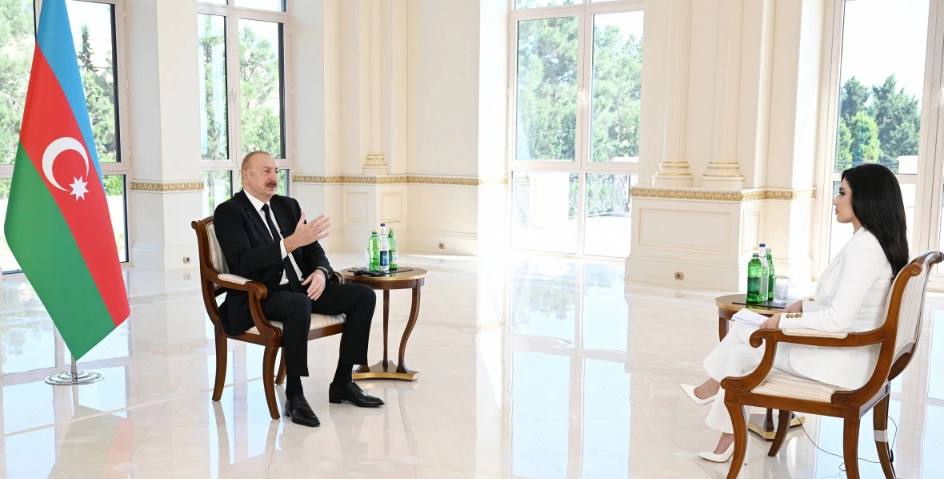
Azerbaijan’s President Ilham Aliyev has delivered one of the strongest anti-Russian statements ever heard from Baku, describing his country’s entry into the Soviet Union in 1920 as nothing less than a “Russian invasion and occupation.” His remarks on Aug. 26 in a Saudi TV interview not only challenge Moscow’s historical narrative but also resonate strongly with Ukraine’s own struggle against Russian imperialism today.
Rewriting history, rejecting Moscow’s narrative
JOIN US ON TELEGRAM
Follow our coverage of the war on the @Kyivpost_official.
For decades, Russia has sought to portray the Soviet Union’s expansion as a process of “voluntary union.” Aliyev’s statement tears down that façade, underscoring that the Azerbaijan Democratic Republic – independent for just two years – was crushed by Bolshevik troops. By framing this event as “occupation,” Aliyev places Azerbaijan in the same historical category as Ukraine and the Baltic states, all of which saw their sovereignty stolen by Moscow’s empire-building.
This reframing is not just historical revision – it is political messaging. Baku is signaling that it sees parallels between its own past and the Kremlin’s current assault on Ukraine.
For Ukraine, this alignment is strategically important: it shows that Moscow’s neighbors are increasingly unwilling to remain silent.
The downing of the Azal plane – a breaking point
Aliyev’s sharpest words, however, were reserved for Moscow’s handling of the downing of an Azerbaijani civilian aircraft near Aktau. He expressed “huge disappointment” with Russia’s silence and accused its authorities of deliberately misleading investigators.
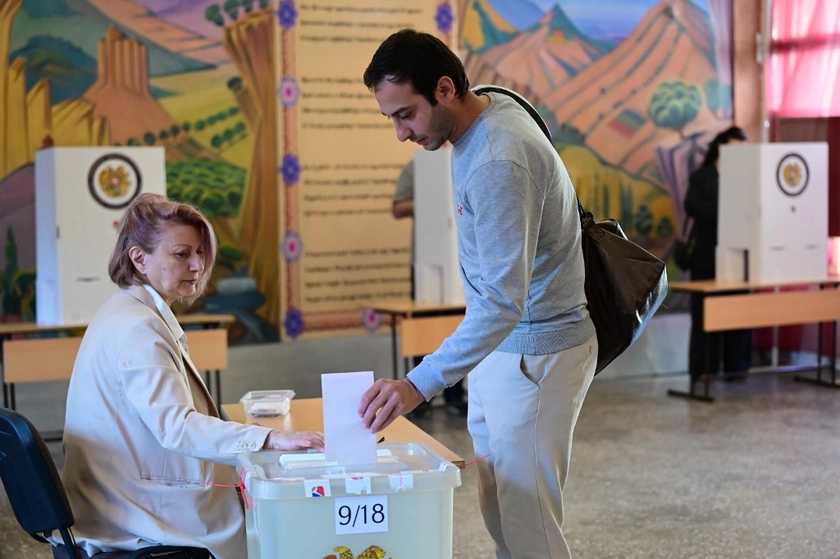
Polls Open in Armenia’s Pivotal Election as Pashinyan Battles Pro-Russian Blocs
According to Aliyev, Russian airports routinely issue an alert signal during drone attacks, warning all aircraft to turn back. Two weeks before the crash, one Azerbaijani flight received such a signal and returned safely. But during the fatal incident, no warning was issued until after the plane had already been struck.
“The plane was fired upon twice,” Aliyev said, adding that only the professionalism of the pilots allowed the aircraft to land safely in Kazakhstan rather than Russia.
The implication is clear: Baku does not view this as an unfortunate accident, but as a politically charged act – and one for which Russia refuses to take responsibility.
Killings of Azerbaijanis in Russia
Aliyev also condemned what he called “unmotivated attacks” on Azerbaijanis in Russia. Two men were reportedly tortured and killed, with Russian officials later claiming they had died of a heart attack. “Even if they committed a crime 20 years ago, they are still people,” Aliyev said. “That was an unprecedented act against our people.”
Here too, Aliyev in an interview with Saudi Arabia’s Al Arabiya TV channel, accused Moscow of stonewalling, while stressing that Azerbaijan responds only “constructively and lawfully” but will never tolerate aggression or disrespect.
Aliyev’s words carry several layers of meaning: To his domestic audience, he positions himself as a leader unafraid to challenge Russia and protect national dignity. To Moscow, he sends a warning that Azerbaijan will not accept humiliation.
Aliyev’s statements matter far beyond the South Caucasus. By openly condemning Russian actions – past and present – the Azerbaijani president reinforces the global narrative that Russia is an aggressor state, one that hides its violence behind lies and silence.
For Ukraine, this alignment is strategically important: it shows that Moscow’s neighbors are increasingly unwilling to remain silent, even those like Azerbaijan, which must balance delicate relations with the Kremlin.
Aliyev’s rhetoric signals a recalibration of Azerbaijan’s foreign policy. The era of quiet deference is ending. What emerges instead is a posture of cautious but firm resistance.
In the volatile geopolitics of the South Caucasus, this could herald a new chapter in Russian-Azerbaijani relations: less dependence, more friction, and a stronger resonance with the narrative of resisting Russian aggression.
You can also highlight the text and press Ctrl + Enter