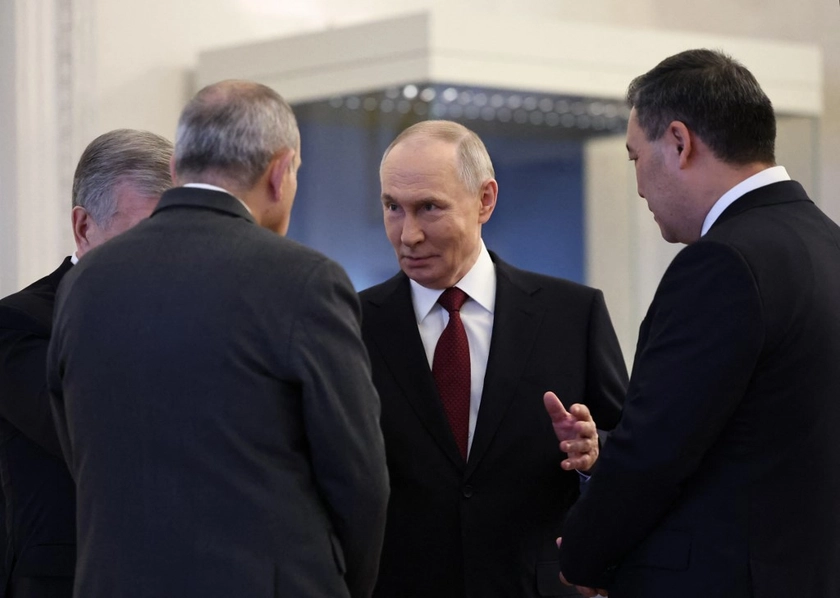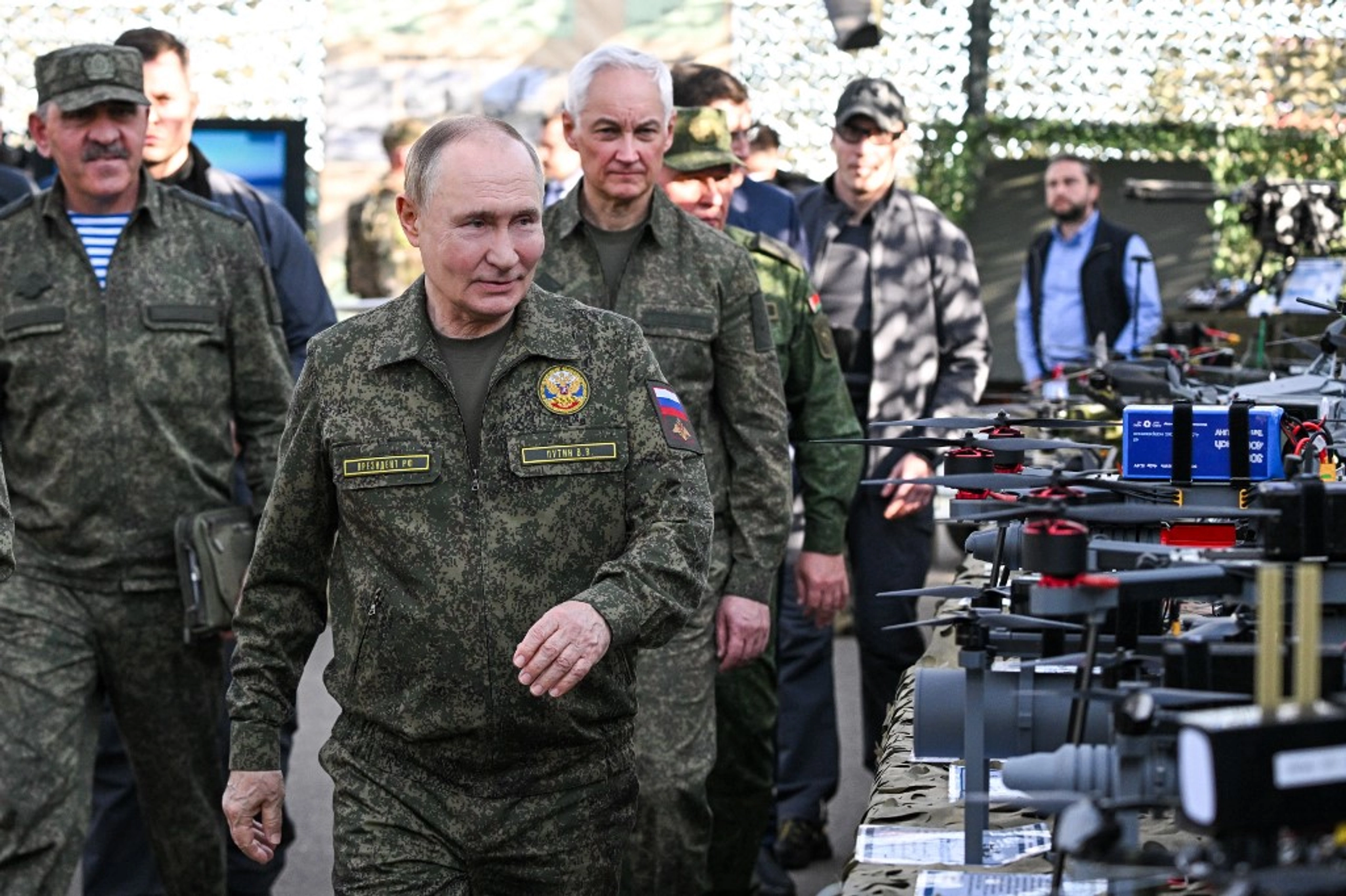
Russian President Vladimir Putin made a surprise trip to the Nizhny Novgorod region to visit joint military drills with Belarus on Tuesday, Russian state television reported.
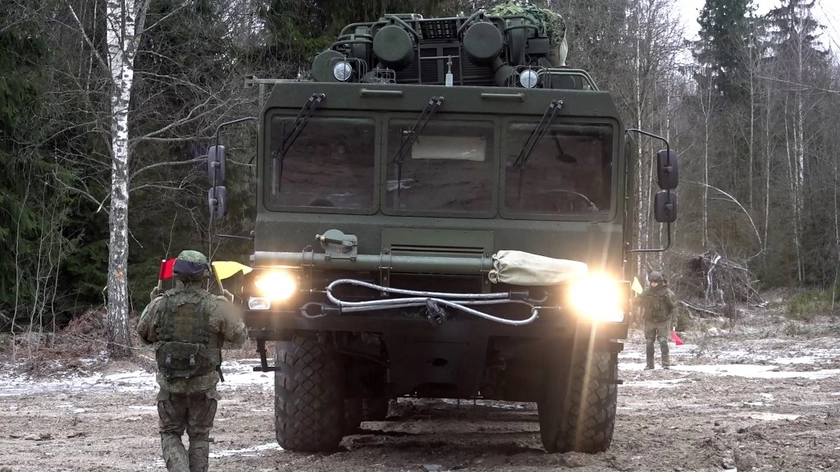
Donning military garb, Putin met with top war officials at the Mulino training ground, listened to briefings from Defense Minister Andrey Belousov and his deputy, and inspected military equipment including motorcycles, quad bikes, anti-drone weapons and radar systems.
JOIN US ON TELEGRAM
Follow our coverage of the war on the @Kyivpost_official.
Putin has rarely been seen in military fatigues since the full-scale invasion of Ukraine, despite his status as “Supreme Commander-in-Chief” of Russia’s army.
In comments broadcast on state-owned TV channel Russia-1, the Kremlin chief said that some 100,000 military personnel had taken part in the exercises at 41 training grounds, using around 10,000 pieces of military equipment.
He added that more than 247 ships, including surface vessels, submarines and support vessels had engaged in the drills.
“The purpose of the exercise is to work out all necessary elements for the unconditional protection of the sovereignty, territorial integrity and defense against any aggression targeted at the Union State [the official moniker for the Belarusian-Russian alliance],” Putin was reported to have said.
On Tuesday, Sept. 16, Russia and Belarus wrapped up five days of war games codenamed Zapad-2025 where they rehearsed launching Russian tactical nuclear weapons in what Western officials condemned as an aggressive projection of military bravado.
Russia Issues 1,100+ ‘Traditional Values’ Visas in 2025 as Kremlin Expands Anti-Western Push
NATO responded with alarm to the drills, with Poland closing its border with Belarus and deploying 40,000 soldiers to its borders as part of its own exercises, though the Kremlin dismissed Europe’s fears as “emotional overload.”
Belarusian leader Alexander Lukashenko shrugged off concern from surrounding countries on Tuesday, claiming “we are absolutely not planning to threaten anyone with this.”
Lukashenko told state news agency Belta that Russia and Belarus were “practising everything there… from firing conventional small arms to nuclear warheads.”
“They [the West] know this too, we are not hiding it,” Lukashenko was quoted as saying. “Again, we must be able to do all this. Otherwise, why would they be on Belarusian territory?”
In comments to Belta, Belarusian General Staff chief Pavel Muraveyko said that the Zapad drills had placed special emphasis on “the planning and consideration of the use of non-strategic nuclear weapons, as well as the evaluation and deployment of the Oreshnik mobile missile complex.”
The Oreshnik missile, which Putin has previously claimed is impossible to intercept, was first used against Ukraine in November 2024 and is expected to be permanently stationed in Belarus by later this year.
Russian state media has bragged that the Oreshnik could reach an air base in Poland within 11 minutes and the NATO headquarters in Brussels within 17.
Russia’s Defense Ministry also said on Tuesday that Tu-160 strategic bombers, capable of carrying nuclear payloads, had conducted simulated cruise missile launches over the Barents Sea north of the Nordic countries.
Meanwhile, Russian Marines from the Northern Fleet practised repelling an amphibious landing on a peninsula in the Murmansk region.
In Kaliningrad, troops employed advanced electronic warfare systems to detect and relay enemy coordinates to artillery and drone units.
On Sept. 15, it was reported that US military officers had made a surprise visit to observe Zapad-2025 alongside military-diplomatic missions from China, Iran, Turkey and Azerbaijan, among others.
The Zapad-2025 drills, which involved extensive coordination between Russian and Belarusian forces, were held just days after Polish and NATO officials said they had intercepted a large number of Russian drones that violated Polish airspace, heightening already fragile tensions on NATO’s eastern flank.
You can also highlight the text and press Ctrl + Enter

Putin’s Worst Nightmare
Zelensky Reveals Intercepted Intel From Putin’s Desk