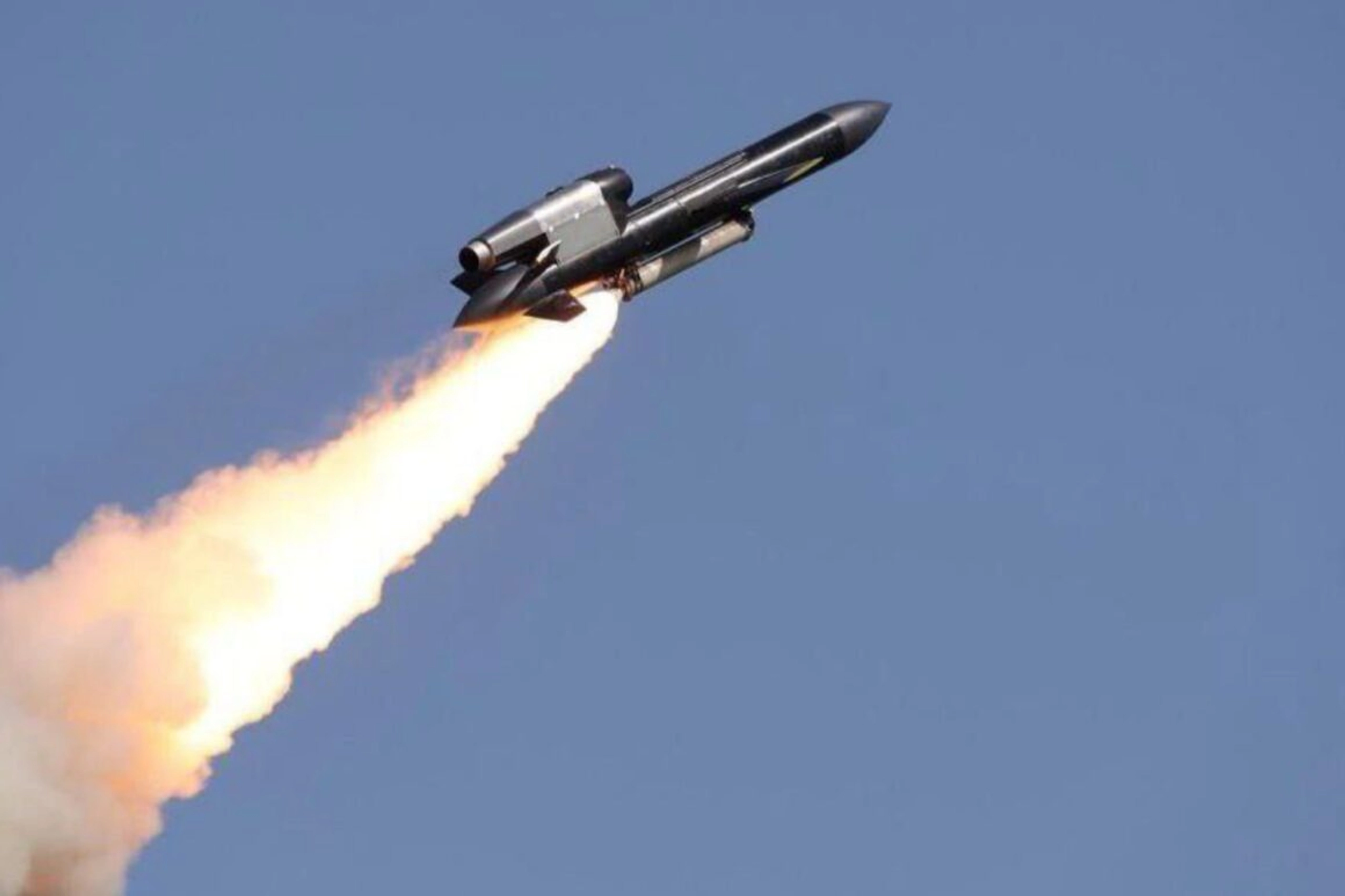
Refurbished jet engines, bunker-busting warheads – the manufacturer of Ukraine’s new Flamingo long-range missile unveiled more details of the weapon during Poland’s MSPO 2025 military exhibition.
Fire Point, which manufactures the missile, has also shared the specifications and manufacturing process, according to defense outlet Militarnyi.
JOIN US ON TELEGRAM
Follow our coverage of the war on the @Kyivpost_official.
The Flamingo long-range (strategic) subsonic cruise missile was unveiled in August 2025 with a claimed range of over 3,000 kilometers (1,864 miles); a Fire Point representative previously claimed that it outperforms the US Tomahawk cruise missiles.
The company said that apart from the warhead, it is involved in the manufacture of all the missile’s components – including the jet engines.
Refurbished jet engines
Fire Point said it sourced jet engines nearing their expiry for inclusion in the current batch of missiles, with plans to localize production of new propulsion units by licensing designs from local firms starting as early as next year.
According to Militarnyi, the company said it uses engines that have up to 10 hours of operational use remaining, making them suitable for the missile, which has a planned maximum flight time of around 3.5 hours.
As part of the refurbishment process, some parts are made from simpler, cheaper materials instead of the original titanium components since durability is not a key concern. This helps lower costs and speed up the refurbishment.

Ukrainian Storm Shadow Hit Iskander-Linked Electronics Plant, Say Russian Sources
Fire Point’s Chief Technical Officer (CTO) Iryna Terekh said the engines weren’t sourced from Motor Sich, an aerospace company, but from aging stockpiles via scrapyards.
“There are thousands of these engines, and we bought them in advance to have a stock before mass production… We have a large stock for many months ahead. No one is currently producing them for us. We found these engines literally ‘in the dump’ and restored them,” Terekh said.
While the company said it has enough engines to sustain production for some months, plans are in place to start producing new engines under license.
“We need to think about tomorrow: That’s why we are already building a plant under the license of a Ukrainian manufacturer to produce this engine ourselves from the beginning of next year,” she added.
Terekh said currently production is around two missiles a day – already up from the previous one missile a month in August; the company said it planned to make seven missiles a day by October.
Warheads and construction
The current missiles are equipped with bunker-busting warheads that “[can pierce] thick concrete” of up to 10 meters (33 feet), according to Fire Point.
The warheads are the only components entirely contracted out to other firms, but plans are in place to equip the Flamingo with other warhead variants, such as cluster munitions.
Previously, the company said the missile has a 1,150-kilogram (2,353-pound) payload.
The fuselage is made using carbon fiber, which conveys a relatively low radar signature for the missile. It is produced on a winding machine, which takes six hours to complete manufacturing.
Operation, visibility, accuracy
Terekh said the Flamingo is built with the intention of delivering a huge payload at a distance “where no one has ever been able to deliver such a load before.”
“Some of our recent operations have proven that despite all the criticism – that the Flamingo is very visible, very vulnerable, not very maneuverable – it has been able to achieve its goals. And in the last three years, no one has been able to break through the [Russian] air defense system,” she said.
“Yes, it may not be perfect, but that is not the main task.”
Practicality is also of key concern.
“You can use anything you want. The main thing is that it works well on the battlefield, not that it looks nice on paper or in advertising brochures. That’s the main criterion,” Terekh said.
In terms of actual deployment, low visibility is another key focus – the missile never flies above 50 meters (164 feet), better to conceal its flight path, according to Terekh, and its launchers are also made to be easily concealable.
“I can confirm: You will never be able to distinguish among trucks on the road whether there is a Flamingo missile inside or not. And this is our goal, for the safety of personnel. Because any equipment with a ‘military look’ on the battlefield is immediately noticed by reconnaissance drones,” she said.
“And this puts people at enormous risk.”
In terms of accuracy, Terekh said the current data shows that it usually hits within 14 meters (46 feet) of the intended target, including environments where electronic jamming or spoofing.
“In our experience, accuracy depends not only on the technical capabilities of the missile, but also on the mission planning strategy. Currently, 14 meters is a repeatedly confirmed result,” she said.
Terekh added that Fire Point is also looking at incorporating other means of navigational aids to bypass GPS jamming.
While current countermeasures are effective, she said Fire Point is exploring alternatives to break out of the ongoing cat-and-mouse race in their development.
“I don’t know how much longer we can use this technology. It’s a constant race: we make better antennas, they make better jammers; we make better GNSS receivers, they try to place the jammers differently to interfere with us,” she said.
“Yes, we are winning so far, but is it worth spending so much effort?”
You can also highlight the text and press Ctrl + Enter