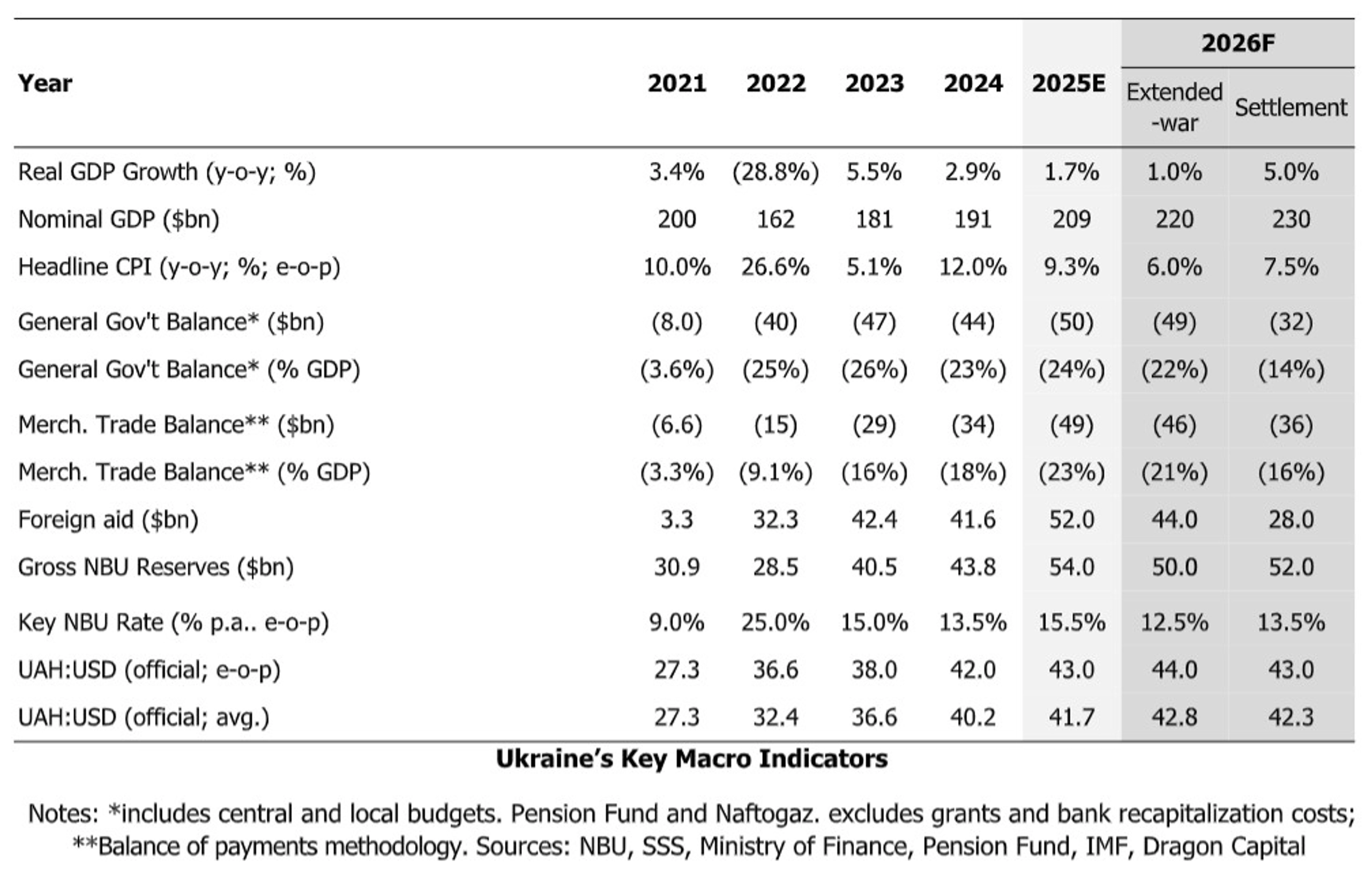
Investment firm Dragon Capital has revised its macroeconomic forecast for Ukraine, cutting GDP growth expectations to 1.7% in 2025 and 1% in 2026, citing Russia’s renewed large-scale attacks on Ukraine’s critical infrastructure, which ended the “energy truce” earlier than expected.
The firm said the strikes have reduced gas production, caused power shortages, and pushed up industrial energy costs.
JOIN US ON TELEGRAM
Follow our coverage of the war on the @Kyivpost_official.
The forecast happened to be the most pessimistic one, compared to other projections of Ukraine’s GDP for 2025: 2% from the International Monetary Fund (IMF), 1.9% from Ukraine’s central bank, the National Bank of Ukraine (NBU), 2% from Kyiv School of Economics.
Economic growth in the first half of 2025 was driven by strong consumer demand, expansion of domestic defense manufacturing, and macroeconomic stability.
But growth slowed due to losses in production capacity, exhaustion of earlier growth drivers (macroeconomic stabilization and full restoration of Black Sea port operations), and severe labor shortages.
Dragon Capital projects that Ukraine’s general government deficit will hit a record $50 billion this year and stay near that level in 2026, compared to $44 billion in the previous forecast.
Ukraine’s General Syrsky: AFU Is Making Fair Progress vs Russia But No Victory Soon
EU “reparation loan” backed by Russian assets to stabilize Ukraine’s economy
A major upside factor, according to Dragon Capital, is the expected launch of the EU’s “reparation loan” mechanism backed by frozen Russian sovereign assets, primarily €185 billion ($215 billion) held in Euroclear.
The proposed scheme would channel about €45 billion to compensate existing ERA loans and make €140 billion available to Ukraine by the first mid-2026. Despite hesitation from some EU members, Brussels has made a political decision to ensure Ukraine receives sufficient financing in the coming years.
The “reparation loan” will be a cornerstone of Ukraine’s next IMF program, expected to start in 2026 and run for four years, assuming the war lasts through 2027. The new program will form part of a $150–170 billion external support package for 2026–2029.
Dragon Capital wrote that the reparation loan would not add to Ukraine’s debt burden, as its repayment will be covered by future reparations from Russia.
Ukraine’s inflation to slow as NBU maintains tight policy
Dragon Capital expects inflation to ease gradually, reaching 9.3% by end-2025 and 6% by end-2026. However, higher energy costs and rapid wage growth in the private sector are likely to keep inflationary pressures elevated in the near term.
Dragon Capital expects core inflationary pressure to strengthen in the coming months due to higher business energy costs and increased budget spending, but to ease again in 2026 as labor shortages stabilize, slowing wage growth.
Given these risks, the National Bank of Ukraine’s decision to keep its key policy rate at 15.5% and delay the start of monetary easing until 2026 “appears justified,” the report said.
“We see room for rate cuts in early 2026 but do not rule out further delays if inflationary pressure intensifies due to deeper infrastructure damage or other factors,” Dragon Capital wrote.
Ukraine’s foreign reserves to reach $50 billion despite record trade deficit
Despite a record $35 billion trade deficit in the first nine months of 2025 — driven by surging imports of energy, defense goods, and consumer products — Ukraine’s international reserves remained strong at $44 billion in September.
The import increase was largely driven by goods critical for a wartime economy, including arms, dual-use items, natural gas, coal, other fuels, energy equipment, and investment goods. The investment bank estimated that imports of such goods rose by $6 billion year-over-year to $30 billion, accounting for nearly half of total imports.
Exports remain dominated by agricultural products, which continue to determine export dynamics. Agricultural exports fell 11% year-over-year in the first nine months of 2025 due to a high comparison base in early 2024, shipping delays from a cyberattack on Ukrzaliznytsia, and a late grain harvest.
Dragon Capital forecasts reserves to climb to a record $54 billion by end-2025, supported by higher international assistance and stable capital flows.
The hryvnia is expected to weaken only moderately, to Hr. 43 per $1 by end-2025 and Hr. 44 per $1 by end-2026.
Dragon Capital sees 5% growth if truce reached in 2026
While the “prolonged war” scenario now dominates the forecast horizon, Dragon Capital also reaffirmed its previous estimate of 5% GDP growth in 2026 under a “sustainable truce” scenario.
It then should be driven by rising consumption and investment recovery amid reduced security risks, partial return of refugees, and the start of reconstruction funded by sufficient external resources.
“We estimate these factors would outweigh the negative effect of reduced defense spending,” analysts wrote.
You can also highlight the text and press Ctrl + Enter