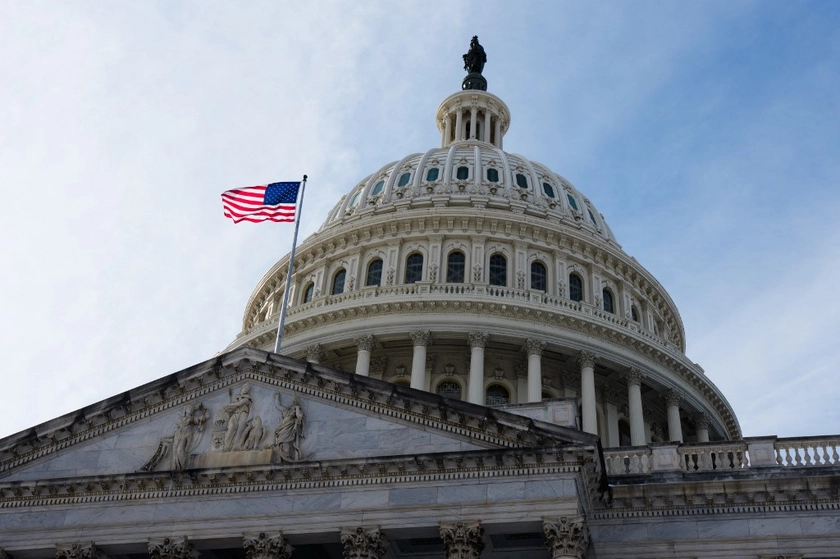
WASHINGTON DC – The US Senate voted 60–40 late Sunday night to advance a legislative vehicle to end the 40-day government shutdown that had paralyzed Washington, furloughed hundreds of thousands of federal workers, and rattled global allies.
The breakthrough arrived after five weeks of gridlock and mounting political and economic pressure.
JOIN US ON TELEGRAM
Follow our coverage of the war on the @Kyivpost_official.
A coalition of eight Senate Democratic centrists finalized a late-night deal with Senate Republican leaders and the White House to reopen the government.
The high-stakes exchange secured a future vote on extending enhanced Affordable Care Act subsidies and guaranteed that federal employees furloughed during the impasse will be reinstated with full back pay.
According to two sources familiar with the discussions, the agreement was the culmination of days of intense backchannel negotiations among Senate moderates and senior White House officials, all equally frustrated by the economic and political costs of the impasse.
Breaking the stalemate
The vote marked a dramatic turn for a Senate mired in the deepest gridlock since the shutdown began.
Democratic Whip Dick Durbin (D-IL) broke ranks with most of his party’s leadership to support advancing the funding package – a pivotal move that helped unlock the logjam.
Durbin was joined by Democratic Sens. Catherine Cortez Masto (NV), John Fetterman (PA), Maggie Hassan (NH), Jeanne Shaheen (NH), Tim Kaine (VA), and Jacky Rosen (NV), along with Independent Sen. Angus King (ME), who caucuses with Democrats.

Russian FPV Strikes Civilians in Nikopol, 3 Dead Including Mother and Son
Together, the eight centrists provided the critical votes to move the bill forward after weeks of tense, closed-door talks.
On the Republican side, the measure saw near-unanimous support. Sen. Rand Paul (R-KY) was the lone Republican dissenter, citing concerns over spending levels and the mandated inclusion of a later vote on healthcare subsidies.
“This is not the bill I wanted, but it’s the one that gets the lights back on,” Durbin said in brief remarks after the vote, adding: “People’s paychecks, safety, and services can’t be held hostage forever.”
What’s in the deal
Senators advanced a House-passed stopgap funding bill, which will now be amended to combine a short-term continuing resolution with three full-year appropriations bills.
The legislative compromise would immediately reopen the government while buying time for broader budget negotiations later this year, according to Senate Majority Leader John Thune (R-SD).
However, the legislative path ahead remains fraught. Any single senator can still delay final passage for several days, and the House of Representatives must swiftly reconvene to approve the Senate-amended version before it can reach President Donald Trump’s desk.
Trump, speaking to reporters Sunday night, expressed measured optimism that the shutdown’s end was imminent. “It looks like we’re getting very close to the shutdown ending,” he said.
Security concerns and arms export freeze
Even as the Senate moved toward reopening the government, the shutdown’s ripple effects continued to reverberate across national security circles.
Alarming reports indicated the funding lapse had frozen more than $5 billion in US weapons exports intended for NATO allies and Ukraine.
This includes halting shipments of AMRAAM missiles, Aegis combat systems, and HIMARS launchers bound for Denmark, Croatia, and Poland.
A senior State Department official told Axios the freeze was “really harming both our allies and partners and US industry” by delaying the delivery of critical defense systems.
Kyiv Post could not independently verify the claims.
In the meantime, speaking to Kyiv Post on condition of anonymity, two senior European diplomats on Sunday dismissed reports of frozen weapons transfers as “domestic politics in the US.”
State Department spokesperson Tommy Pigott placed the blame squarely on Democrats, saying in a written statement that “Democrats are holding up critical weapons sales, including to our NATO allies, which harms the US industrial base and puts us and our partners’ security at risk.”
The delays, officials warned, could fundamentally undermine US strategic commitments and create dangerous openings for adversaries – particularly as the war in Ukraine enters another difficult winter.
Ukraine on edge
Since the beginning of the shutdown, the uncertainty has fueled anxiety among Ukraine watchers and humanitarian groups who rely on consistent US military support.
Yuriy Boyechko, CEO of the US-based nonprofit Hope for Ukraine, told Kyiv Post last month that the prolonged shutdown “could start affecting shipments of military equipment to NATO for transfer to Ukraine” if it continued much longer.
Boyechko warned Sunday that if Ukraine does not have enough supplies to defend, “we can see the same scenario that happened when the last aid package to Ukraine was stuck in Congress back in 2023.”
Speaking to Kyiv Post, he elaborated: “That time Russians occupied Maryinka – this time we can see them move past Pokrovsk toward Kramatorsk and Slovyansk, the last two fortress cities in the Donetsk region.”
The road ahead
While Sunday’s vote marks a decisive step toward ending one of the longest shutdowns in US history, key legislative hurdles remain before government operations can fully resume.
The Senate must finalize the amended package, and the House must pass it before President Trump can sign it into law.
Still, the vote underscored the renewed influence of Senate centrists willing to cross party lines to resolve a crisis that had grown politically and economically untenable for the administration and Congress alike.
As one exhausted Republican staffer put it late Sunday night: “Nobody’s celebrating – they’re just relieved. It took 40 days and a lot of damage to get here.”
The shutdown’s end, whenever it officially arrives, may offer only a temporary reprieve before the next fiscal confrontation. But for now, Washington’s long-stalled machinery is grinding back to life – and the world is watching to see how much lasting stability this fragile truce can deliver.
You can also highlight the text and press Ctrl + Enter

Putin’s Worst Nightmare
Zelensky Reveals Intercepted Intel From Putin’s Desk