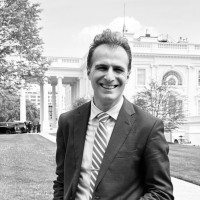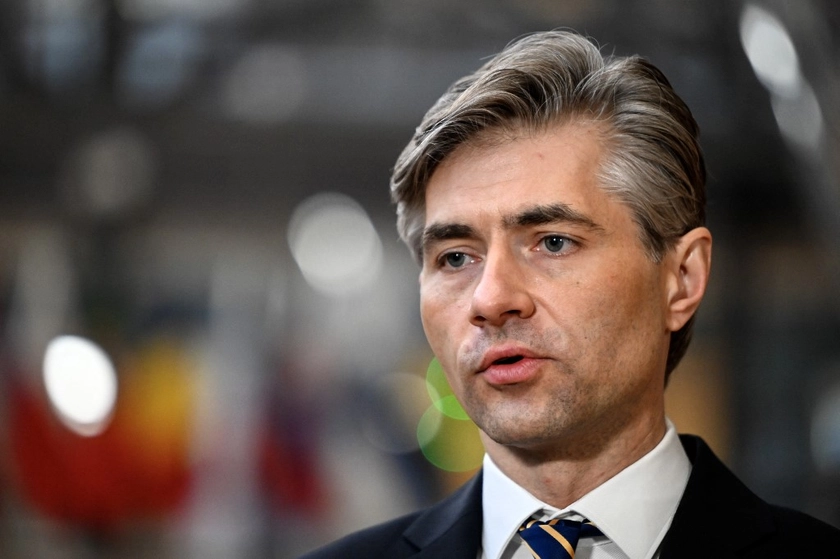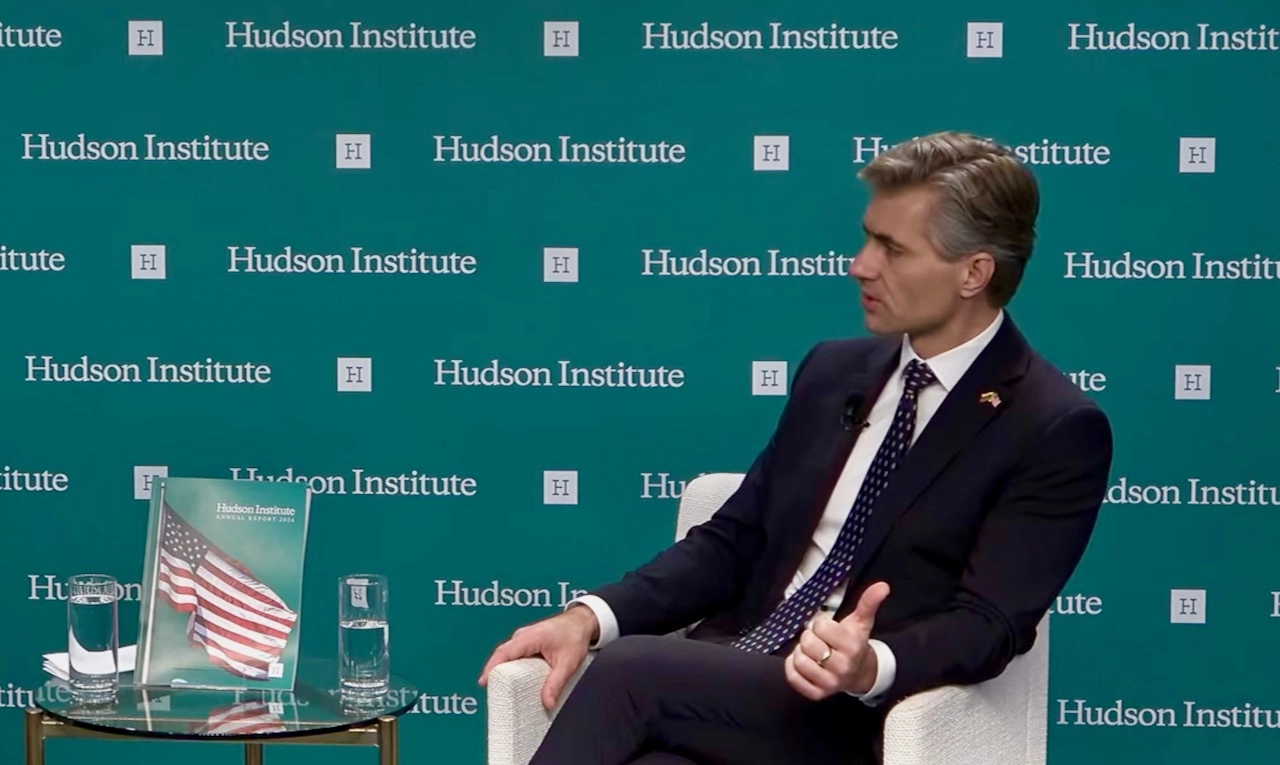
WASHINGTON, DC – Lithuania’s top diplomat, Kęstutis Budrys, delivered a stark message to Western allies from NATO’s eastern flank during his Monday visit to Washington: The era of self-deterrence is over.
The time, he insisted, is now to confront Russian aggression with overwhelming force – and budget.
JOIN US ON TELEGRAM
Follow our coverage of the war on the @Kyivpost_official.
Speaking at the Hudson Institute after a day of meetings with Secretary of State Marco Rubio, Treasury Secretary Scott Benson and other US officials, Budrys offered a stark, cold-eyed assessment from NATO’s front line. The West, he argued, has been trapped by a Russian-planted idea: that escalation should always be avoided.
“The only thing that you shouldn’t do is escalate – who created this [mantra]?” Budrys challenged. “You shouldn’t be afraid to escalate. This is what works,” he emphasized.
Drawing on Lithuania’s long experience with Russian power, Budrys said that Western restraint only invites more aggression.
He paraphrased Lenin’s maxim – that if you probe with a bayonet and encounter mush, push; if you encounter steel, withdraw – to argue that Russia always advances until it meets force.
Every time the West holds back, he warned, “they think we’re weak – pushovers,” he said.
New doctrine of deterrence
For Budrys, this call for “steel” is not theoretical. It’s shaped by real-world provocations – Russian drone incursions, undersea sabotage, and hybrid operations across the Baltic.
Intent in Plain Sight: the Politics of a UN-Recognized Genocide
Lithuania, he said, has learned that firmness works.
When Vilnius increases its defensive posture and shows resolve, Moscow backs off – and at the same time, Lithuania ramps up support to Ukraine.
“In all of these activities, when we increase our posture, when we show the strength, when we are not afraid, to increase the pressure, we have also simultaneously to increase assistance to Ukraine,” he said.
Budrys sees NATO – and the US leadership within it – as the absolute prerequisite for global stability. “We have to put NATO in front of it, because it is most effective. It is working. It is the huge power that provides us all deterrence,” he asserted.
He underscored that for deterrence to work, it must be backed by “hard force, by steel,” not just thick books of operational plans.
Putting the money where the bayonet is
In a thinly veiled rebuke to NATO allies lagging on defense spending, Budrys detailed how Lithuania is leading the charge on committing resources.
Already well above the 2 percent GDP target, Vilnius is now cementing its commitment to spend over 5 percent of GDP on defense in 2026, a decision Secretary Rubio “applauded,” according to the State Department readout.
This commitment makes Lithuania “the number one, first country that met the commitment” spurred by leaders like President Trump to increase spending.
This investment is calculated to make NATO operational plans executable, focusing on building a “strong land forces division in Lithuania,” complete with tanks and advanced artillery.
The US also specifically thanked Lithuania for “excellent host nation support to rotational troops,” a crucial role for NATO’s eastern flank.
“If we are allies, I commit and I promise, if it is needed for your defense, I will die for it,” Budrys stated, framing the alliance commitment not merely as a budget line, but as a sworn oath.
War crimes playbook
Budrys tied the violence in Ukraine to the Baltic region’s own historical trauma, noting that a visit to the KGB museum in Vilnius now hits differently after Russia’s full-scale invasion, citing the documented atrocities, including the systematic abduction and re-indoctrination of children.
“What we’ve seen in Ukraine shows history repeating itself,” he said.
Up to 30,000 Ukrainian children have been abducted, he noted, some taken to Belarus – “another ally of Russia” – for ideological conditioning. “That’s a war crime by definition,” he said.
This determination to prevent history from repeating itself underpins Lithuania’s push for more aid to Kyiv and for an international tribunal to prosecute Russian war crimes.
Full spectrum partnership: sanctions and sovereignty
Budrys’ Washington meetings focused on what he called the “holy trinity” of security: defense, energy, and economic strength.
A State Department summary said discussions with Rubio centered on expanding bilateral trade and investment, strengthening the defense industrial base, and boosting energy cooperation – including LNG and small modular nuclear reactors.
On sanctions, Budrys said Europe must stop taking a gradualist approach. Economic tools, he argued, should be “sharpened” and used “at full force from the beginning.”
Nineteen European Union sanctions packages, he said, showed that the bloc had moved too slowly – and some EU members still haven’t targeted major Russian energy firms. “We are still not denying enough income from Lukoil to the Russian budget,” he said.
Belarus threat
He also warned about the threat from Belarus, describing Alexander Lukashenko’s regime as a “full-scale model dictatorship” that has effectively surrendered its sovereignty to Moscow.
“The price for Lukashenko to remain where he is,” Budrys said, “is giving away Belarus’ sovereignty to Russia.”
That dependence, he added, has turned Belarus into a launchpad for aggression and a participant in war crimes – including the deportation of Ukrainian children.
He also condemned Lukashenko’s use of “instrumentalized migration” to put pressure on the European Union.
Budrys closed with a prediction – and a warning. Ukraine will win, he said, and it will join the European Union. The only uncertainty lies to its north.
“I’m not sure where Belarus will be,” he said. “If there will be Belarus at all.”
You can also highlight the text and press Ctrl + Enter