The line of cars at the Polish border had barely inched forward in an hour. By then, most of us had stepped out of our vehicles, gathered along the roadside, and begun doing what Ukrainians have mastered in this war: refreshing Telegram channels with one hand while scanning the sky with the other.
Word spread quickly: Polish airports were closed, NATO aircraft were scrambled, and a major Russian strike wave was tearing across Ukraine. Eventually, we managed to pass the border, but the updates didn’t stop, as the resulting carnage became clearer throughout our journey onto Warsaw: Ternopil hit, Lviv burning, Kharkiv struck over and over, dozens dead, scores injured, children among them.
JOIN US ON TELEGRAM
Follow our coverage of the war on the @Kyivpost_official.
What haunted me most on that fateful day this past Wednesday, Nov. 19, was the contrast.
Only one day earlier, I had been in a quiet, dignified hall at Zhytomyr Polytechnic State University, where US Ambassador Julie S. Davis had attended a meeting of the Academic Council as I received the title of Honorary Professor amongst friends and veteran colleagues.
It was a ceremony that symbolized everything Ukraine is still fighting to build: partnerships with American institutions, global exchange, new programs in rehabilitation and mental health, and a vision of a future not defined by war. This came after several days spent meeting with Ukrainian clinicians, humanitarian teams, veterans, and researchers – people who refuse to stop building, teaching, training, and healing even as missiles fall around them.

A System Under Fire: WHO’s Ukraine Chief on How Healthcare Has Held On
That dissonance captures something essential about Ukraine today. The country is simultaneously constructing a new system of education, healthcare, rehabilitation, and human potential while absorbing nightly barrages of Iranian-made drones and Russian missiles now guided, powered, and financed by an increasingly desperate reliance on China. That night at the border and as I sat waiting for my flight back from Warsaw, it struck me with renewed clarity that this war is no longer primarily about Russia. Ukraine is not only Europe’s shield against Russia. Ukraine has become the first kinetic battleground in the US’ long, unavoidable confrontation with China.
Washington still speaks about the conflict as if it were a regional crisis – an unfortunate but contained fire on Europe’s eastern flank. But the truth is that China is already waging a form of cold war against the US, using Russia as its kinetic instrument and a web of authoritarian partners – Venezuela, Cuba, Iran, North Korea, Nicaragua, the Sahel juntas, and cartel networks – as the distributed architecture of a global proxy strategy.
Beijing benefits from Russia’s aggression in three critical ways. First, Russia is exhausting itself militarily on China’s timeline, not its own, and becoming more dependent on Beijing by the month. Second, the West is forced to expend resources and political attention, which China correctly interprets as a test of Western resolve ahead of any move on Taiwan. And third, Chinese influence operations and dual-use infrastructure projects accelerate when the US becomes distracted by crises elsewhere.
China, not Russia, is the strategic center of gravity in the 21st century. And the country doing the most to degrade Beijing’s authoritarian network right now is Ukraine. And its potential to do more outside the Ukrainian-Russian theater is ample.
If Russia fails in Ukraine, China loses its primary military partner, its strategic shield, and the illusion that aggression produces gains. If Russia succeeds, China’s calculus shifts overnight. A victorious Russia would embolden Beijing to move more aggressively in the Indo-Pacific, expand its footprint in Latin America, deepen coordination with cartels and sanctioned regimes, weaponize information systems in Europe, and accelerate a timeline for Taiwan.
For all the debates in Washington, the reality is blunt: supporting Ukraine is the single most cost-effective way for the US to slow China’s global advance. For a fraction of the US defense budget, the West is degrading half of Russia’s conventional military power, forcing China to shoulder an enormous burden, testing Western technology against a near-peer adversary, and demonstrating that alliances still matter. No “active” US servicemembers are dying, but American interests are being protected on multiple continents.
But those are well worn arguments. What else does Ukraine have to offer?
A covert “spider web”
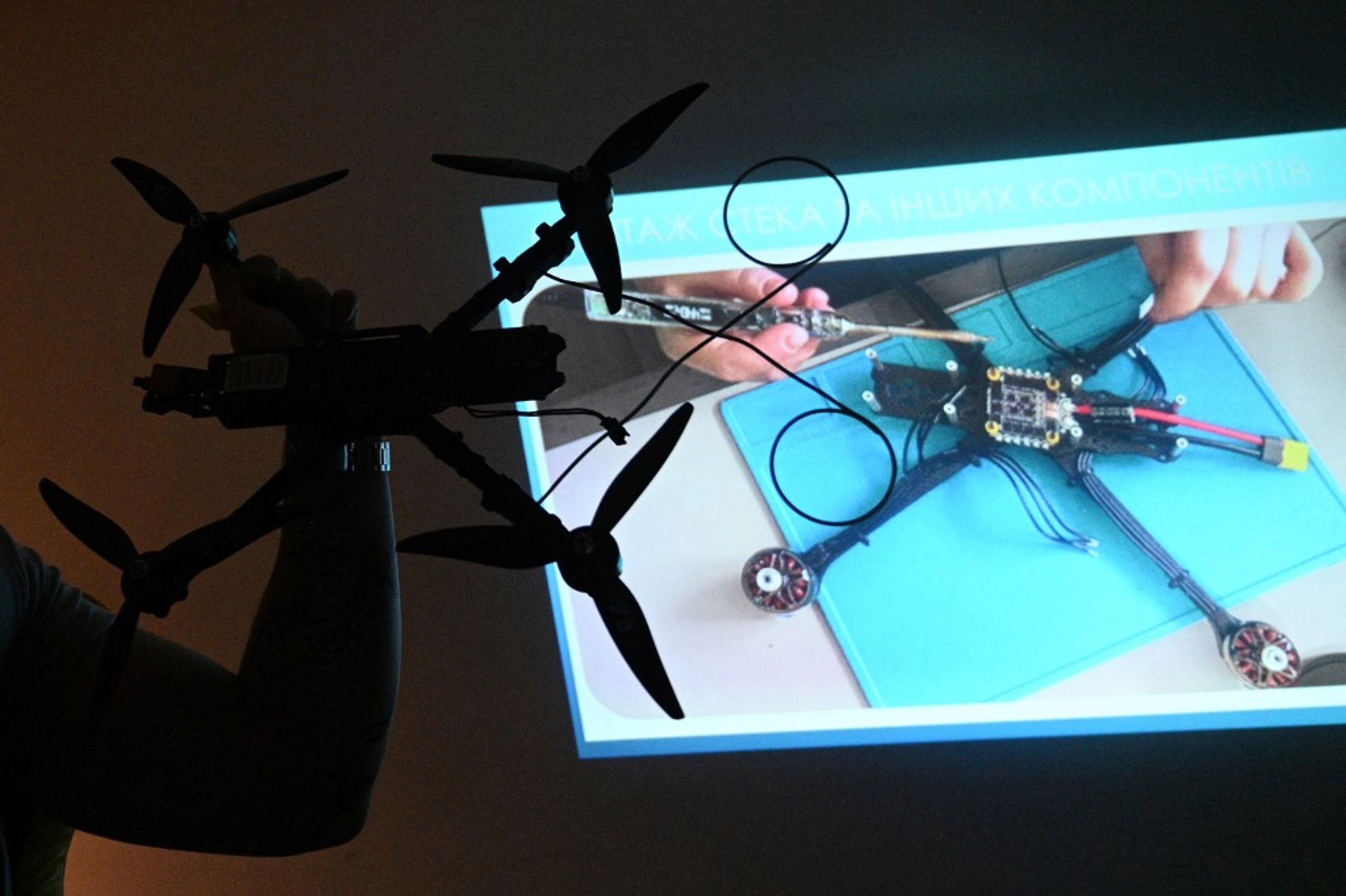
What makes Ukraine’s position even more strategically significant is not only its courage, but its astonishing pace of innovation. In less than three years, Ukraine has built the fastest military-technology ecosystem anywhere on earth. What takes the Pentagon years to research, approve, and deploy, Ukraine prototypes in weeks. Their engineers 3D-print drone components in frontline basements. Their programmers push battlefield software updates overnight. Their naval innovations have forced the Black Sea Fleet into a posture of permanent fear. Their electronic warfare teams iterate faster than Russia’s, and sometimes faster than that of the US. And their universities – like the one I visited in Zhytomyr – continue to train the next generation of cyber, engineering, and medical talent even as sirens interrupt their lectures.
Chinese strategists are studying Ukraine obsessively. American strategists should be doing the same.
But there is another, more quiet evolution underway that matters even more: Ukraine has developed a covert and clandestine ecosystem unlike anything in the Western world. It is not a traditional intelligence structure. It is a decentralized, adaptive, distributed network that fuses special forces, intelligence and military organizations, civilian technologists, diaspora groups, startups, and volunteers.
Together, these teams have sabotaged Russian oil depots deep inside Russia, disrupted Iranian drone supply chains, tracked North Korean munitions shipments, exposed Chinese dual-use technology flows, and penetrated Russia’s logistics lines across at least three continents.
This ecosystem – the Ukrainian “spider web” – Is precisely the kind of capability the US lacks when confronting China’s global proxy network. The US faces enormous political and escalatory constraints on covert action. Ukraine does not. Ukraine can operate in the gray zone with a form of strategic ambiguity the US cannot employ.
Ukraine can degrade China’s proxies under the legal and moral framework of self-defense against those who fuel Russia’s war. Ukrainian operators can penetrate Russian- and Chinese-linked logistics networks in Latin America, Africa, and Asia in ways that would be diplomatically explosive if done by US forces.
This is not about Ukraine acting as an American proxy. It is about Ukraine pursuing its own survival in ways that directly align with US national security interests. Ukraine’s clandestine and technological ecosystem can quietly pressure Chinese proxies in ways the US cannot.
Similar to Israel, Ukraine can operate in the gray zone without triggering the escalatory dynamics that restrict US action. Ukrainian special operators, cyber units, and mil-tech innovators can target the very networks that sustain Russian aggression – many of which directly overlap with China’s global hybrid-warfare machinery.
Imagine, for example, what happens if Ukraine quietly applies pressure to the Chinese-backed intelligence networks in Venezuela or Cuba that support Russian operations. Imagine Ukraine exposing Chinese cartel-linked chemical pipelines that feed the fentanyl epidemic killing tens of thousands of Americans each year. Imagine Ukrainian cyber teams probing the digital infrastructure China uses to influence politics in the Sahel or the Balkans. Imagine Ukrainian long-range drones disrupting North Korean weapons shipments headed to Russia’s Far East. These are all actions that weaken Russia, harm China’s strategic position, avoid US escalation, and reinforce US security—all without a single American warfighter entering harm’s way.
Put simply: Ukraine is not just a shield. It could become the tip of the spear in hybrid and kinetic conflict against our greatest strategic rival: China.
Ukraine is not a regional conflict. Ukraine is the hinge on which the US–China strategic competition now turns. The US cannot deter China in the Pacific while allowing China to win its first great-power test through Russia in Europe. It cannot defend the homeland while ignoring the Chinese-backed networks that Ukraine is already undermining. And it cannot pretend the future of war will resemble the past when Ukraine is showing us, in real time, what 21st-century warfare looks like.
If the US wants to preserve the world it helped build, deter the adversary that seeks to replace it, and prevent a global war with China, there is only one path forward: help Ukraine win decisively and empower Ukraine to take the fight globally against the enemies that seek to destroy it and the US. Win win.
The views expressed are the author’s and not necessarily of Kyiv Post.
You can also highlight the text and press Ctrl + Enter