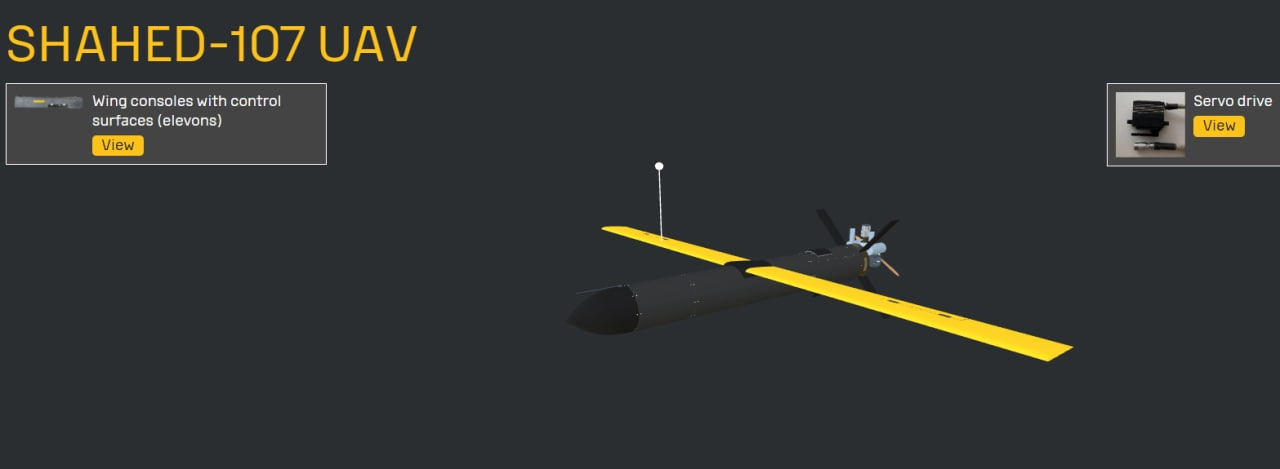
Ukraine’s Defense Intelligence (HUR) has published a technical breakdown of Iran’s Shahed-107 drone, warning that its use by Russia in Ukraine signals Tehran is field-testing its weapons against Western defense systems.
Russia has begun deploying against the frontline regions of Ukraine, according to HUR.
JOIN US ON TELEGRAM
Follow our coverage of the war on the @Kyivpost_official.
A Tuesday report on HUR’s War&Sanctions portal outlines the Shahed-107’s construction, components, and foreign electronics. The drone was first unveiled by Iran’s Islamic Revolutionary Guard Corps (IRGC) in June as tensions with Israel rose.
HUR described the Shahed-107 as a fixed-wing, high-wing drone with a 3-meter (10-feet) wingspan and an X-shaped tail for stability. It features a carbon-fiber airframe reinforced with aluminum and was fitted with a 15-kilogram (33-pound) cumulative-fragmentation warhead – a design consistent with other Iranian Shahed models.
A Chinese DLE-111 two-stroke gasoline engine powers the drone – the same type of small engine also found on other Russian drones such as the Gerbera, BM-35, Parodya, and Delta, according to HUR.
With a 28-liter (7-gallon) fuel tank, the Shahed-107 has an estimated range of roughly 300 kilometers (186 miles).
HUR said the drone uses an inertial navigation system (INS) similar to Iran’s Sadra system, a protective anti-jamming unit, and a four-element antenna. Flight control relies on an onboard flight controller unit (FCU) that controls servos for the elevons and engine.
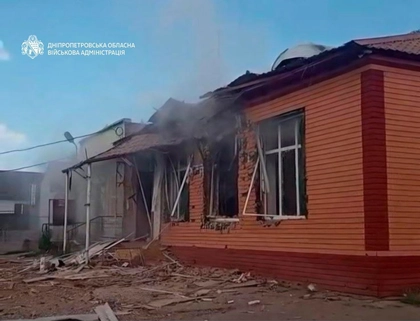
Russian FPV Strikes Civilians in Nikopol, 3 Dead Including Mother and Son
An INS calculates a vehicle’s position and motion using internal sensors, but errors accumulate over time, causing it to drift off course unless corrected by an external reference such as GPS.
HUR’s report says the Shahed-107 uses electronics sourced from countries frequently seen in Iranian and Russian drones, such as the US, Switzerland, China, Japan, Taiwan, the Netherlands, and Ireland.
HUR said the appearance of the Shahed-107 in Russia is further evidence of deepening military cooperation between Moscow and Tehran.
Iranian weapons, the agency said, continue to undergo real-world testing on Ukrainian territory against Western defense systems – cautioning that the data collected may later be used by Iran and Russia elsewhere.
The War&Sanctions platform, created and maintained by HUR, documents supply chains, tracks sanctioned entities, and lists foreign components found on Russian weapons.
In recent months, Ukrainian intelligence has released technical profiles and supplier lists for missiles, cruise systems and drone families – steps Kyiv says are crucial for helping partners close loopholes and stop the flow of dual‑use goods.
Last week, HUR published new evidence on how foreign-made machinery continues to feed Russia’s missile, bomb, and ammunition production lines despite global sanctions.
According to HUR’s Nov. 17 update, investigators identified multiple non-Russian industrial machines used to manufacture glide-bomb kits (UMPK), missile components, and artillery munitions.
Among the key findings:
- Japanese and Chinese computer numerical control (CNC) machines used to make Russian glide-bombs: Analysts identified Okuma (Japan) and Hision (China) machining centers on production sites belonging to Russia’s Tactical Missiles Corporation, which manufactures UMPK kits used to convert dumb bombs into precision glide bombs.
- Taiwanese equipment used to produce mortar stabilizers: The Central Research Institute “Burevestnik” was found operating a vertical machining center Performa made by Taiwanese firm AKIRA SEIKI to produce stabilizing elements for mortar rounds.
- Foreign machines delivered after the full-scale invasion: Newly uncovered procurement data shows that Russian companies supplied the Votkinsk Plant – manufacturer of the Iskander ballistic missiles and other cruise missiles – with Chinese machines, as well as Taiwanese CNC milling centers ECOM VL-12i, all purchased since 2022.
HUR says the findings are now being used to strengthen sanction proposals, close loopholes, and restrict the Kremlin’s ability to churn out weapons.
You can also highlight the text and press Ctrl + Enter