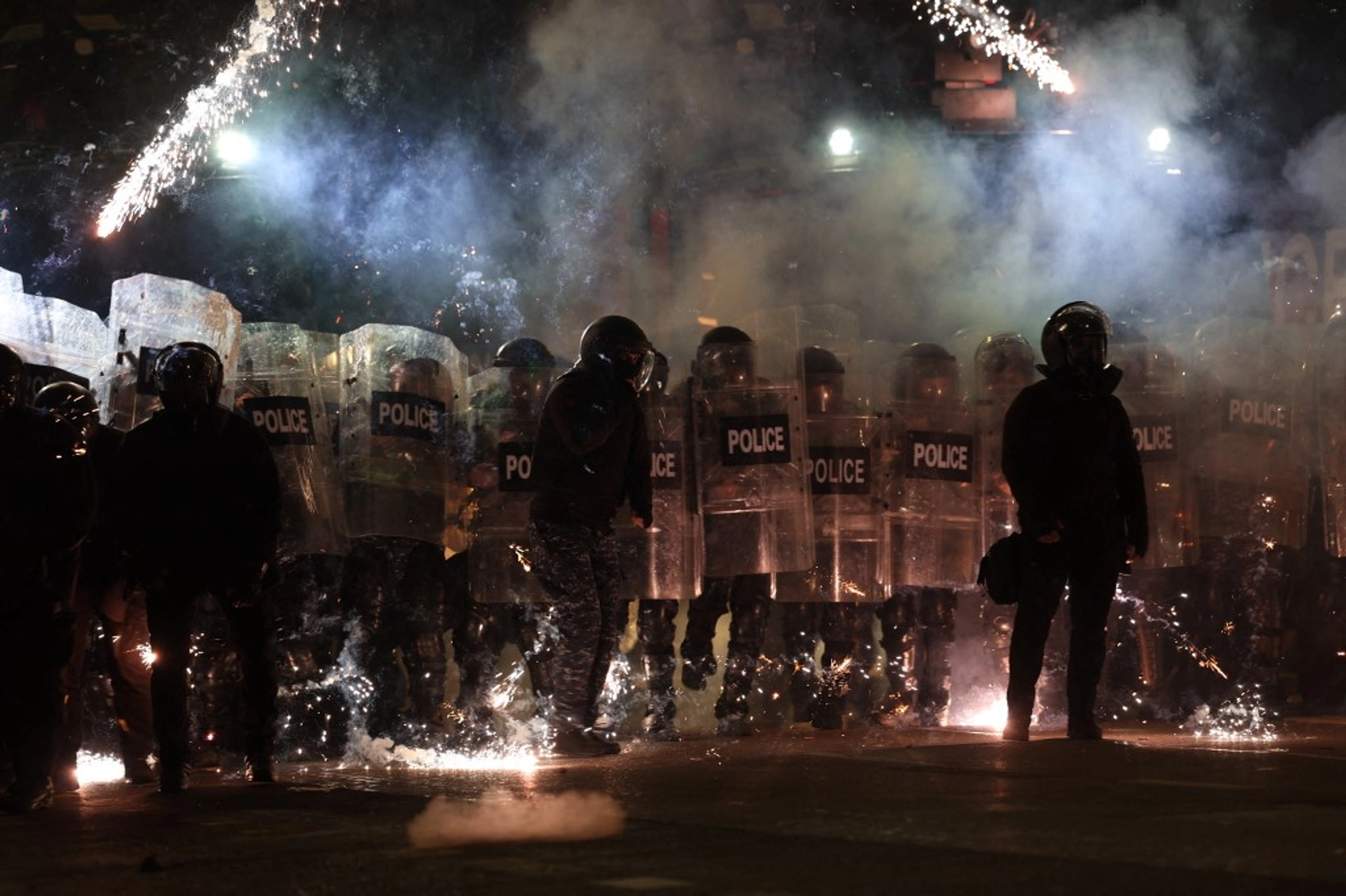
Georgian authorities reportedly used “camite,” a WWI-era chemical weapon, to disperse anti-government protesters last year.
Camite is a long-abandoned compound once used by the French military and deemed too dangerous for modern crowd control. According to the BBC investigation, chemical weapons experts, riot police whistleblowers, doctors and victim accounts all point to the deployment of camite.
JOIN US ON TELEGRAM
Follow our coverage of the war on the @Kyivpost_official.
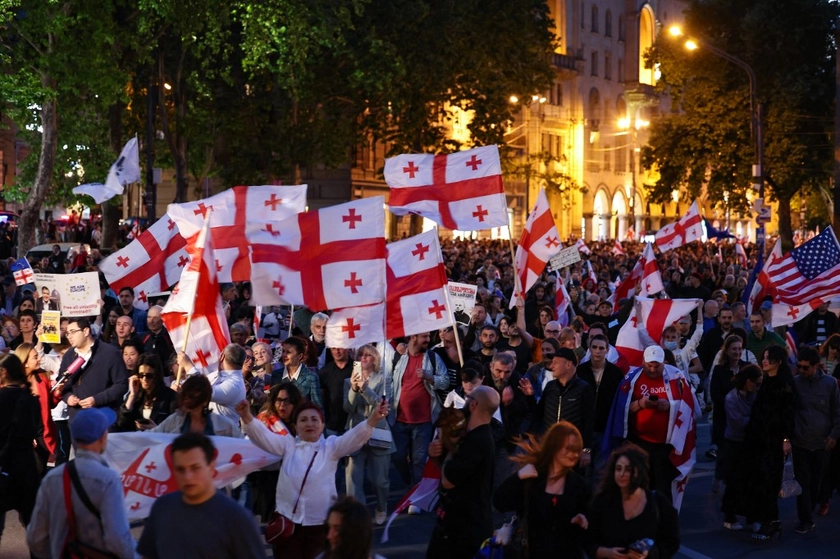
“You could feel [the water] burning,” one protester told the BBC, describing water cannon deployed against crowds on Tbilisi’s Rustaveli Avenue. The burning sensation, he said, “could not immediately be washed off.”
Severe, persistent symptoms among protesters
The daily protest movement began on Nov. 28, 2024, after the ruling Georgian Dream party abruptly announced it would freeze the country’s EU integration process – a reversal that struck at a core national aspiration, with the government having applied for EU membership in March 2022.
The decision came just weeks after a disputed parliamentary election marred by allegations of vote manipulation, fueling public anger and drawing thousands onto Tbilisi’s streets.
Protesters later reported severe and persistent symptoms – including shortness of breath, coughing and vomiting – lasting for weeks.
Georgia’s authorities called the BBC findings “absurd” and insisted police acted legally in response to the “illegal actions of brutal criminals.”
Health survey finds weeks-long impact among protesters
Dr. Konstantine Chakhunashvili, a pediatrician who was among those sprayed, said his skin felt as though it was “burning for days,” and washing “made it worse.”
Trump to Join Zelensky for G7 Working Session on Ukraine Peace Conditions
Seeking answers, he collected survey responses from nearly 350 people exposed to riot-control measures during the protests. Almost half reported at least one symptom persisting for over 30 days – including headaches, fatigue, cough, respiratory distress and vomiting.
Sixty-nine respondents he later examined showed a “significantly higher prevalence of abnormalities” in cardiac electrical signals, his peer-reviewed study found. The research has been accepted for publication by “Toxicology Reports.”
His findings echoed conclusions drawn by local journalists, doctors and civil rights groups that the water cannon must have been mixed with a chemical agent. Georgia’s Ministry of Internal Affairs refused calls to identify the substance used.
Police whistleblowers point to historic chemical compound
Multiple whistleblowers from the Special Tasks Department – Georgia’s riot police – told the BBC that the chemical matched one tested internally years before.
Lasha Shergelashvili, the department’s former head of weaponry, said the compound he tested in 2009 caused extreme, long-lasting irritation and could not be washed off, even with a prepared baking soda solution.
“We noticed that the effect was not wearing off, as is the case for [regular] tear gas,” he said. He described the agent as “probably 10 times” stronger than conventional riot-control agents.
Shergelashvili said he recommended against its use, but the water cannon vehicles were nevertheless loaded with it, remaining so until at least 2022, when he left the country for Ukraine. Watching protest footage last year, he said he immediately suspected the same compound was being used again.
Inventory records trace chemical to “camite”
A 2019 inventory document from the Special Tasks Department – authenticated by a separate former high-ranking officer – listed two unnamed chemicals: “Chemical liquid UN1710” and “Chemical powder UN3439.”
UN1710 corresponds to trichloroethylene (TCE), a solvent used to dissolve other compounds in water. UN3439 is a broader classification, but BBC analysis found only one historically used for riot control: bromobenzyl cyanide, also known as camite.
Professor Christopher Holstege, a leading toxicology and chemical weapons expert consulted by the BBC, assessed that “the clinical findings reported by both those exposed and by other witnesses are consistent with bromobenzyl cyanide.”
He ruled out 2-chlorobenzylidene malononitrole (CS gas), a common crowd-control agent, noting its effects do not persist for days or weeks.
“I’ve never seen camite being utilized in modern society,” Holstege said. “It would keep people away for a long time […] If that is indeed the case – that this chemical has been brought back – that is actually exceedingly dangerous.”
UN: potential torture, chemical weapons violation
UN Special Rapporteur on Torture Alice Edwards said the findings were deeply concerning.
“It does lead me to consider [this practice] as an experimental weapon,” she said. “Populations should never be subjected to experiments. This is absolutely in violation of human rights law.”
She said that crowd-control chemicals must have only temporary effects under international law, whereas the symptoms described were “beyond what would be considered temporary and acceptable.”
Experts consulted by the BBC said the deployment of camite – given the existence of safer alternatives – could be classed as the use of a chemical weapon.
Government denials amid year of near-nightly protests
Georgian authorities dismissed the BBC’s reporting as “deeply frivolous” and “absurd,” insisting law enforcement acted “within the bounds of the law and constitution.”
Protests on Rustaveli Avenue have continued almost nightly for a year, despite increased fines and jail terms. Demonstrators accuse the ruling Georgian Dream party of rigging elections, advancing pro-Russian interests and imposing increasingly restrictive laws on civil society.
The party denied pursuing Russian interests, telling the BBC that legislative changes serve “public welfare.”
You can also highlight the text and press Ctrl + Enter