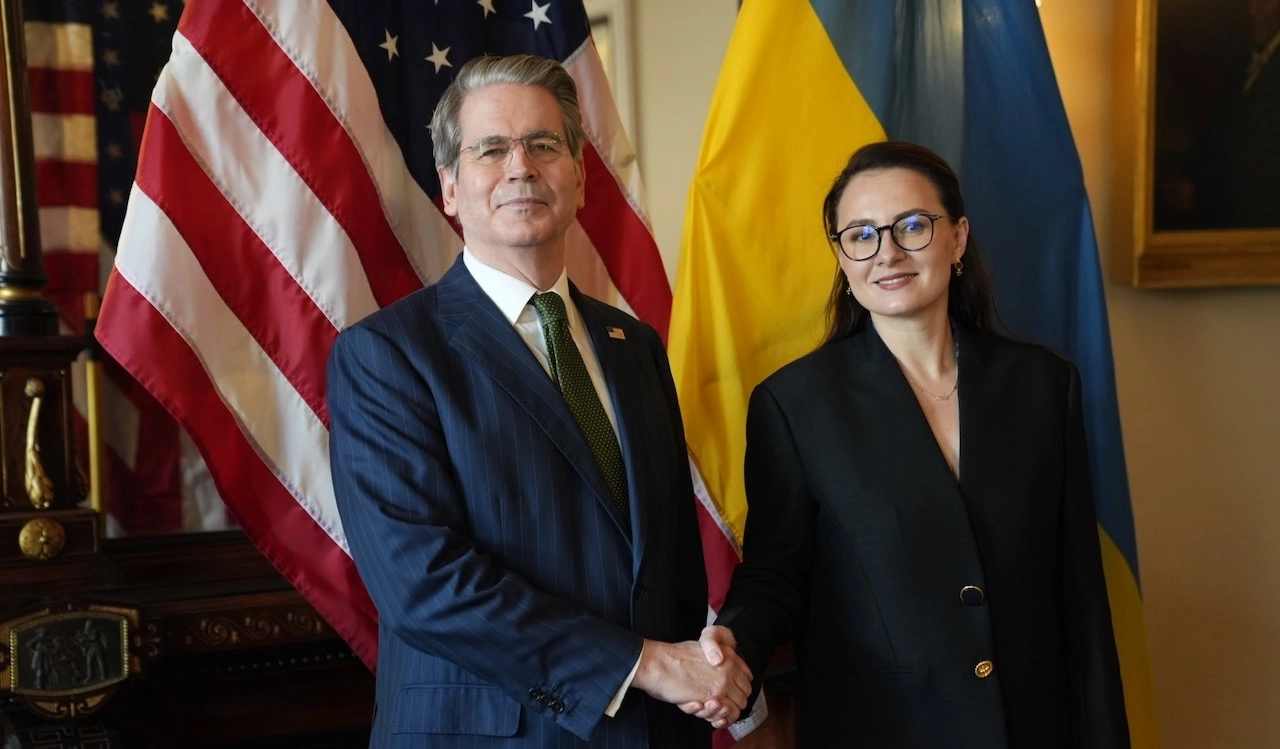
WASHINGTON DC – US Treasury Secretary Scott Bessent on Tuesday held what both sides described as a substantive and forward-leaning call with Ukrainian Prime Minister Yulia Svyrydenko, underscoring President Donald Trump’s push for what he calls a “lasting peace” in Ukraine while spotlighting the administration’s newest sanctions on Russia’s oil behemoths and a fast-moving US-Ukraine reconstruction fund.
Bessent used the conversation – detailed in synchronized social media posts from both officials – to highlight the administration’s latest measures targeting Lukoil and Rosneft, which he framed as part of Trump’s “bold, decisive leadership.”
JOIN US ON TELEGRAM
Follow our coverage of the war on the @Kyivpost_official.
He also emphasized the need for Kyiv to maintain momentum on reform and anti-corruption efforts, describing them as essential to unlocking long-term economic stability.
Svyrydenko, in turn, welcomed the latest sanctions, calling them “effective” in cutting revenues that finance Russia’s war.
She also noted that the US-Ukraine Reconstruction Investment Fund is now “rapidly becoming an effective instrument” for mobilizing American capital, with the appointment of Alvarez & Marsal allowing the fund to move into its “decisive stage.”
The next steps, she noted, involve identifying priority projects and “turning commitments into tangible results.”
Intent in Plain Sight: the Politics of a UN-Recognized Genocide
Energy security featured prominently in the prime minister’s readout. She told Bessent that expanding Ukraine’s ability to purchase American liquefied natural gas would bolster both domestic needs and Europe’s “overall energy security,” calling energy independence “a strategic shield.”
She also stressed the importance of preserving key World Bank support mechanisms to secure Ukraine’s next IMF program and accelerate its Reparations Loan initiative.
Both officials cast the call as part of a joint US-Ukraine effort – reinforced by their presidents – to move toward a “just and lasting peace.”
OFAC drops hammer on oligarch-linked US attorney
Even as Treasury’s diplomatic outreach was underway, another arm of the department delivered a stark warning to America’s professional class.
The Office of Foreign Assets Control announced a $1,092,000 settlement with an American attorney – identified only as “US Person-1” – for managing the US-based family trust of a sanctioned Russian oligarch and executing 122 apparent sanctions violations between 2018 and 2022.
Treasury said the attorney’s actions allowed the oligarch to maintain influence over the trust even after he was designated.
In a sign of OFAC’s stepped-up posture, the agency stressed that “substance over form” now governs enforcement, particularly where legal structures such as trusts can mask real control.
Sanctions lawyer Alex Fesenko called the settlement “a wake-up call.”
“Complex legal structures don’t shield US persons when a sanctioned individual still exerts hidden influence,” Fesenko wrote in a social media post, adding: “OFAC is signaling that compliance isn’t about box-checking – it’s about understanding economic reality.”
On Capitol Hill, patience runs thin
The tough-talk energy was matched by growing irritation in Congress, where lawmakers are pressing the White House to approve their own Russia sanctions effort.
During a Tuesday Senate Appropriations Subcommittee hearing, Republican Senator John Kennedy (R-LA) confronted US Trade Representative Jamieson Greer over the stalled Graham sanctions bill.
“How come the administration hasn’t given us the green light to pass the bill?” Kennedy demanded.
Greer responded that the administration “notionally” supports the legislation and has provided Senator Lindsey Graham (R-SC) with technical assistance while discussing the measure internally.
But he acknowledged he would “take the question back to the White House to see what’s going on.”
Kennedy didn’t hide his frustration: “Lots of us are concerned about Ukraine and stopping Russia,” he said, urging the administration to green-light the bill – or offer a Plan B.
In Washington’s Ukraine policy landscape, officials keep emphasizing that diplomacy is accelerating, enforcement is tightening, as the clock is ticking.
But the real signal wasn’t the diplomatic overture, or even the hammer dropping on a sanctions-evading attorney. It was the uneasy tension between the White House and Capitol Hill.
While the administration touts its “bold, decisive leadership” in targeting oil giants, Congress is demanding the legislative firepower to back it up.
The stalled Graham bill is a testament to the persistent tug-of-war over pace and strategy. The message from the Hill is simple: The executive branch can move the levers of sanctions and diplomacy, but without legislative backing, the entire policy can feel like a high-wire act – impressive, but one missed step away from a major fall.
For now, as Bessent’s Treasury running point on diplomacy and enforcement, Congress looking over its shoulder, waiting to see which play the White House makes next.
You can also highlight the text and press Ctrl + Enter
Putin’s Worst Nightmare