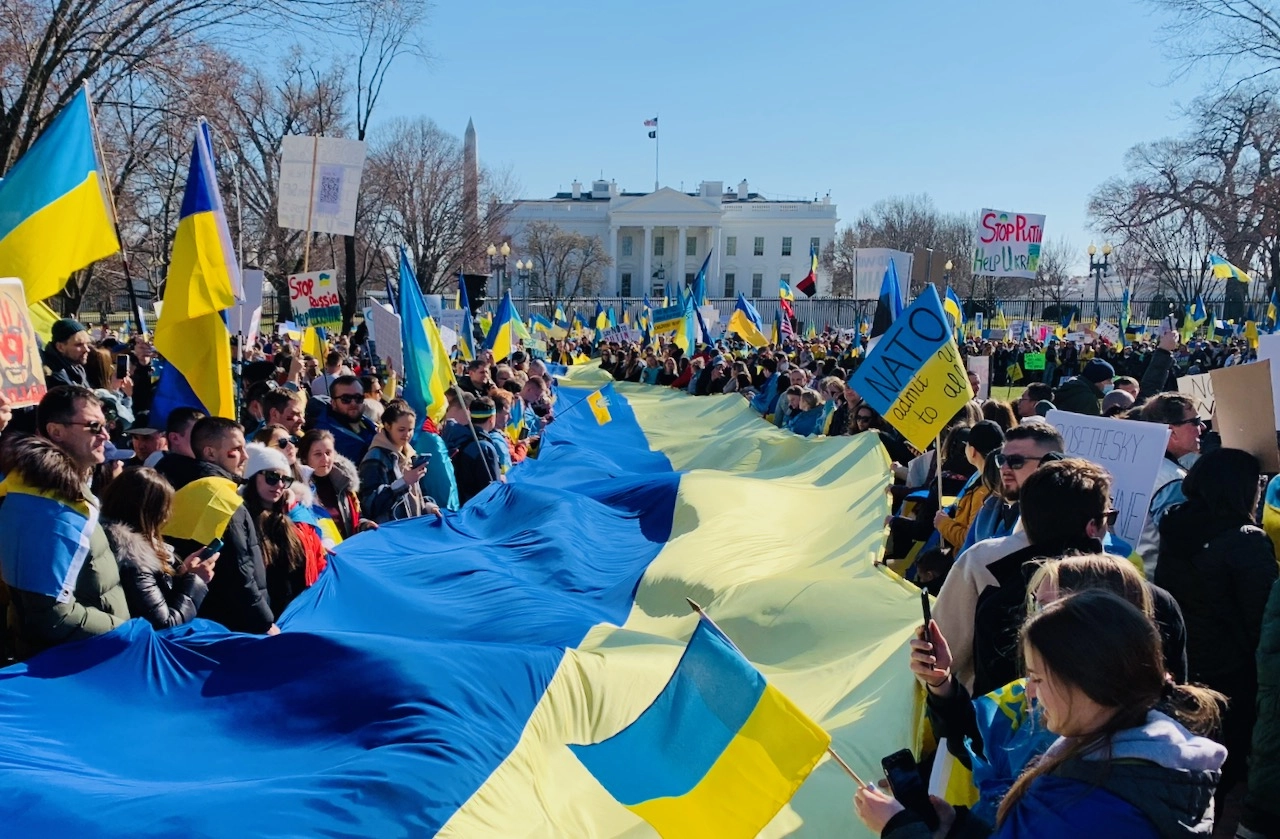
WASHINGTON DC – As Russia’s war against Ukraine grinds toward its fourth year, a once-academic argument is breaking into the political mainstream: that Moscow’s campaign should be formally labeled genocide – not just a catalogue of war crimes, but a case of intent to destroy a people.
That push is no longer confined to white papers and advocacy reports. It landed squarely in Washington’s policy bloodstream at a recent event at Georgetown University, where the International Partnership for Human Rights (IPHR) and the Harvard Law School International Human Rights Clinic convened what was nominally a legal conference – and functionally a strategic briefing for lawmakers, diplomats and policy staff.
JOIN US ON TELEGRAM
Follow our coverage of the war on the @Kyivpost_official.
The message was unmistakable. The debate over Ukraine, speakers argued, has stalled at the wrong altitude. War crimes are no longer the question. Genocidal intent is.
And the stakes of naming it as such are enormous.
Invoking the UN Genocide Convention, advocates contend, would trigger a far more binding set of legal and moral obligations for the US and its allies – limiting diplomatic wiggle room and raising the cost of inaction.
Capitol Hill enters the frame
Senior members of Congress – from both parties – lent their voices, signaling that the genocide designation is migrating from activist circles into legislative thinking.
Rep. Joe Wilson (R-SC), a senior member of the House Foreign Affairs and Armed Services Committees, cast the issue in historical terms, recalling a congressional hearing he once hosted inside the Nuremberg courtroom.
Iran Rebuilds Missile Arsenal During US Truce, Stockpiling Fresh Russian Munitions
“I have seen firsthand the genocidal campaign by war criminal [Vladimir] Putin to erase Ukrainian identity,” Wilson said, adding, “War criminal Putin will one day be similarly tried for his crimes.”
Democrats struck a parallel note. Rep. Mike Quigley (D-Ill), co-chair of the bipartisan Ukraine Caucus, argued that the current war is not a sudden rupture but the continuation of a long-standing project.
“Long before the full-scale invasion, Russian rulers sought to dominate, silence, and erase the Ukrainian people – their language, their culture, and their identity,” Quigley said.
The bipartisan resonance mattered. It suggested that the genocide argument is no longer theoretical – it is becoming politically actionable.
The legal threshold: intent
From there, the conversation narrowed to the hardest legal question in international law: intent.
Genocide, unlike war crimes, requires proof not just of atrocities, but of a deliberate effort to destroy a national, ethnic, racial or religious group.
Speaker after speaker argued that Russia’s campaign clears that bar.
Andrii Pasichnyk, counselor at the Embassy of Ukraine, rejected the framing of the war as a conventional imperial land grab.
“This is not simply a war of imperial ambition,” he said. “It is a deliberate intent to destroy. Russia’s actions constitute a genocide against the Ukrainian people.”
Others pointed to Moscow’s own words as evidence. Joel Hellman, dean of Georgetown’s School of Foreign Service, cited Russian state rhetoric that explicitly denies Ukraine’s legitimacy as a nation.
“One only needs to listen to Putin himself,” Hellman said, pointing to what he described as “eliminationist, genocidal rhetoric that denies Ukraine as a people, a culture, and a nation.”
The clearest evidence: stolen children
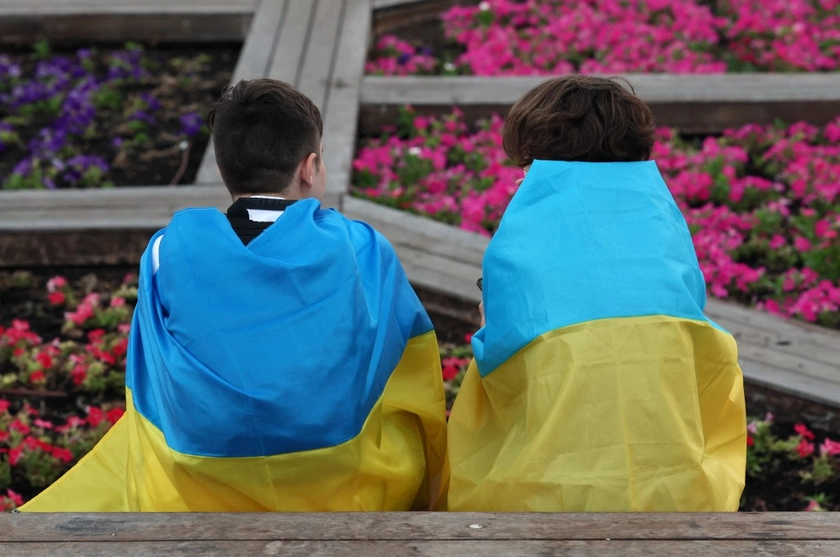
For many legal experts, the strongest case for genocidal intent rests not on battlefield conduct alone, but on Russia’s systematic abduction of Ukrainian children – a crime explicitly enumerated in the Genocide Convention.
Svitlana Valco, who leads IPHR’s Ukraine field team, presented documentation indicating that approximately 19,000 Ukrainian children have been forcibly transferred to Russia.
According to the evidence, many are subjected to identity erasure, language bans, reeducation programs and placement in military-style camps.
“This is not an incidental byproduct of war,” Pasichnyk said. “It is a calculated effort to destroy the future of my nation by targeting its most vulnerable.”
Lawmakers seized on the political implications. Rep. Marcy Kaptur (D-OH), also a co-chair of the Ukraine Caucus, warned that failing to act would carry consequences far beyond Ukraine.
“We must hold dictator Putin accountable for the crimes he continues to commit against the people – and the children – of Ukraine,” she said.
The danger of impunity
Beneath the legal arguments ran a shared anxiety: that half-measures risk normalizing atrocity.
Quigley was blunt about the cost of restraint. “Peace built on impunity is no peace at all,” he said, adding, “It will only embolden Putin – and every autocrat watching around the world.”
Several speakers argued that the credibility of international law itself is on trial – and that continued diplomatic caution in the face of mounting evidence threatens to hollow out the Genocide Convention altogether.
The conference ended on a note of frustration with the West’s pace. Anastasia Donets, legal team lead at IPHR, delivered the sharpest critique. “Russia is not seeking peace – it is seeking annihilation,” she said.
Calling the gathering “only the first step,” Donets added that the effort is “three to five years late in naming Russia’s war against Ukraine for what it is: a genocidal war.”
White House caught between words and law
The question of genocide now lands squarely on a White House that has never fully embraced the label – and on a president who once rejected it outright.
Former US President Joe Biden crossed a rhetorical Rubicon during his term when he publicly accused Russia of committing genocide in Ukraine, becoming the first US president to use the word in that context.
But even then, the declaration stopped short of a formal legal determination. Biden’s State Department continued to document war crimes and crimes against humanity while carefully avoiding the legal trigger embedded in the Genocide Convention.
“That gap between words and action still rankles in Washington,” one former Biden aide told Kyiv Post on Saturday, speaking on background. “Yes, Biden said it, but the bureaucracy never moved. Once genocide is a legal finding, you lose flexibility – and the administration wasn’t willing to go there.”
The current administration has taken a different approach – one defined less by rhetorical escalation and more by deliberate ambiguity.
President Donald Trump has consistently avoided framing Russia’s campaign in absolutist legal or moral terms. During the early months of his first term, he openly speculated about Russian motives, at times portraying Moscow as reacting to NATO expansion or Western pressure rather than pursuing an exterminatory campaign.
“Trump doesn’t want language that locks him into permanent confrontation,” said a Republican foreign policy aide familiar with internal deliberations. “Genocide is a one-way door.”
Yet even among Republicans, frustration is building.
“This isn’t about ideology anymore,” said a GOP congressional aide involved in Ukraine policy. “It’s about whether the United States is willing to call something what it is – even if it complicates diplomacy.”
Pressure building inside Washington
What has shifted, aides say, is not the evidence but the politics of delay.
Several congressional staffers described the genocide push as entering a new phase – less about assembling proof and more about forcing a choice between legal clarity and executive caution.
“The record is already there,” said a senior aide tracking the issue. “What’s missing is a decision.”
Lawmakers from both parties are quietly discussing whether Congress should move first – through resolutions or statutory language – if the White House continues to hedge.
“If the executive branch won’t touch it, the Hill might,” another aide said.
For now, the administration is balancing its aversion to legal commitments with mounting pressure from lawmakers, lawyers and human rights advocates who argue that delay itself is corrosive.
And that tension – between flexibility and accountability – is quickly becoming the central fault line.
In Washington policy circles, the debate is no longer about whether Russia’s actions meet the definition of genocide.
It’s about who’s willing to say so – and accept the consequences.
You can also highlight the text and press Ctrl + Enter