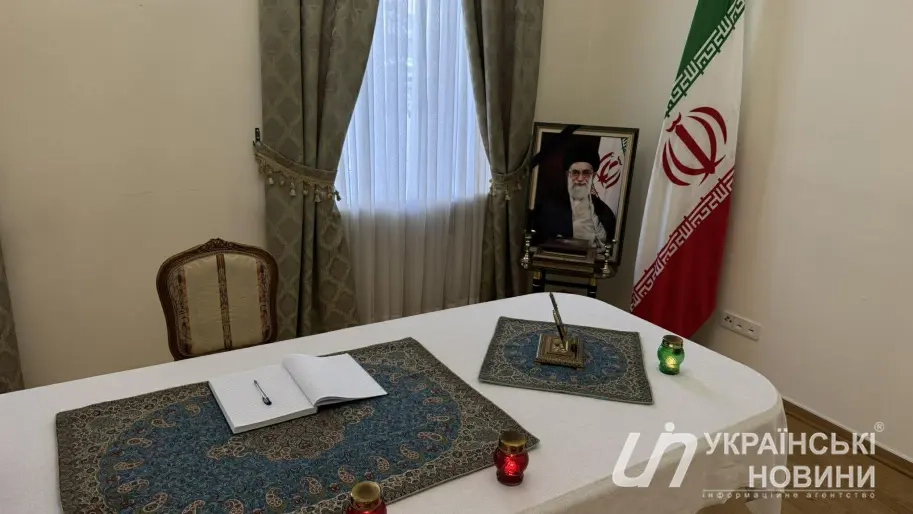
Ukraine reacted sharply after the Iranian Embassy in Kyiv opened a book of condolences for the late Supreme Leader Ayatollah Ali Khamenei, inviting “all who wish” to leave messages of sympathy. The book is open from March 4 to March 6 between 10 a.m. and 4 p.m. at the embassy on Kruhlo-Universytetska Street in central Kyiv.
But the announcement triggered a sharp response from Ukrainian diplomats, highlighting the deep scars left by Iran’s military cooperation with Russia during the war.
JOIN US ON TELEGRAM
Follow our coverage of the war on the @Kyivpost_official.
Oleksandr Shcherba, Ukraine’s ambassador to South Africa, publicly rejected the idea of expressing condolences. In his response, the diplomat said Iran’s leadership had helped enable Russia’s war by supplying weapons, including Shahed drones that have repeatedly struck Ukrainian cities
According to Shcherba, those weapons killed thousands of Ukrainian civilians, men, women, children, and elderly people, making it impossible for him to mourn the Iranian leader’s death.
“Your leaders were accomplices in the endless grief suffered by Ukrainian civilians,” he said, adding that although he tries not to rejoice at anyone’s death, he cannot express sorrow for people whose actions contributed to the suffering of his country.
The diplomat also added that he holds no personal hostility toward Iranian diplomats, noting that “sometimes good diplomats must represent bad leaders and their policies.” Still, he concluded that he would not sign a condolence book for someone “whose death does not cause me grief.”
Russian Troops Forced to Walk 30 km After Ukraine Hits Logistics, Minister Says
The embassy’s invitation followed reports that Khamenei was killed during a wave of US and Israeli strikes on Iran that began on Feb. 28, escalating tensions across the Middle East and prompting diplomatic responses worldwide.
The United States and Israel, on Saturday, unleashed a massive air bombardment campaign against Iran, primarily targeting Iran’s national leadership and major Iranian war-making capacity.
Some of the strikes sought to kill top-level Iranian officials, most others attempted to smash major Iranian weapons like warships, weapons stores and long-range missile launchers.
The overall US-Israel objective was to smash the Iranian capacity to resist militarily. An immediate, shorter-term objective was to establish total air dominance over Iran so that it would be easier for more massed strikes to hit whatever was still in one piece in later attacks, so that all resistance might be quickly crushed.
Loud cheers echoed across parts of Tehran late Saturday as residents went to their windows, applauded and played celebratory music following reports that Iran’s supreme leader Ali Khamenei had been killed, according to multiple witnesses and audio recordings.
The celebrations began shortly after 11 p.m. local time, witnesses said, though there was no official confirmation from Iranian authorities.
Who Is Ali Khamenei, Iran’s Supreme Leader?
Iran’s Supreme Leader Ayatollah Ali Khamenei has been the country’s paramount authority since 1989, holding ultimate control over national security decisions. Now 86, he played a central role in the 1979 Islamic Revolution that toppled the shah. A hard-line figure, Khamenei has overseen repeated crackdowns on protests and has long been a focal point of opposition to Iran’s restrictive domestic policies and confrontational foreign stance.
In mid-February, Khamenei warned that Iran was ready to respond to any US military action, saying that threats posed by Iran’s weapons were greater than those of American warships. He added that the United States could be struck with such force that it would be unable to recover.
You can also highlight the text and press Ctrl + Enter